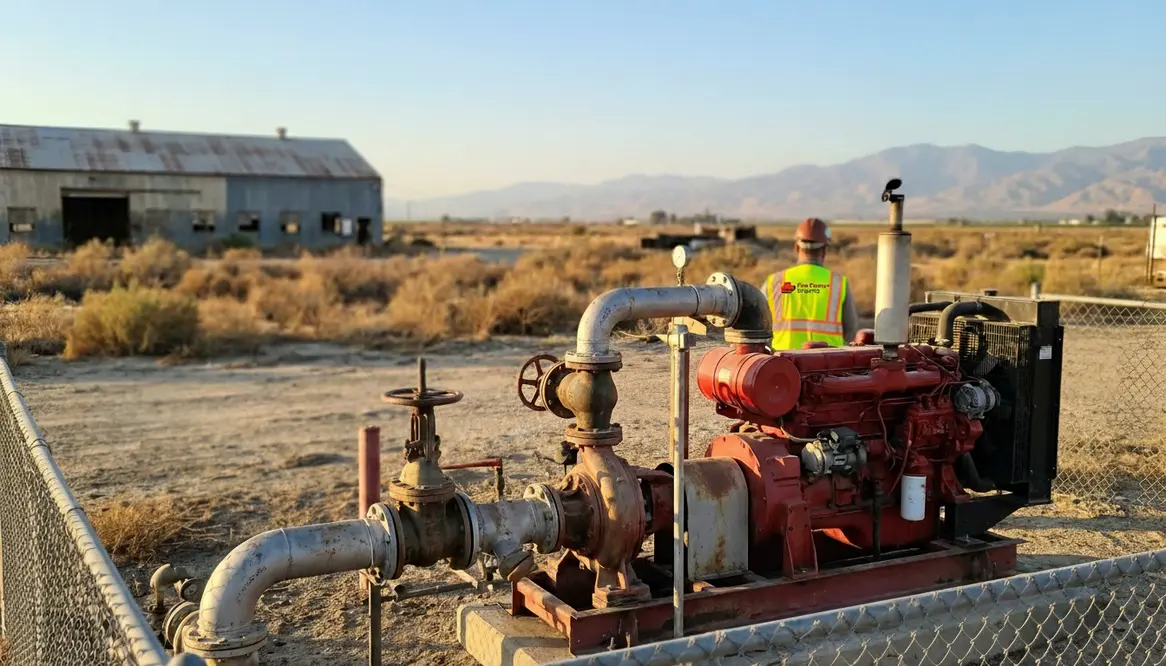
Kern County Fire Pump Selection for High Risk Sites
I have spent years working around complex fire protection systems, and if there is one thing I have learned, it is this. Local conditions shape everything. When it comes to Kern County fire pump selection, those conditions are not just important. They are the whole story. From dry winds that seem to have a personal grudge against buildings to water supply challenges that can make engineers sweat, every decision must be grounded in reality. And yes, sometimes that reality feels like planning for a scene straight out of an action movie, just without the slow motion hero walk.
What makes Kern County fire risk so unique
Kern County does not play by gentle rules. I have seen how its hot, dry climate combines with seasonal winds to create fast moving fire conditions. As a result, commercial and industrial facilities face higher ignition risks and faster fire spread compared to many other regions.
Because of this, I always approach fire pump planning here with a sharper eye. Wind driven fires can overwhelm standard suppression timelines. Therefore, pump systems must deliver strong, consistent pressure without hesitation. It is not the place for “good enough.” It is the place for “over prepared but sleeping well at night.”
Additionally, water availability varies widely across the county. Some areas have strong municipal supply, while others rely on stored water or boosted systems. That variability directly impacts pump sizing and configuration, and it is one of the main reasons Kern County fire pump selection needs to be done with precise local data rather than generic templates.
Why high risk sites feel the impact first
High risk occupancies in Kern County — refineries, large warehouses, energy facilities, and high-piled storage — live at the intersection of challenging climate and high fuel loads. When something goes wrong, it goes wrong fast. That is why Kern County fire pump selection for these properties is less about minimum compliance and more about building in performance headroom.
Strong, resilient water supply and robust fire pumps are part of the same story: limiting that first ten minutes of fire growth so the rest of your protection strategy actually has a chance to work.
Kern County fire pump selection for high demand commercial systems
When I evaluate systems for large facilities, I focus on performance under stress. A pump that works perfectly in ideal lab conditions but struggles during peak demand is about as useful as a screen door on a submarine.
In Kern County, I often prioritize:
- High capacity pumps that can sustain pressure during extended operations
- Diesel driven units for reliability during power outages
- Redundant configurations to prevent single points of failure
Moreover, I consider how quickly the system can respond. Fires in this region escalate fast, so ramp up time matters. Every second shaved off activation can reduce damage across large commercial properties.
At the same time, I balance performance with compliance. Local codes and NFPA standards are not suggestions. They are the baseline. And in Kern County, exceeding that baseline is often the smarter move, especially when Kern County fire pump selection decisions affect multi-building campuses and critical infrastructure.
When I want owners and engineers to better understand how pump design, installation, and testing fit together, I often point them to a deeper overview of NFPA 20 requirements, such as Kord Fire Protection’s guide at NFPA 20 fire pump compliance, and then translate those principles into Kern County specific layouts and sizing.
How do water supply challenges affect system design
Design starts with pressure and flow reality
This is one of the first questions I get, and for good reason. Water supply can make or break a fire protection system.
In some parts of Kern County, municipal systems cannot provide consistent pressure during peak demand. Therefore, I design with supplemental storage tanks and booster pumps. This ensures that even if the city supply dips, the system holds steady.
In other cases, long pipe runs create friction loss that eats away at pressure. So I compensate by selecting pumps with higher output and carefully calculating system curves. It is not glamorous work, but it is the difference between a system that performs and one that disappoints when it matters most.
High risk facilities and stored water strategies
For high risk sites, Kern County fire pump selection often goes hand in hand with on-site water storage. Elevated tanks, ground-level reservoirs, and dedicated fire water loops give the pump something reliable to pull from when municipal supply becomes a question mark.
The goal is always the same: guarantee that your rated flow and pressure are available on the worst day, not just on the day the inspection gauge looked friendly.
Balancing efficiency and reliability in large scale facilities
I always remind clients that efficiency is important, but reliability is everything. A slightly higher energy cost is far easier to accept than a system that fails during an emergency.
Efficiency focus
- Lower operating costs
- Optimized pump curves
- Smart control systems
Reliability focus
- Backup power integration
- Durable components
- Redundant pump setups
However, the real art lies in blending both. I design systems that run efficiently day to day but can instantly shift into full power mode during an emergency. Think of it like a hybrid car that suddenly turns into a race car when needed. Not quite Fast and Furious, but close enough for engineers.
For large campuses, this blend often means variable speed controllers, intelligent sequencing of multiple pumps, and clear operating logic that even an on-call technician at 2 a.m. can follow without a whiteboard session.
Kern County fire pump selection and long term compliance strategy
Beyond day one: keeping systems ahead of change
Planning does not stop after installation. In fact, that is where the real work begins. Kern County regulations and fire codes evolve, and I make sure systems stay ahead of those changes.
Regular testing, inspection, and maintenance are critical. I build systems that are easy to service because a neglected pump is a liability waiting to happen. Also, documentation plays a major role. Clear records ensure compliance and help identify performance trends over time.
Furthermore, I advise facility managers to think long term. Expansion, increased occupancy, or process changes can all impact fire protection needs. Designing with flexibility today prevents costly upgrades tomorrow, and it keeps your hard-won Kern County fire pump selection from becoming obsolete the moment you add a new production line or storage wing.
Coordinating with inspections and local officials
High risk sites benefit from proactive coordination with Kern County inspectors and fire marshals. Walking them through your pump design, test data, and maintenance plan turns inspections into conversations instead of surprises. It is much easier to adjust a test frequency on paper than to retrofit an undersized pump room after a failed inspection.
FAQ
Below are a few of the questions I hear most often when owners and engineers start working through Kern County fire pump selection for demanding facilities.
Conclusion
If you are responsible for a commercial or industrial property in Kern County, I would not leave fire protection to guesswork. The right system is built on local knowledge, smart engineering, and a clear plan for the future. I can help you navigate every step, from design to long term support. Reach out today, and let us build a fire pump system that stands ready when it matters most.
Thoughtful Kern County fire pump selection is one of the best investments you can make in protecting people, property, and uptime. Done well, it fades into the background of your operation, quietly ready 24/7, and only stepping into the spotlight when it is absolutely needed.