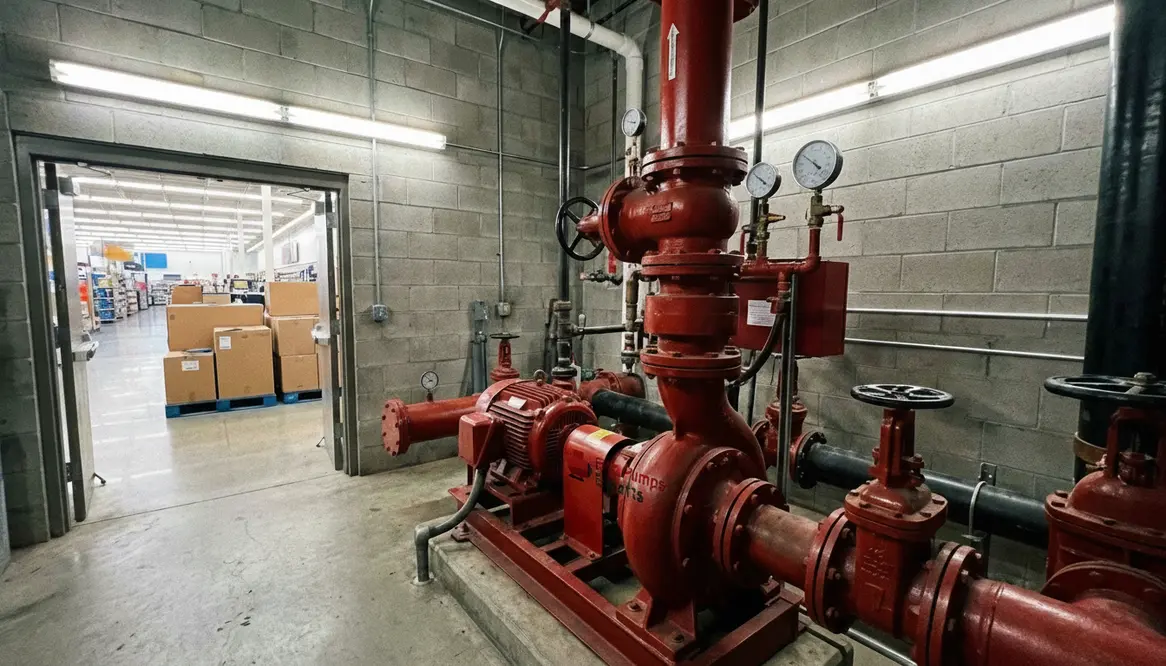
Mixed Use Retail Fire Pump System Design Guide
I have spent years walking through large commercial buildings where retail space blends into offices, storage, and sometimes even light industrial operations. And right at the center of that complexity sits a quiet hero most people never notice until it matters. mixed use retail fire pump systems. These systems do not just move water. They hold together the safety strategy of entire properties where different occupancies collide. So let us talk about what really happens when retail overlaps with other uses and why fire pump design cannot afford guesswork.
Why overlapping occupancies change everything
Retail alone is predictable. Add storage, restaurants, or office towers above it, and suddenly the risk profile shifts. For example, a clothing store behaves very differently from a stockroom packed floor to ceiling with boxed goods. Therefore, I always look at the highest hazard first, not the most visible one.
Moreover, codes require systems to meet the most demanding condition within the building. That means your fire pump is not sized for the storefront. It is sized for the worst case scenario hiding behind it. In many projects, that hidden risk quietly dictates everything from pump capacity to pressure requirements.
And yes, that is usually where budgets start sweating.
What fire pump capacity do mixed use buildings actually need
I get this question often, usually from owners hoping for a simple number. I wish it worked that way. Instead, I walk them through flow demand, pressure requirements, and system duration. Each of these depends on occupancy type, building height, and sprinkler design.
However, when retail overlaps with higher hazard uses, the pump must support:
- Higher flow rates due to denser sprinkler layouts
- Increased pressure to reach upper floors or distant zones
- Longer run times if storage or industrial risks are present
Consequently, what starts as a modest retail system often evolves into a robust fire protection backbone. Think less corner shop and more blockbuster action scene. Water needs to show up fast and in force.
Design challenges I see in mixed use retail fire pump systems
Now here is where things get interesting. Or complicated. Usually both.
First, zoning becomes critical. Different occupancies demand different sprinkler densities. Therefore, I often design systems that segment the building while still relying on a shared fire pump. This balance keeps the system efficient without compromising safety.
Second, pressure management can become tricky. Too much pressure in retail areas can damage equipment, while too little pressure in upper or industrial zones can fail inspections. So, I rely on pressure reducing devices and careful calibration.
Finally, redundancy matters more than people expect. When multiple occupancies rely on a single pump, failure is not an option. That is why backup power, controller reliability, and maintenance planning move to the front of the conversation.
Because when everything shares one system, everything depends on it.
How I approach system layout across shared spaces
When I design fire pump layouts for these buildings, I start with flow paths. Water must reach every hazard quickly and reliably. However, I also think about access, serviceability, and future expansion.
Retail side priorities
- Clear routing that avoids tenant disruption
- Compact equipment footprint
- Stable pressure for standard sprinkler heads
Non retail occupancy priorities
- Higher capacity piping
- Durability for harsher environments
- Flexibility for changing use cases
At the same time, I make sure the fire pump room itself meets strict commercial standards. Accessibility, ventilation, and protection from flooding all play a role. Because a powerful pump in the wrong environment is like a sports car stuck in traffic. Impressive, but not very helpful.
Compliance and inspections are not optional
I have yet to meet a building owner who enjoys inspections. Still, they are where theory meets reality. Mixed occupancy buildings face layered code requirements, often pulling from multiple standards.
Therefore, I always align designs with national and local codes while anticipating inspector expectations. This includes performance testing, flow verification, and system redundancy checks.
Additionally, documentation becomes essential. When different occupancies share a system, inspectors want clarity. They need to see how each area is protected and how the fire pump supports them all.
In other words, paperwork matters almost as much as water flow. Not glamorous, but neither is explaining a failed inspection.
Future proofing commercial fire pump systems
Buildings evolve. Retail spaces change tenants, storage areas expand, and new uses appear. So I design fire pump systems with flexibility in mind.
For instance, I often plan for higher capacity than currently required. This allows the system to handle future changes without major upgrades. Additionally, I consider modular components that can adapt as the building grows.
Because let us be honest, no one builds a commercial property hoping it stays the same forever.
And if it does, well, that might be a different kind of problem.
FAQ: Fire pump needs in mixed occupancy buildings
The most common questions about mixed use retail fire pump systems usually sound simple, but the answers shape every design decision in a building where occupancies overlap.
Closing thoughts and next steps
If your property blends retail with other commercial or industrial uses, your fire protection strategy needs more than a standard approach. I can help you design or evaluate systems that meet real world demands, not just minimum code. Reach out today and let us make sure your fire pump system is ready when it matters most. Because in this business, preparation is everything, and second chances are not part of the plan.
If you are looking for deeper technical references, performance curves, and layout examples for mixed use retail fire pump systems, resources at https://firepumps.org are a solid starting point before you move into project-specific engineering.