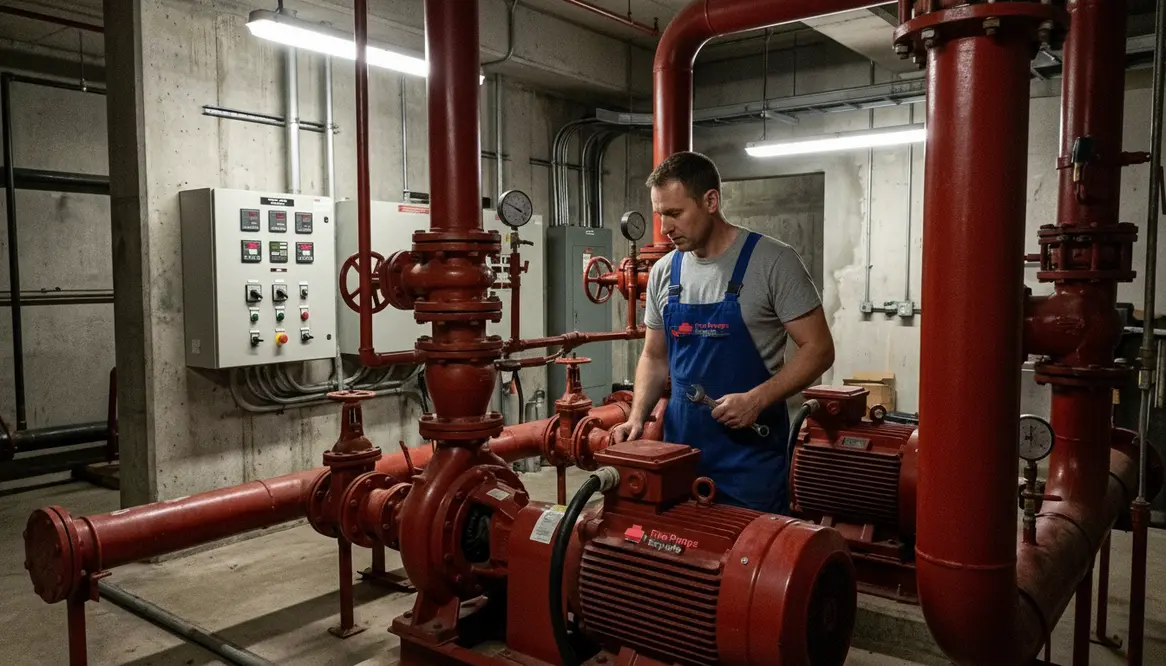
Multistory Retail Fire Pump Systems Design Guide
I have spent years walking through towering retail spaces where escalators hum and skylights stretch like cathedrals. And right there, quietly doing the heavy lifting behind the scenes, are multistory retail fire pump systems. These systems are not glamorous. They will not trend on social media. Yet, when everything goes sideways, they are the reason a bad day does not become a headline. So let’s talk about what really matters when you are protecting vertical retail environments that reach higher than your average superhero origin story.
Why vertical retail buildings change the fire protection game
First, height changes everything. Water does not like climbing unless you give it a serious push. Therefore, in tall retail structures, fire pumps must overcome gravity, friction loss, and complex layouts. I always remind clients that what works for a single level store will struggle in a multi level retail tower.
Moreover, these buildings mix open atriums, tenant spaces, storage zones, and parking decks. Each area demands different pressure and flow characteristics. As a result, your pump selection must account for peak demand across multiple zones, not just one dramatic sprinkler activation.
And yes, shoppers expect comfort, not chaos. So while the system must be powerful, it also needs to operate smoothly without causing pressure surges that could damage piping. Think of it like a good bass line in music. You feel it, but it never overwhelms the song.
Key vertical retail pressures
- Static head from elevation
- Friction loss in long risers
- Different uses on stacked floors
- Customer comfort versus system force
How do I size fire pumps for tall retail buildings?
I get this question a lot, and the answer is not guesswork. I start with hydraulic calculations that consider the most demanding sprinkler area at the highest elevation. Then I layer in standpipe requirements, because firefighters will rely on those connections when things heat up.
Next, I evaluate pressure zones. In many vertical retail designs, one pump alone is not enough. Instead, I may use pressure reducing valves or even multiple pumps serving different zones. This approach keeps pressures balanced and avoids turning your sprinkler heads into accidental power washers.
Future-proofing the design
Additionally, I always plan for future tenant changes. Retail spaces evolve. What is a clothing store today could become a restaurant tomorrow. Therefore, I build in a margin that allows the system to adapt without requiring a full overhaul.
This is especially important in multistory retail fire pump systems where a single new high-demand tenant can change the entire hydraulic profile of a zone.
Designing multistory retail fire pump systems for reliability
Reliability is where things get serious. Because when a fire starts, there are no second chances, no timeouts, and definitely no helpful narrator stepping in to explain the plot.
So I prioritize redundancy. This often means installing backup pumps or ensuring a dependable secondary power source such as a generator. In addition, I look closely at controller placement, suction supply, and system monitoring.
However, reliability is not just about hardware. It is also about accessibility. If your maintenance team cannot easily inspect and test the system, small issues will grow quietly until they are not small anymore.
What I focus on
- Proper pump room layout
- Clear access for maintenance
- Stable power supply
- Code compliant controllers
What I avoid
- Overcrowded equipment rooms
- Undersized suction piping
- Ignoring voltage drops
- Hard to reach valves
Pressure zoning and flow balance across multiple levels
Now, let’s talk about control. Because too much pressure is just as risky as too little. In tall retail properties, lower floors can experience excessive pressure if the system is designed only for the top levels.
Therefore, I often divide the building into zones. Each zone operates within a safe pressure range. Pressure reducing valves help maintain balance, while careful pump selection ensures consistent flow.
Meanwhile, I also consider simultaneous demand scenarios. For example, what happens if sprinklers activate on one level while firefighters connect to a standpipe several floors below? The system must handle both without hesitation.
Balancing act across floors
This is where thoughtful engineering separates a solid system from a future headache. In multistory retail fire pump systems, the best designs make the building feel calm and ordinary, even while quietly managing pressure differences between an airy atrium and a stockroom several levels away.
Power sources and emergency readiness that actually hold up
If the power goes out during a fire, and your pump goes silent, that is a problem you do not want to explain later. So I always evaluate power reliability early in the design process.
Electric pumps are common, but they depend on stable power. Therefore, I often pair them with generators. In some cases, diesel driven pumps provide an extra layer of independence.
Additionally, I consider fuel storage, ventilation, and maintenance schedules. Because a backup system that does not start is just expensive decoration.
And let’s be honest, no one wants their fire protection strategy to rely on hope and crossed fingers. In multistory retail fire pump systems, dependable power is not a luxury. It is the thin line between a controlled incident and a disastrous story that gets passed around at safety conferences for years.
Integrating multistory retail fire pump systems with building operations
Fire protection does not exist in isolation. It connects with alarms, building management systems, and even tenant operations. So I make sure the fire pump communicates clearly with these systems.
For instance, alarms should trigger instantly when the pump activates. Monitoring systems should provide real time data. This way, facility managers can respond quickly and confidently.
Furthermore, coordination with other building systems prevents conflicts. You do not want ventilation systems working against smoke control strategies, or electrical systems interfering with pump performance.
Making the building act as one system
Everything needs to work together, like a well rehearsed cast instead of a chaotic improv show. That means multistory retail fire pump systems should talk seamlessly to the building automation platform, the central monitoring station, and even the tenant fit-out teams planning their next big flagship store.
Done right, the technology feels invisible on a good day and absolutely uncompromising on a bad one.
FAQ
Conclusion
When I design fire protection for vertical retail spaces, I am not just installing equipment. I am building confidence into every floor. If you are planning or upgrading a system, now is the time to get it right. Reach out, ask the hard questions, and invest in a solution that performs when it matters most. Because in the end, safety is not a feature. It is the foundation.
Well executed multistory retail fire pump systems live quietly in the background for years, then show their true value in a single intense hour. Getting that hour right is worth every bit of attention put into design, coordination, testing, and long term care.