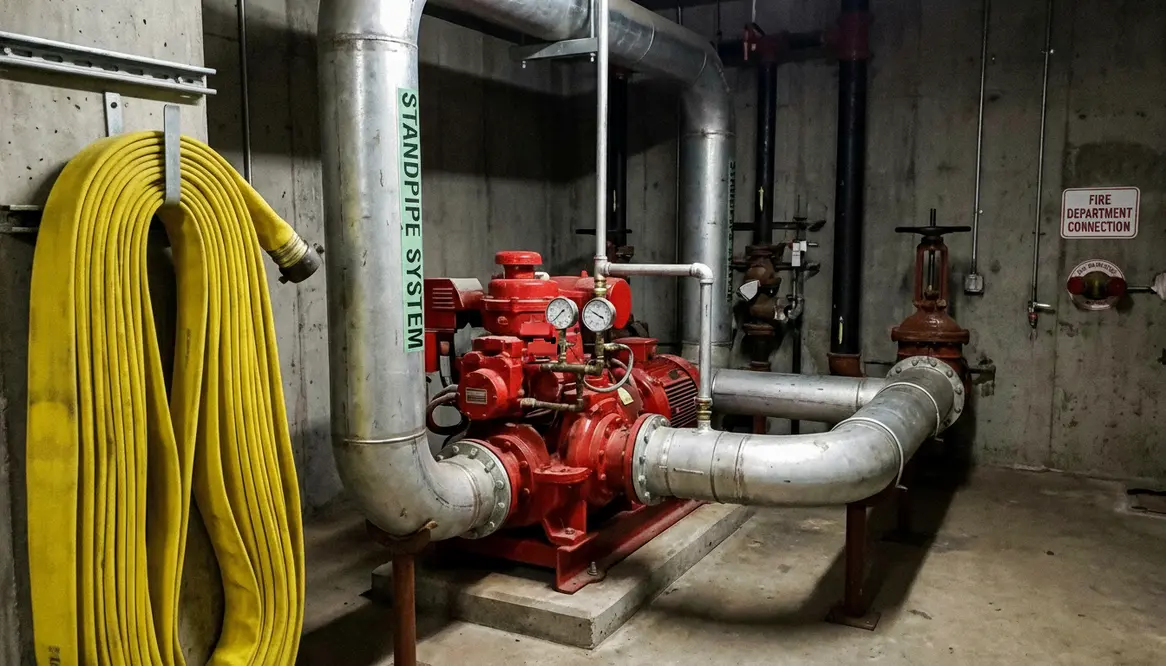
NFPA 14 Fire Pump Requirements for Standpipes
When Fire Pumps Are Required for Standpipe Systems Under NFPA 14
I have spent enough time around fire protection systems to know one thing for sure. Water only matters if it shows up with confidence. And that is exactly where the NFPA 14 fire pump requirements standpipe conversation comes in. In large commercial and industrial buildings, gravity does not always feel like doing its job. So, when pressure drops and firefighters are left staring at a hose that whispers instead of roars, a fire pump becomes the quiet hero in the background.
In this article, I will walk you through when fire pumps become mandatory for standpipe systems, why they matter, and how to spot the conditions that trigger those requirements. Think of it as decoding the rulebook, but without the headache.
Understanding Standpipe Pressure Demands in Real Buildings
First, let me ground this in reality. Standpipe systems are designed to deliver water at a specific pressure and flow rate to hose connections throughout a building. However, taller buildings and sprawling industrial facilities do not always cooperate.
As a result, NFPA 14 sets minimum pressure requirements at the most remote hose outlet. Typically, that means 100 psi for Class I and III systems. Now, here is the catch. Municipal water supply does not always meet that demand, especially during peak usage or in high rise environments.
So, when available water pressure falls short, a fire pump is not optional. It becomes essential. Without it, the system fails its basic mission. And nobody wants to explain that to a fire crew mid emergency. That is a career limiting conversation.
NFPA 14 Fire Pump Requirements Standpipe Conditions Explained
I like to think of this as a simple equation. If supply cannot meet demand, you boost it. NFPA 14 outlines several situations where fire pumps are required for standpipe systems in commercial and industrial buildings.
Common triggers for a required fire pump
- Insufficient municipal pressure: If the water supply cannot maintain required residual pressure at the highest outlet, a pump is required.
- High rise structures: Buildings exceeding certain heights often cannot rely on gravity alone.
- Large footprint facilities: Warehouses and industrial campuses stretch water delivery beyond what city mains can handle.
- Pressure loss from friction: Long pipe runs reduce effective pressure, even if supply looks good on paper.
In other words, if your system feels like it is running a marathon with no water break, you install a fire pump. Problem solved.
How Do I Know If My Building Needs a Fire Pump for a Standpipe?
I get this question a lot, and thankfully, the answer is not mysterious. You start with a hydraulic calculation. Engineers evaluate the available water supply and compare it to the system demand.
However, the moment the numbers do not line up, that is your signal. A fire pump bridges the gap. It ensures that even the most remote hose valve gets the pressure it needs.
Meanwhile, in large commercial properties like distribution centers or manufacturing plants, I often see this requirement triggered by distance rather than height. Water simply loses energy over long runs. Physics does not negotiate.
So, if your building stretches wider than a Marvel movie plot, there is a good chance a pump is part of the design. In many of these projects, NFPA 14 fire pump requirements standpipe criteria end up being the deciding factor that moves a pump from “nice to have” to “non‑negotiable.”
Breaking Down Pressure and Flow Without the Headache
Let me simplify what can feel like a technical maze. You need two things for a compliant standpipe system. Pressure and flow. Lose either one, and the system underperforms.
Two key factors that decide if a pump is required
Column A: What You Have
- Available water supply
- Static and residual pressure li>Municipal reliability
Column B: What You Need
- Required psi at top outlets
- Flow rate for hose operations
- Allowance for system losses
When Column A falls short of Column B, the NFPA 14 fire pump requirements standpipe criteria step in. A pump boosts pressure, stabilizes flow, and ensures compliance.
It is not glamorous, but neither is explaining why your system failed during an inspection. Or worse, during an actual fire.
Why Fire Pumps Matter More in Industrial and Commercial Spaces
Now, let us zoom in on large scale properties. These environments introduce complexity that smaller buildings simply do not have.
For example, industrial facilities often include high ceilings, heavy equipment, and compartmentalized layouts. As a result, hose coverage must reach further and perform under tougher conditions.
Additionally, commercial high rises stack floor upon floor, each demanding consistent pressure. Elevation alone can drain available water pressure faster than a phone battery at 1 percent.
Because of this, fire pumps become less of a backup and more of a foundation. They ensure that every part of the building, from ground level to the uppermost floor, receives reliable water delivery.
And let us be honest. Firefighters already have enough to deal with. They do not need a weak hose stream joining the list. In projects where NFPA 14 fire pump requirements standpipe rules apply, that pump is the difference between “the system should be fine” and “the system is ready.”
Design Coordination and Compliance Strategy
Installing a fire pump is not just about dropping equipment into a mechanical room and calling it a day. It requires coordination between system designers, engineers, and code requirements.
First, the pump must match the system demand curve. Oversizing or undersizing creates inefficiencies and potential compliance issues. Second, power supply and redundancy must be considered, especially in mission critical facilities.
Then, ongoing testing and maintenance keep the system reliable. NFPA standards do not just care about installation. They care about performance over time.
So, when I evaluate a system, I do not just ask if a pump exists. I ask if it is ready to perform when everything else goes wrong. If the NFPA 14 fire pump requirements standpipe thresholds have pushed that pump into the design, then it deserves the same seriousness as any other life safety system in the building.
Conclusion: Make Pressure Problems a Thing of the Past
If your commercial or industrial building depends on a standpipe system, do not leave pressure to chance. Evaluate your water supply, confirm your system demand, and act before gaps become liabilities. At firepumps.org, we help you align with NFPA standards and keep your system ready when it matters most. Reach out today and let us make sure your standpipe system delivers exactly what it promises.