Philippines Fire Pump Requirements Guide
Philippines Fire Pump Requirements Explained
When I talk about Philippines requirements for fire pumps, I am really talking about one thing: keeping commercial and industrial buildings ready when fire decides to show up uninvited. And yes, fire always arrives with terrible timing, like a villain in a movie who thinks the elevator music is for him. In the Philippines, fire pump rules matter because large buildings, factories, warehouses, malls, and other major properties need strong water supply systems that can support firefighting when pressure drops. So, if you manage a big site, this is not a nice to have. It is part of the survival kit.
In this guide, I will break down the basic fire pump setup, the usual code expectations, and the things I would check first in a commercial or industrial property. I will keep it clear, practical, and useful, because the goal is not to impress a textbook. The goal is to protect people, assets, and the building itself.
What fire pump systems must do in large buildings
A fire pump system boosts water pressure for sprinkler systems, standpipes, and hose reels when the normal supply cannot do the job. In major properties, I look at the fire pump as the muscle behind the fire protection plan. Without it, the system may look complete on paper, but in real life it can fold faster than a cheap lawn chair.
The Philippines requirements for these systems usually follow accepted fire safety standards used by local authorities and project engineers. In practice, the system should deliver enough pressure and flow to support the most demanding part of the building. That means I check the building size, height, hazard level, water source, and demand from the connected fire protection equipment. If the site is a warehouse with high fuel load, the need can be very different from a mid rise office tower. Same country, different beast.
Why these systems are non‑negotiable
In large commercial and industrial buildings, fire protection is only as strong as the weakest link in the water supply chain. Sprinklers, hydrants, and hose reels can be perfectly laid out, but if the pump cannot deliver, everything becomes a very expensive decoration. That is why Philippines requirements focus so heavily on real, tested performance, not just good intentions on drawings.
Every floor addition, new tenant with higher hazard, or expansion that adds storage or process areas can change water demand. A pump sized for yesterday’s risks may not be ready for today’s realities. That is where proper assessment comes in: checking that the system still matches what the building has become, not what it used to be.
How I check Philippines requirements for fire pump setup
When I review a fire pump design, I start with the basics.
1. Capacity: matching flow and pressure
First, I confirm the pump can meet the required flow and pressure for the property. If the pump is too small, the system weakens. If it is too large, the design wastes money and may create other problems. Nobody wants an expensive machine doing the job of a treadmill in an empty gym.
2. Water supply: the fuel behind the pump
Second, I look at the water supply. Fire pumps need a dependable source, such as a tank or reliable connection. The system should keep enough reserve for the expected fire demand. In major commercial and industrial buildings, water storage often becomes a key part of the design because the building cannot depend on hope and good vibes.
3. Pump arrangement: making sure backup is real
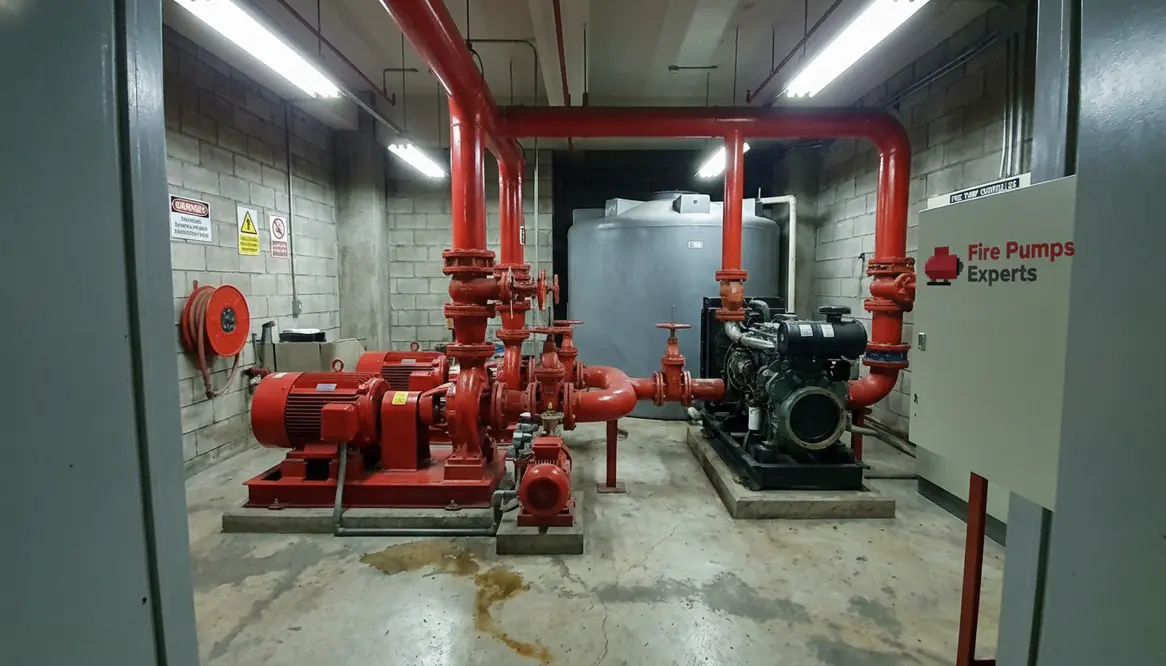
Third, I check the pump arrangement. Many projects use a main electric pump, a backup diesel pump, and a jockey pump to maintain pressure. This setup gives better reliability, especially for larger facilities. The jockey pump keeps pressure stable and reduces unnecessary starts. It is the quiet one in the group, while the big pumps are the action stars.
When looking at Philippines requirements, I expect to see clear logic behind each pump in the lineup, proper sizing, and proper control settings so they do not fight each other. Coordination matters: the jockey pump should handle minor pressure drops, the main pump should respond when things get serious, and the diesel backup should be ready when power problems arrive at the worst possible time.
What the fire pump room should include
I always pay close attention to the fire pump room because it affects performance, access, and maintenance. A proper room should stay dry, accessible, and protected from damage. It should also allow enough space for inspection and repair.
Here is a simple dual view of what matters most:
Design side
- Space for the pump, controller, valves, and pipes
- Proper ventilation and lighting
- Clear access for technicians and responders
Operation side
- Reliable power supply for electric pumps
- Fuel readiness for diesel backup units
- Regular testing and maintenance access
This room should never become a storage closet for old chairs, unused boxes, or the office Christmas tree from 2018. I have seen stranger things, but the fire pump room should stay a pump room.
Testing, maintenance, and proof of performance
Meeting Philippines requirements does not stop at installation. The system must also work over time. That is why testing matters. I usually recommend routine checks on pump start up, pressure levels, water flow, controller function, and backup power. If the system has not been tested, then it is basically a very confident guess.
Maintenance should cover seals, bearings, valves, gauges, and the condition of the power source. For diesel pumps, I also look at fuel quality and battery health. For electric pumps, I check controller alarms and power continuity. These steps keep the system ready and help avoid failure during a real emergency.
Documentation matters too. Records of tests, repairs, and inspections support compliance and help building owners prove that the system stays in good working order. If a facility grows, changes use, or adds floor space, I would review the system again. Fire risk does not stay still, and neither should the protection plan.
When a commercial or industrial site needs a review
I suggest a fire pump review when a property has new construction, expansion, tenant changes, or signs of weak water pressure. I also recommend one if the site has aging equipment, repeated alarm issues, or a recent code review from local authorities. For commercial and industrial buildings, this kind of check can save time, money, and a very bad day.
If you want a deeper look at fire pump planning for major properties, you can also explore this fire pump compliance guide for commercial buildings. It can help you connect design choices with real world protection needs.
Across these situations, the core theme is simple: the building evolves, so the fire protection should follow. Reviewing against current Philippines requirements keeps the system aligned with the real fire load, the current tenants, and the actual way the building is used today.
FAQ
Conclusion
If I were managing a commercial or industrial property in the Philippines, I would treat fire pump compliance as a core safety task, not a side project. The right system protects people, supports code compliance, and reduces risk when every second counts. So, if your site needs a fire pump review, do not wait for trouble to make the first move. Get the system checked, keep the records clean, and make sure your protection is ready before the heat turns up.
In the end, meeting Philippines requirements is not about ticking boxes. It is about turning pumps, pipes, and controls into a reliable safety net that works when the alarms sound and the hallway fills with smoke. That is the moment when every test, every inspection, and every design choice proves its worth.