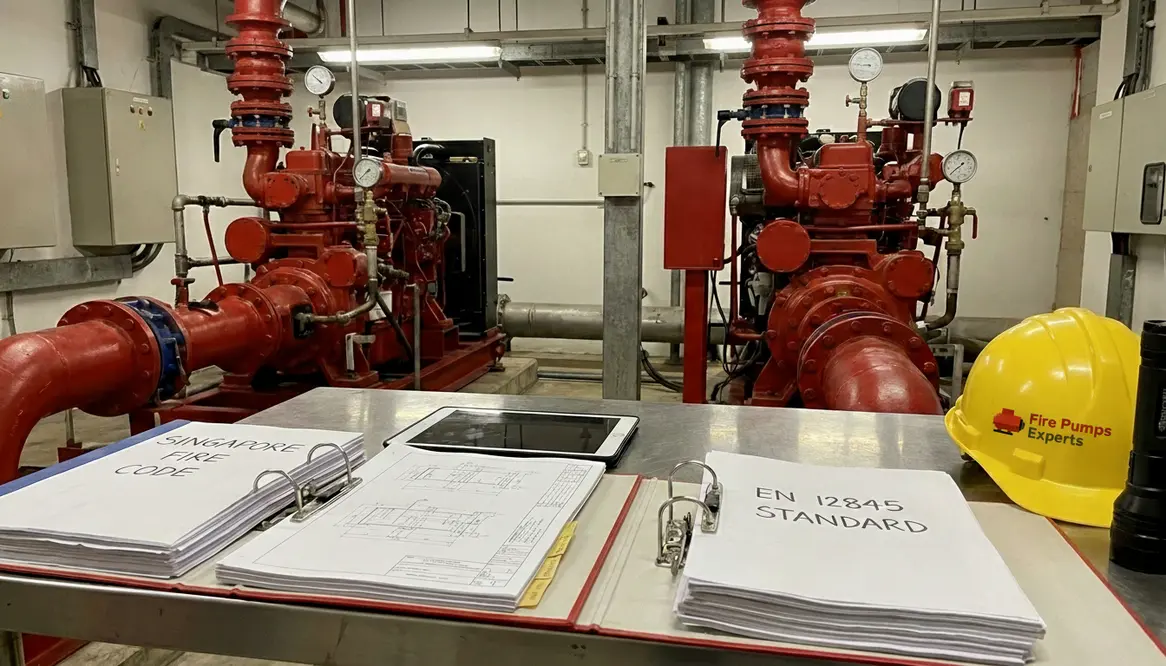
Singapore Fire Code vs EN 12845 Fire Pumps Guide
Singapore Fire Code vs EN 12845 Fire Pump Requirements: What I Look At First
When I compare Singapore Fire Code vs EN 12845, I start with one simple truth: both aim to protect people and property, but they do not always ask for the same thing. That matters a lot for commercial and industrial buildings, where fire pumps are not just boxes in a plant room. They are the heartbeat of the whole fire system. If they fail, the rest of the setup can feel like a superhero team with no power source. Not ideal.
In this article, I walk through the main differences, what each standard expects, and how I approach fire pump planning for major properties. I will keep it practical, because code talk can get dry fast enough to make a sprinkler look exciting.
How I Read the Singapore Fire Code for Fire Pumps
The Singapore Fire Code focuses on local safety needs, building use, and compliance with national rules. For me, that means I never treat it like a loose guide. I treat it as the rulebook for approval, installation, and system performance in Singapore.
For fire pumps, the code usually pushes me to check the building type, water demand, pump arrangement, and backup support. In commercial and industrial sites, the system often needs to serve a larger risk profile, so I look at flow, pressure, redundancy, and access for maintenance. I also pay close attention to how the pump room fits into the building design. A pump that cannot be reached easily is like Batman with no way out of the cave.
The key point here is simple: the Singapore Fire Code leans hard on local authority expectations. So even if a global standard looks tidy on paper, I still have to make sure it fits the local approval path.
What EN 12845 Demands from Fire Pump Systems
EN 12845 takes a more standard based approach. It gives clear rules for automatic sprinkler systems, and that includes fire pump supply, performance, and reliability. I find it very useful when a project wants a structured technical path, especially for large industrial plants and major buildings with complex fire loads.
EN 12845 usually expects strong water supply security, proper pump sizing, and dependable duty and standby arrangements where needed. It also pays close attention to system classification, water storage, and how long the system must run under fire conditions. That matters, because a pump that works for five minutes is about as useful as a phone with one percent battery during a long meeting.
So, while the Singapore Fire Code drives local compliance, EN 12845 gives me a detailed technical framework. In practice, I often compare both side by side to avoid gaps that only show up during review or commissioning. And those gaps can be expensive little surprises.
Singapore Code vs EN 12845: Side by Side View
Here is the simplest way I separate them.
Singapore Fire Code focuses on local legal compliance, building approval, and site specific fire safety rules.
EN 12845 focuses on technical system design, sprinkler performance, and fire pump reliability.
Singapore Fire Code focus
- Local compliance driven
- Authority approval focused
- Built around Singapore risk and building rules
EN 12845 focus
- Technical standard driven
- System design focused
- Built around sprinkler and pump performance
This is why I never ask, “Which one is better?” That is the wrong question. I ask, “Which one applies here, and where do they overlap?” That question saves time, budget, and a lot of face in front of reviewers. The discussion around Singapore Code vs EN 12845 only makes sense when it is tied to real project conditions and actual approval paths.
What I Check in a Commercial Fire Pump Design
When I work on a commercial or industrial site, I check more than the pump nameplate. I look at the full chain, because a strong pump still depends on the rest of the setup.
Core checks before locking in the fire pump
- Water demand and pressure needs
- Duty and standby pump setup
- Power source and backup supply
- Water tank size and refill support
- Pump room access and ventilation
- Testing, alarms, and routine maintenance access
These details matter because fire pumps must work under stress, not just during a shiny handover photo. Also, major properties often face high occupancy, long operation hours, and valuable assets. So I build for reliability first, and fancy extras come second. Or never, if they only add drama.
When I Recommend a Code Review Before Installation
I recommend a review before installation whenever a project mixes local rules with international design standards. That happens a lot in industrial plants, shopping complexes, logistics hubs, data centers, and tall commercial buildings.
Local-first, standard-smart
If the design team uses EN 12845, I still check the Singapore Fire Code early. That way, I catch issues before they turn into redesigns, delays, or a pile of red pen comments from the authority. In the Singapore Code vs EN 12845 discussion, local approval always wins the tie-breaker.
Why early checks pay off
In my experience, early review is cheaper than late correction. Every time. By lining up Singapore Code vs EN 12845 requirements from the start, projects avoid awkward last-minute changes to pump capacity, tank sizing, or room layout.
For better guidance, I also suggest looking at a trusted Singapore fire pump compliance guide for commercial buildings when planning the system path. It helps align technical design with local expectations, which is exactly where many projects save time.
How I Balance Singapore Code vs EN 12845 in Real Projects
On most major properties, I do not treat Singapore Code vs EN 12845 as a contest. I treat them like two lenses on the same pump room. One lens is tuned to local approval, the other to robust technical performance. Used together, they give a clearer picture of what the fire pump system really needs to do on the day it is called on to work.
That means confirming local authority expectations, checking EN 12845 for sprinkler and pump reliability, and then making sure the final design is buildable, maintainable, and testable without gymnastics. It is a straightforward way to keep both standards working in your favor, instead of fighting each other at the worst possible time.
FAQ
Conclusion
If you manage a commercial or industrial property, I would not treat fire pump compliance as a box to tick. I would treat it as a core part of building safety. The smart move is to align the Singapore Fire Code with EN 12845 early, before the project gets too far down the road. If you want a cleaner path to approval and a stronger system, review your fire pump design now and make sure it stands up where it counts.