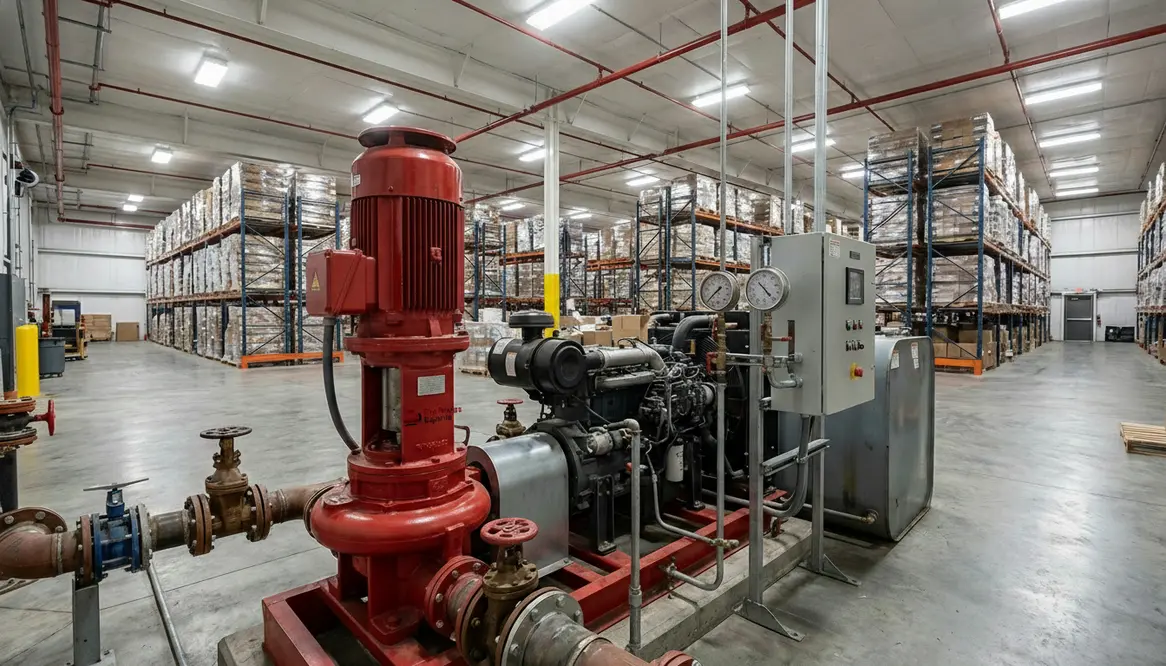
Warehouse Fire Pump Requirements for Commercial Buildings
I have spent enough time around mechanical rooms to know one truth. Fire pumps do not care about excuses. When a system is called into action, it either performs or it becomes a very expensive paperweight. That is why understanding warehouse fire pump requirements for commercial buildings is not just a code exercise. It is a business survival strategy. In large industrial spaces where inventory stacks high and operations never really sleep, the right fire pump setup becomes the quiet hero in the background, waiting for its moment.
What are warehouse fire pump requirements for commercial buildings and why do they matter?
Let me answer this the way I would explain it to a building owner standing next to a humming pump controller. These requirements define how water gets where it needs to go, at the pressure needed, when everything else is going wrong.
Warehouses present unique challenges. High ceilings, dense storage, and sometimes hazardous materials all raise the stakes. Therefore, fire pumps must meet standards like NFPA 20 while aligning with local fire codes. More importantly, they must support sprinkler systems designed for high pile storage.
Because of this, the pump is not just about flow. It is about reliability under stress. And yes, much like a seasoned action hero, it must perform without hesitation when the plot gets intense.
Core Components That Make the System Work
When I walk into a commercial pump room, I look for harmony between parts. Each component plays a role, and if one goes rogue, the whole system suffers.
Key elements that work together under pressure
- Fire pump unit that delivers required pressure and flow
- Controller that starts the pump automatically
- Reliable power source such as electric or diesel backup
- Water supply that can sustain demand without dropping pressure
- Jockey pump that maintains system pressure during idle periods
Additionally, these components must work together without hesitation. Think of it like a band. If the drummer loses tempo, the whole performance falls apart. And no one wants their fire protection system to sound like a garage band on its first day.
How do I size a fire pump for a large warehouse?
I get this question a lot, and the answer is not guesswork. It is math, code, and a bit of foresight.
From hazard classification to final pump curve
First, I determine the hazard classification. High piled storage demands more water than standard commodity storage. Then, I calculate sprinkler demand, including the most remote area. After that, I factor in hose allowances and pressure losses.
Consequently, the pump must meet both flow and pressure at peak demand. Oversizing can cause system damage, while undersizing creates a dangerous shortfall. Neither is acceptable.
And yes, choosing the right size pump feels a bit like casting the lead role in a blockbuster. Too small, and the story collapses. Too big, and it steals the show in all the wrong ways.
Design Priorities That Keep Systems Code Compliant
Performance focus
- Meet NFPA 20 standards
- Maintain consistent pressure
- Ensure automatic activation
- Provide redundancy where needed
Operational focus
- Allow easy maintenance access
- Include clear monitoring systems
- Use durable materials
- Plan for long term reliability
At the same time, I always stress accessibility. A fire pump tucked behind obstacles is like hiding the fire extinguisher during a kitchen fire. It defeats the purpose.
Common Mistakes I See in Commercial Installations
Even experienced teams slip up. However, the same issues tend to repeat.
Where good intentions collide with bad details
One common mistake is underestimating water supply reliability. Another is ignoring future expansion. Warehouses evolve, and fire systems must keep up.
Then there is maintenance neglect. A fire pump that is not tested regularly becomes a gamble. And if you enjoy gambling, I recommend Vegas, not your fire protection system.
Additionally, poor coordination between engineers and contractors can lead to mismatched components. When that happens, the system may pass inspection but fail under real conditions. That is a risk no serious operation should accept.
Inspection, Testing, and Long Term Performance
I always say that installation is just the beginning. The real story unfolds over time.
Keeping the quiet hero ready for its worst day
Routine testing ensures the pump starts, runs, and delivers as expected. Weekly churn tests, annual flow tests, and periodic inspections all play a role. Moreover, documentation matters. If it is not recorded, it might as well not have happened.
Because of this, facility managers must treat fire pumps like critical infrastructure. Not background equipment. Not optional maintenance. Critical.
And yes, a well maintained pump room has a certain charm. It is clean, organized, and quietly confident. Kind of like that one character in every movie who never panics while everyone else is losing their minds.
FAQ: Quick Answers You Can Use Immediately
What is the main purpose of a fire pump in a warehouse?
It boosts water pressure to meet sprinkler system demands during a fire.
Are fire pumps required in all warehouses?
No, only when municipal water supply cannot meet required pressure and flow.
How often should fire pumps be tested?
Weekly visual checks and annual full performance tests are standard.
Can I use electric instead of diesel fire pumps?
Yes, if the power supply is reliable and meets code requirements.
What codes govern fire pump installations?
NFPA 20 is the primary standard, along with local fire codes.
Conclusion: Build It Right Before You Need It
I have seen what happens when preparation meets reality, and when it does not. If you are managing a large facility, now is the time to align your system with warehouse fire pump requirements for commercial buildings. Work with specialists who understand industrial risks, not guesswork. Because when the moment comes, your system should not hesitate. It should respond with precision, strength, and quiet confidence. Let us make sure it does exactly that.
Putting warehouse fire pump requirements for commercial buildings into practice
For facilities with high value inventory, hazardous materials, or complex operations, warehouse fire pump requirements for commercial buildings should be treated as a design roadmap, not a minimum checklist. From water supply reliability to controller configuration, every decision either strengthens or weakens resilience. Reviewing these requirements against actual building conditions, planned expansions, and operational patterns reveals gaps that can be closed long before the system is put to the test.
It is also worth revisiting warehouse fire pump requirements for commercial buildings whenever storage layouts change, racking heights increase, or new processes move into the space. What worked for a light commodity warehouse may fall short in a high piled, mixed commodity operation. The pump, the sprinklers, and the water supply all have to play the same game under the same rules, or someone will lose badly when alarms go off.
If you want to go deeper into system behavior under real demand, resources at https://firepumps.org offer useful technical insights, case studies, and breakdowns of how modern pump configurations respond to high challenge warehouse fires. Pair that knowledge with your local codes and insurer requirements, and you have a solid foundation for both compliance and performance.