How AHJs Impact Fire Pump Approvals in Kern County
How Local AHJs Shape Fire Pump Approvals in Kern County
I have spent enough time around commercial buildings to know one truth. Nothing moves faster than a fire, and nothing slows a project down like a missed approval. When I work with warehouse fire pumps in Kern County, I do not just think about flow rates and pressure. I think about people. Specifically, the Authority Having Jurisdiction, or AHJ. They are the gatekeepers, the referees, and sometimes the unexpected plot twist in your construction story.
So, let me walk you through how these local authorities influence approvals, timelines, and outcomes. And yes, I will keep it interesting. Because if we can make fire pumps feel like a Netflix drama, we are doing something right.
What Local AHJs Actually Control in Kern County
The AHJ is not just a name on a checklist. In Kern County, this role can include fire marshals, building departments, and even water districts. Each one has a say, and together, they form a system that decides whether your fire protection setup passes or stalls.
Interpreting National and Local Codes
First, they interpret codes. While national standards like NFPA set the baseline, local AHJs decide how strictly those standards apply. Therefore, what works in Los Angeles might not slide in Bakersfield. For warehouse fire pumps, that means you cannot simply copy a design from another county and assume it will pass here.
Reviewing Fire Pump Plans in Detail
Second, they review plans. Every pump curve, pipe size, and layout detail lands under their microscope. If something feels off, even slightly, they will flag it. And trust me, they do not miss much. When you are dealing with warehouse fire pumps that protect large, high-rack storage, those details are not academic; they decide whether your system works under real heat and smoke.
Inspecting the Final Installation
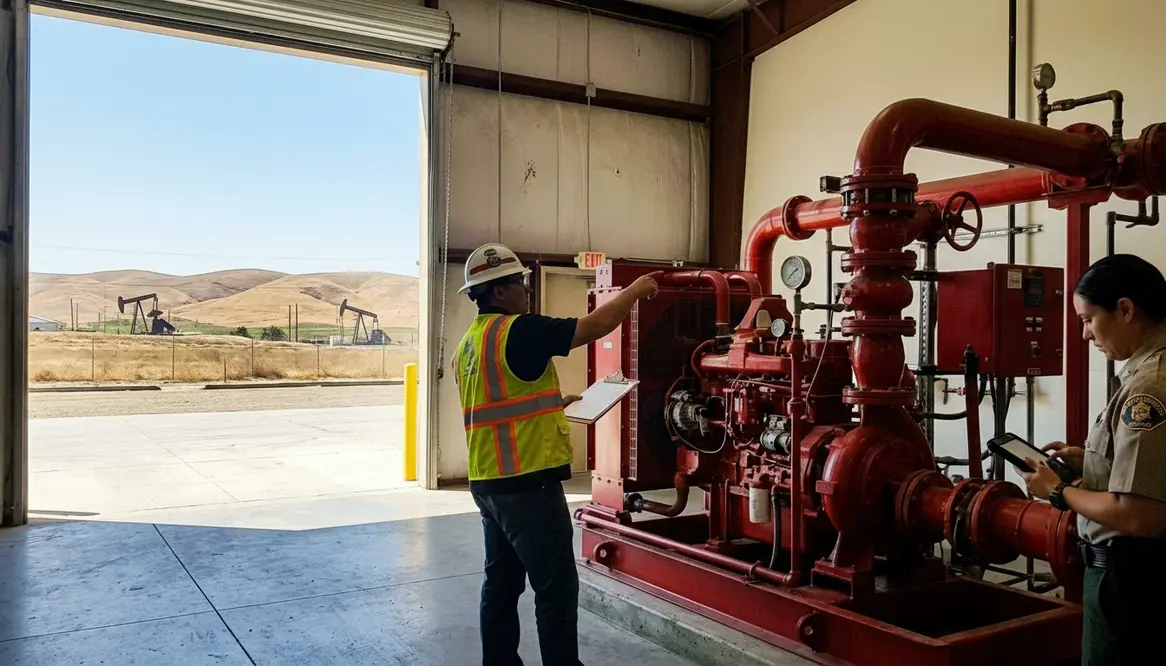
Finally, they inspect installations. Even if your paperwork looks flawless, the physical setup must match. Otherwise, you are back to the drawing board. Suction piping routing, controller settings, signage, and test headers all move from lines on a plan to hardware in a pump room that the AHJ will walk, flashlight in hand.
Why Kern County Feels Different from Other Regions
Kern County has its own rhythm. It blends industrial zones, agriculture, and expanding commercial developments. Because of that, AHJs here often take a practical but firm approach. They understand that fire pumps are not theoretical; they are the backup plan for when everything else is already going wrong.
Water Supply Realities on the Ground
For example, water supply can vary widely. Some areas have strong municipal systems, while others rely on tanks or boosters. As a result, AHJs pay close attention to redundancy and reliability. They want to know what happens if your preferred source fails at the very moment your warehouse fire pumps are needed most.
Documentation Style: Less Drama, More Clarity
Also, they value clarity. If your submittal package reads like a mystery novel, you are in trouble. They want clean, direct documentation. Think less Shakespeare, more instruction manual. Clear sequences of operation, logical layouts, and straightforward hydraulic summaries all make approvals smoother.
Timelines and Safety Priorities
And yes, timelines can stretch. Not because anyone enjoys delays, but because safety takes priority. A fire pump is not a decorative fountain. It is a lifeline. Kern County AHJs are well aware that once racks are full of product and trucks are backing up to the dock, nobody wants to shut down for fixes that should have been caught on paper.
How I Navigate AHJ Expectations for Warehouse Fire Pumps
Over time, I have learned that success with AHJs is less about “winning an argument” and more about showing that you understand their world. For warehouse fire pumps, that means thinking like an inspector long before one shows up on site.
Planning Phase
I start by aligning design with local interpretations, not just national codes. Then I consult early, because waiting until submission is like showing up to a test you did not study for. Early conversations with Kern County fire protection experts, such as the team at Kord Fire Protection, help confirm that assumptions about supplies, demand, and pump sizing match local expectations.
Approval Phase
I keep communication open and quick. If an AHJ asks for clarification, I respond fast and clearly. Silence, in this process, is never golden. I treat comments as a checklist, not as criticism, and I focus on making it easy for them to say “yes” without feeling like they compromised on safety.
Installation Phase
I verify that the field conditions match approved plans. Even small deviations can raise red flags. That includes everything from pump room clearances and ventilation to how controllers are labeled. When crews are moving fast to hit schedule dates, I act as the person asking, “Will this pass inspection?” before the AHJ has to ask it for me.
Final Inspection
I walk the site beforehand. Because surprises are great for birthdays, not for fire system approvals. I check signage, access pathways, test headers, drain terminations, and power feeds so that the first time anyone is surprised, it is by how smoothly the inspection goes, not by a missing tag or blocked valve.
This approach keeps projects moving. More importantly, it builds trust. And in Kern County, trust with your AHJ goes a long way. Once they see that you consistently install and maintain warehouse fire pumps that perform as promised, conversations shift from suspicious to collaborative.
Hidden Factors That Can Delay Fire Pump Approvals
Now, here is where things get interesting. Not all delays come from obvious mistakes. Sometimes, they come from details people overlook, the small gaps that only show up when an AHJ starts asking uncomfortable questions.
Water Supply Data and Documentation
Water supply documentation is a big one. If your test data is outdated or unclear, the AHJ will pause everything. Therefore, I always make sure it is current and easy to read. Clear dates, test locations, static and residual pressures, and safety factors matter even more when sizing warehouse fire pumps that must support long hose lines and tall rack storage.
System Coordination Beyond the Pump
Another factor is coordination. Fire pumps do not exist in isolation. They connect to alarms, sprinklers, and power systems. If those pieces do not align, approvals stall. When the sequence of operation reads one way, the alarm programming does another, and the transfer switch has its own ideas, the AHJ has every right to slow things down.
Access, Safety, and Inspector-Friendly Design
Then there is access. Yes, physical access. If inspectors cannot safely reach the equipment, they will not sign off. It sounds simple, yet it trips people up more often than you would think. Ladders stored in front of panels, temporary storage jammed into pump rooms, and awkward door swings all send a clear message: “We did not think about you when we built this.” AHJs notice.
Drawing and Specification Consistency
And finally, consistency matters. If your drawings say one thing and your specs say another, expect questions. Lots of them. When you are submitting a complex system for a large facility, every mismatch chips away at confidence that the warehouse fire pumps and related systems will operate as intended when nobody has time to think.
Working With AHJs Instead of Against Them
I have seen projects turn into tug of war matches. That never ends well. Instead, I treat AHJs as partners. Because, in truth, we share the same goal. We want systems that work when everything else fails, and we want people to leave the building alive when the sprinklers, alarms, and pumps have done their job.
Proactive Questions and Early Clarifications
So, I stay proactive. I ask questions early. I clarify assumptions. And when feedback comes in, I do not argue for the sake of ego. I respond with solutions. If an AHJ wants a slightly different arrangement for test headers or controllers, I look for a way to make that happen without turning the project upside down.
Seeing AHJs as Long-Term Allies
It is a bit like dealing with a wise mentor in a movie. Think Mr. Miyagi, but with a clipboard and a codebook. If you listen carefully, you come out better on the other side. Over multiple projects, that relationship becomes an asset: the AHJ knows you bring in solid designs, you respect their role, and your warehouse fire pumps are not cutting corners.
FAQ Quick Answers for Fire Pump Approvals in Kern County
A few questions come up on almost every project. Here are the quick versions so you are not guessing when you sit down with your next set of plans.
Conclusion
If you are planning a project in Kern County, do not treat AHJs as a final hurdle. Bring them into the process early and often. When you align design, communication, and execution, approvals move smoother and faster. I have seen it happen time and again. So, if you are working on a commercial or industrial facility, now is the time to get your fire pump strategy right and keep your project on track.