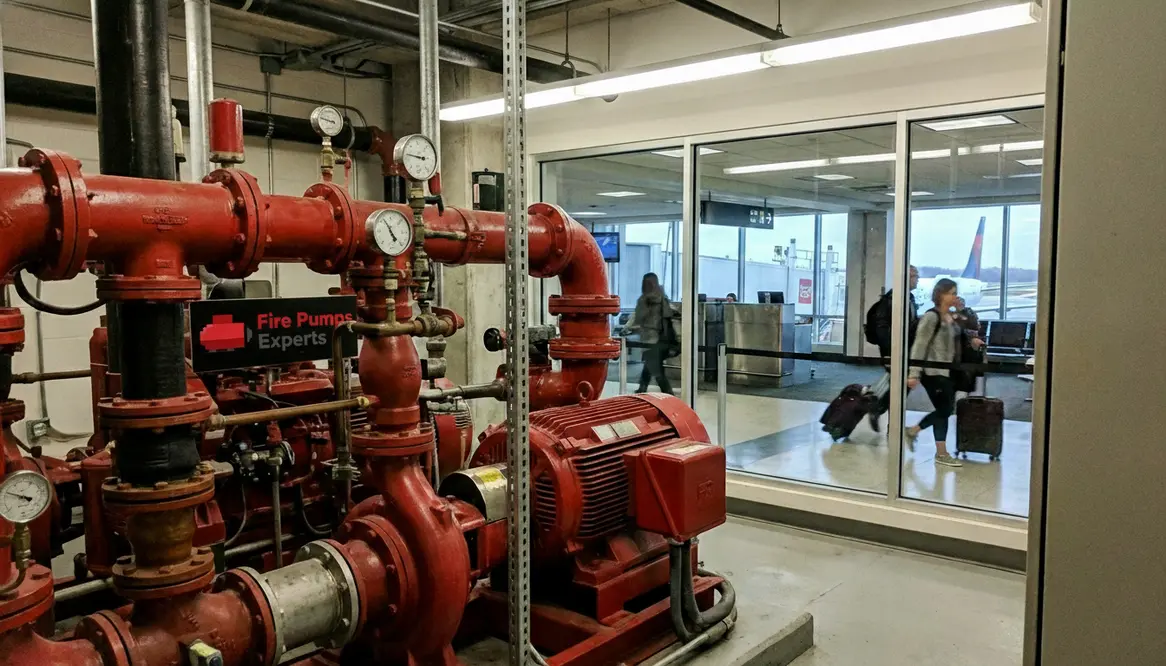
Public Assembly Fire Pumps for Airports Safety
I have spent enough time around airports and major transportation hubs to know one thing for certain. When thousands of people move through a space every hour, safety cannot whisper. It has to speak in a calm, steady voice. That is where public assembly fire pumps step in, doing the quiet work that no one notices until everything depends on it. These systems are not just mechanical equipment. They are the backbone of fire protection in complex, high occupancy environments.
And yes, while they do not wear capes like a Marvel hero, they might as well. Because when things heat up, they are the ones keeping everything under control.
Understanding Fire Pump Requirements in High Traffic Hubs
Airports and transportation centers operate like small cities. Because of that, fire pump requirements go far beyond basic compliance. I always look at three critical factors. First, the scale of the building. Second, the occupancy load. Third, the complexity of interconnected systems.
Accordingly, codes such as NFPA 20 and NFPA 101 set the tone. However, airports often layer additional requirements due to federal oversight and local regulations. Fire pumps must deliver consistent pressure across vast sprinkler networks, standpipes, and specialized suppression systems.
Moreover, redundancy is not optional. If one system fails, another must take over instantly. Think of it like a backup singer who suddenly becomes the lead when the star loses their voice. The show must go on.
How Do Fire Pumps Support Life Safety in Airports?
I like to keep this simple. Fire pumps ensure water moves where it needs to go, at the pressure required, without hesitation. In airports, that means supporting multiple zones at once.
For example, a single terminal may include retail spaces, baggage systems, mechanical rooms, and aircraft access points. Each area presents a different fire risk. Therefore, the pump system must adapt quickly and maintain performance under varying demand.
Additionally, response time matters. A delay of even seconds can change outcomes. That is why public assembly fire pumps are designed for immediate activation and sustained operation.
Key Design Considerations for Large Transportation Facilities
When I evaluate systems for large properties, I focus on how design decisions affect real world performance. It is not just about meeting code. It is about exceeding expectations.
Operational Priorities
- Consistent water pressure across long distances
- Integration with alarm and detection systems
- Backup power reliability
- Ease of maintenance access
Risk Management Factors
- High passenger density zones
- Critical infrastructure protection
- 24 hour operational demands
- Coordination with emergency responders
Furthermore, engineers must consider future expansion. Airports rarely stay the same size. If anything, they grow like a sequel that keeps adding characters. Therefore, scalability becomes essential.
Compliance Is Only the Beginning
Meeting code requirements is important. However, I never treat it as the finish line. Instead, I see it as the starting point.
Transportation hubs demand systems that can perform under stress, not just pass inspection on a calm Tuesday afternoon. This means regular testing, performance verification, and system tuning. In addition, coordination with fire protection professionals ensures that public assembly fire pumps continue to operate at peak efficiency.
Also, documentation plays a major role. Clear records help facility managers track performance trends and identify potential issues before they escalate. It is a bit like going to the doctor for regular checkups. You do not wait for something to go wrong.
Integrating Fire Pumps with Complex Infrastructure
Airports are layered environments. Electrical systems, fuel lines, ventilation networks, and security systems all intersect. Because of this, fire pump integration must be precise.
I often emphasize communication between systems. Fire pumps must sync with alarms, emergency lighting, and control panels. When one system activates, others must respond instantly. There is no room for confusion.
Additionally, power supply is critical. Backup generators must support fire pumps without delay. After all, during an emergency, losing power is not dramatic in a good way. It is more like the part of the movie where everyone starts yelling.
Why Specialized Fire Pump Systems Matter for Commercial Giants
Not all fire pumps are created equal. Large scale facilities require tailored solutions that reflect their size and function. I have seen generic systems struggle under the demands of a major airport. It is like asking a compact car to tow a jet. Ambitious, but unrealistic.
Instead, purpose built systems ensure reliability. These include high capacity pumps, advanced controllers, and materials designed for continuous operation. For commercial and industrial properties, this level of specialization is not a luxury. It is a necessity.
Furthermore, working with experienced providers ensures proper installation and long term support. That relationship often makes the difference between a system that performs and one that merely exists. When it comes to airports and other public assembly fire pumps applications, that difference can define the outcome of an emergency.
FAQ: Fire Pump Requirements for Airports
Conclusion: Building Safety That Never Sleeps
Airports never truly rest, and neither should their fire protection systems. If you manage a large commercial or industrial facility, investing in high performance fire pump solutions is not optional. It is essential. At firepumps.org, we help you design, install, and maintain systems that stand ready at all times. Because when safety calls, you want an answer that is immediate, reliable, and built to last. In the world of public assembly fire pumps, that readiness is the quiet promise behind every safe takeoff and landing.