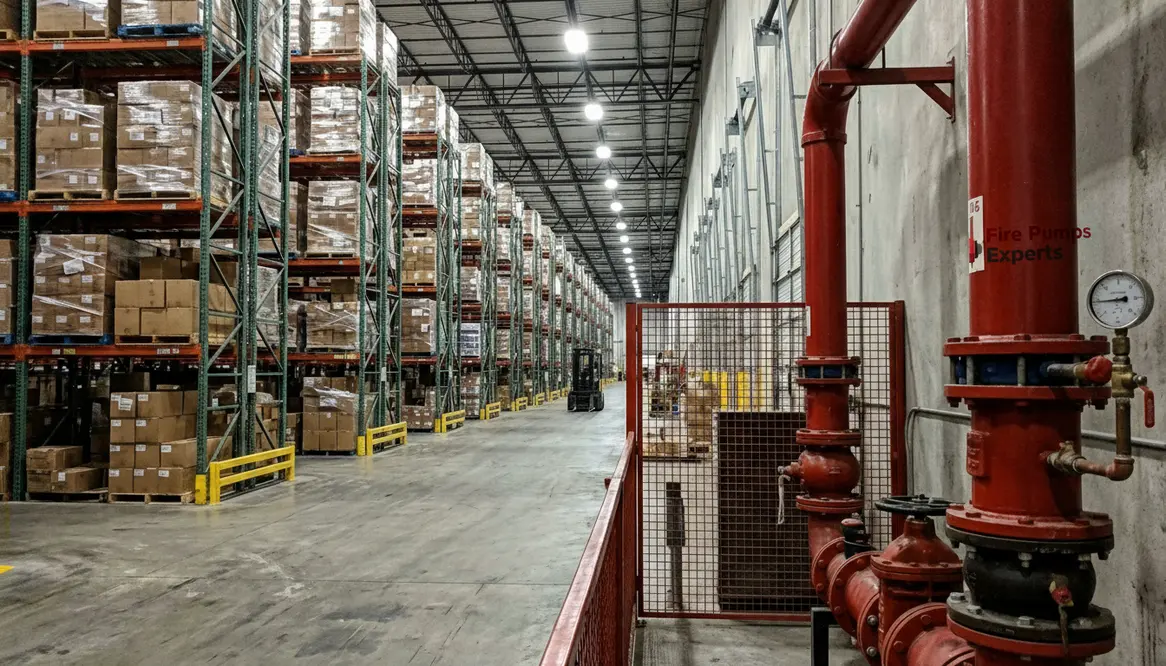
Fire Pump Considerations for Rack Storage Warehouses
I have spent years walking through distribution centers that feel more like cities than buildings. High racks, endless aisles, and inventory stacked like a game of industrial Tetris. And right at the heart of protecting it all sits a topic many overlook until it matters most: Fire pump considerations for rack storage and inventory. Within the first few steps inside any large warehouse, I am already thinking about pressure, flow, and whether the system can keep up if things go sideways. Because when fire shows up uninvited, it does not RSVP. It just starts the party.
Understanding Distribution Warehouse Fire Pump Requirements
When I evaluate a distribution warehouse, I start with one simple truth. Storage height changes everything. The taller and denser the storage, the more aggressive the fire risk becomes. Therefore, fire pumps must deliver enough pressure and flow to support sprinkler systems designed for high challenge storage.
In these environments, I am not dealing with a small office setup. I am working with systems that may require thousands of gallons per minute. Additionally, I look at how quickly the pump can respond. Because in a rack storage fire, seconds matter more than most people realize. It is less slow burn, more action movie explosion without the soundtrack.
As a result, proper sizing is not optional. It is critical. I always align the pump with NFPA standards while also considering real world variables like friction loss, elevation, and system demand peaks.
How Fire Pump Considerations for Rack Storage and Inventory Shape System Design
Let me be clear. Rack storage changes the rules. It traps heat, limits water penetration, and encourages vertical fire spread. Because of that, I focus heavily on how water will actually reach the fire.
I often review whether in rack sprinklers are present, and if so, how they interact with ceiling systems. Then I match the fire pump output accordingly. If the pump underperforms, the entire system struggles. If it overperforms without control, it creates pressure issues. Balance is everything.
Meanwhile, commodity type plays a role too. Plastics burn differently than paper goods. Therefore, I adjust expectations based on what is stored. It is not just about stacking boxes. It is about understanding what those boxes do when they ignite.
What Size Fire Pump Does a High Pile Warehouse Need?
I get this question a lot, and the answer is always the same. It depends. I know, not the dramatic reveal you were hoping for, but stick with me.
Typically, I calculate demand based on sprinkler design density and the most demanding remote area. Then I factor in hose stream allowances. After that, I account for system losses. Only then do I land on a pump size.
However, for large distribution centers, I often see pumps ranging from 1500 to 5000 gallons per minute. That range covers many scenarios, but not all. Therefore, I always validate with hydraulic calculations rather than guessing. Guessing belongs in trivia night, not fire protection design.
Key System Components That Support Fire Pump Performance
Fire pumps do not work alone. They are part of a larger system that must operate in harmony. So I always look at supporting components with equal attention.
Water supply reliability
I confirm whether the supply is municipal, tank fed, or a combination. Then I verify duration and refill capability.
Controller functionality
The controller must start the pump instantly and reliably. No hesitation, no drama.
Backflow prevention
I ensure it does not create excessive pressure loss. Every pound matters.
Power source stability
Electric or diesel, I evaluate redundancy. Because losing power during a fire is about as helpful as bringing a spoon to a sword fight.
Additionally, I review testing and maintenance access. A great system on paper means nothing if no one can maintain it properly.
Fire Pump Considerations for Rack Storage and Inventory in Modern Facilities
Warehouses are evolving. Automation, robotics, and tighter storage layouts are becoming the norm. As a result, fire pump considerations for rack storage and inventory must evolve too.
I now factor in obstructions caused by conveyors and robotic systems. These can interfere with water distribution. Therefore, I often coordinate closely with layout designers to ensure fire protection is not an afterthought.
Moreover, I look at future expansion. Many facilities grow quickly. So I design systems that can adapt without requiring a full overhaul. Because tearing out a fire pump system later is not exactly a weekend DIY project.
Common Mistakes I See and How to Avoid Them
Over the years, I have seen patterns. Some mistakes show up again and again, like reruns of a show nobody asked for.
One major issue is undersized pumps. This usually comes from relying on outdated data or ignoring changes in storage configuration. Another is poor coordination between sprinkler design and pump capacity.
Additionally, maintenance often gets overlooked. A fire pump that has not been tested regularly is a gamble. And this is one place where I do not recommend rolling the dice.
To avoid these pitfalls, I always recommend regular system reviews, updated hazard assessments, and performance testing. It is not glamorous, but it works.
Why Fire pump considerations for rack storage and inventory sit at the core
For large, complex facilities, Fire pump considerations for rack storage and inventory often become the difference between a controllable incident and a catastrophic loss. The interaction between pump performance, storage height, commodity mix, and sprinkler layout is where real protection lives. When all of those elements support each other, the system can respond fast enough and strong enough to keep a high challenge fire within the boundaries it was designed for.
That is why I focus so much attention on Fire pump considerations for rack storage and inventory instead of treating the pump like just another line item. Its performance is not abstract; it is tied directly to whether water actually reaches the base of the fire with enough force and volume to stop vertical fire growth in racks that stretch upward like steel forests.
FAQ
Conclusion
If you are responsible for a distribution facility, I encourage you to take a closer look at your fire protection strategy. The right fire pump setup is not just compliance. It is protection for your people, property, and operations. I help commercial and industrial facilities design systems that perform when it matters most. Reach out, and together we will make sure your system is ready long before it is ever needed.