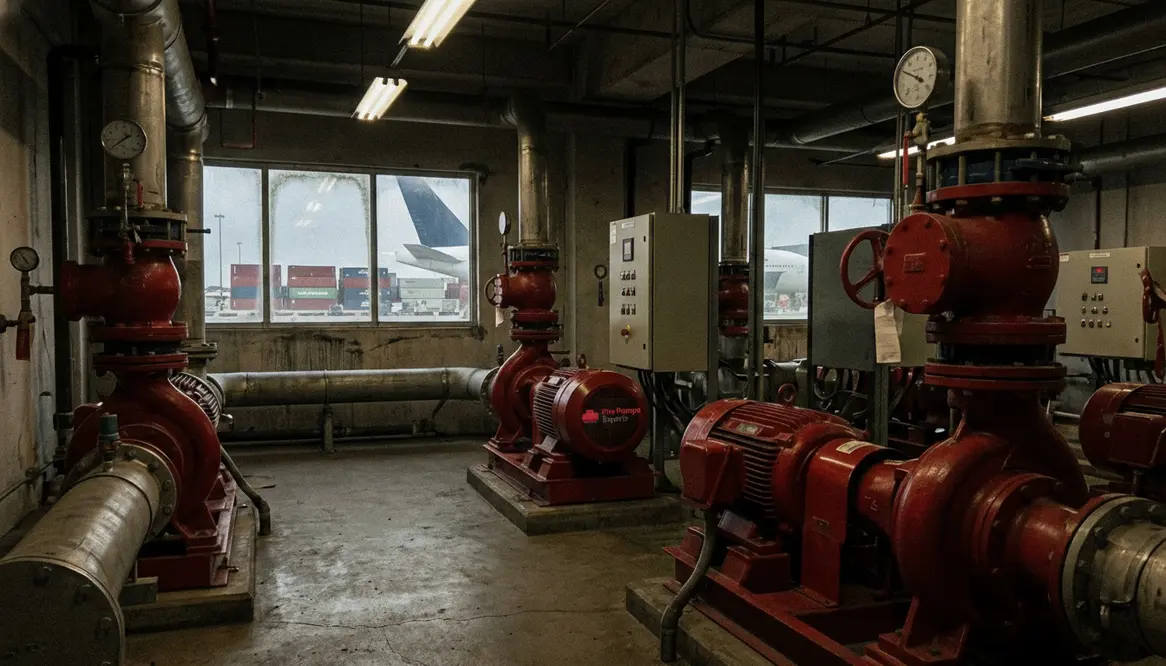
Fire Protection for Airport Cargo Operations
I have spent years walking the echoing corridors of airport cargo facilities, where the hum of machinery never quite sleeps. And right there, beneath the steel and concrete, sits a quiet hero that rarely gets applause. Fire protection for cargo handling operations is not just a requirement. It is a promise. A promise that when things go wrong, and they do, the system responds faster than panic can spread. Now, if that sounds dramatic, well, it should. Fire does not wait for paperwork.
Why airport cargo facilities demand specialized fire pump systems
Airport cargo buildings are not your average warehouse. They store high value goods, hazardous materials, and tightly packed inventory that can turn a small spark into a headline. Because of this, I always recommend fire pump systems designed for high demand and rapid response.
Moreover, these facilities operate around the clock. Therefore, reliability is not optional. A properly engineered fire pump ensures consistent pressure even when multiple suppression systems activate at once. Think of it as the difference between a garden hose and a hydrant. One waters your lawn. The other saves your building.
And yes, I have heard someone say, “What are the odds of a fire?” Well, the odds are low until they are not. Just ask any action movie villain who underestimated the situation.
How do fire pump requirements differ for cargo handling operations?
In airport cargo environments, fire pump requirements go beyond basic compliance. I always focus on three key elements.
First, flow capacity. Large open spaces and high storage racks require significant water volume. This ensures sprinkler systems reach every corner without delay.
Second, redundancy. Backup pumps are essential. If one fails, another takes over instantly. No drama. No downtime.
Third, integration. Fire pumps must work seamlessly with alarm systems, foam suppression setups, and emergency controls.
Because of these factors, Fire protection for cargo handling operations becomes a coordinated system rather than a single piece of equipment. It is more orchestra than solo act.
Fire protection for cargo handling operations in high risk zones
Not all areas inside a cargo facility carry the same level of risk. Some zones require extra attention, and I treat them accordingly.
Hazardous material storage
These areas often require foam based suppression systems paired with high capacity fire pumps. Water alone will not always do the job.
Aircraft adjacent zones
Fuel presence raises the stakes. Therefore, rapid pressure delivery and precise control become critical.
Automated storage systems
Dense vertical storage limits access. Strong pump pressure ensures water penetrates deep into stacked goods.
Loading docks
Constant movement increases ignition risk. Reliable pump activation ensures immediate response without delay.
Each zone has its own personality. Some are calm. Others are just waiting for an excuse to cause trouble.
Design considerations I never overlook in airport facilities
When I approach a fire pump design, I think beyond code compliance. Codes set the floor, not the ceiling.
First, I evaluate peak demand scenarios. What happens when multiple systems activate simultaneously? The pump must handle that without hesitation.
Next, I look at power supply. Electric pumps are efficient, but diesel backups add resilience. And in an airport setting, resilience is everything.
Then, I consider maintenance access. A fire pump that cannot be easily serviced is like a sports car with no doors. Impressive, but not very useful.
Finally, I factor in future expansion. Cargo facilities grow. Systems must grow with them. Otherwise, today’s solution becomes tomorrow’s problem.
Fire protection for cargo handling operations and compliance standards
Regulations for airport cargo facilities are strict, and for good reason. I regularly work with standards such as NFPA 20 for fire pumps and NFPA 13 for sprinkler systems. However, compliance alone is not enough.
Authorities often require additional safeguards based on cargo type and facility size. Therefore, I make sure systems exceed minimum thresholds. It is always better to have capacity you never use than to need capacity you do not have.
And let us be honest, inspectors have seen everything. Cutting corners is not just risky. It is obvious.
Common mistakes I see in cargo facility fire pump setups
Even well funded projects can get this wrong. I have seen it more times than I would like.
One major mistake is undersizing the pump. It may pass initial checks, but it struggles under real conditions.
Another issue is poor system integration. Pumps that do not communicate with alarms or suppression systems create dangerous delays.
Finally, neglecting testing routines is a silent risk. A fire pump must be tested regularly. Otherwise, you are trusting equipment that has not proven itself.
It reminds me of owning a smoke detector with no batteries. Technically present. Practically useless.
FAQ: Fire Pump Requirements for Airport Cargo Facilities
Conclusion
If you manage or design airport cargo facilities, you already know the stakes are high. I encourage you to invest in fire pump systems that go beyond minimum standards and truly protect your operation. Strong design, reliable equipment, and regular testing make all the difference. When the unexpected happens, and it will, you want a system that responds instantly and performs without compromise. Reach out to experts who understand large scale commercial fire protection and get it right the first time.