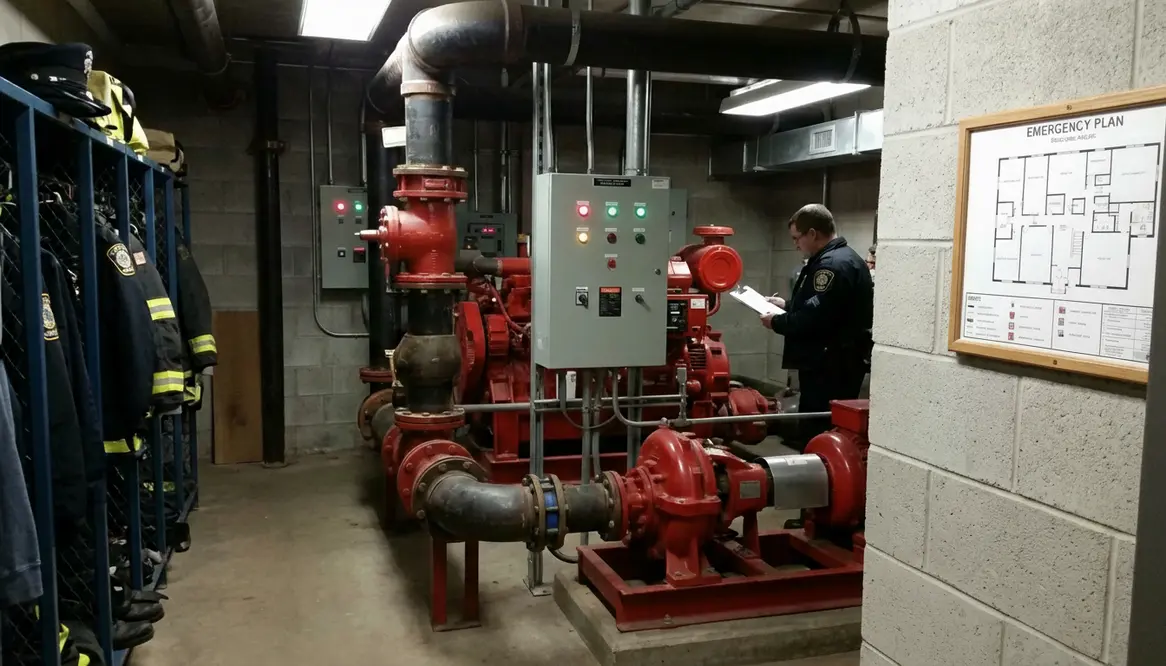
Fire Pump Systems for Police Stations Safety
I have walked through enough public safety buildings to know one truth. When seconds matter, systems matter more. That is why I always bring the conversation back to Fire Pump Systems for Police Stations. These facilities never sleep. Officers move in and out at all hours, evidence rooms stay locked tight, and dispatch centers hum like a heartbeat. So, fire protection cannot be an afterthought. It has to be precise, reliable, and ready to perform without hesitation. Think of it as the silent partner that never calls in sick.
Why fire protection in public safety facilities demands more than standard systems
Public safety buildings carry a unique risk profile. On one hand, they store sensitive equipment and critical records. On the other, they serve as operational hubs during emergencies. Therefore, fire protection must go beyond basic compliance. I always recommend layered systems that combine detection, suppression, and pressure control.
Moreover, these facilities often operate under strict municipal codes. Because of that, fire pump performance must align with both local regulations and national standards. It is not just about passing inspection. It is about ensuring continuity during real world emergencies. And yes, if a system fails, there is no dramatic movie music to warn you. Just silence, which is far worse.
How do fire pump systems support police stations during emergencies?
Fire pump systems act as the backbone of water based fire suppression. In police stations, they ensure consistent water pressure even when municipal supply drops. That matters during peak demand or infrastructure strain.
Additionally, these systems support sprinkler networks across holding areas, administrative offices, and secure storage zones. Without adequate pressure, even the best sprinkler design becomes ineffective. So, I treat fire pumps as the engine behind the entire safety strategy.
Furthermore, modern systems include monitoring technology. This allows facility managers to detect issues before they become failures. It is a bit like having a watchful guard who never blinks, minus the coffee breaks.
Design priorities that actually make a difference
When I evaluate fire protection strategies, I focus on design choices that directly impact performance. Not all systems are created equal, and in high demand environments, details matter.
Core Design Elements
- High capacity pumps matched to building demand
- Redundant power sources for reliability
- Corrosion resistant materials for longevity
- Smart controllers for real time monitoring
Operational Benefits
- Stable pressure during peak usage
- Reduced risk of system failure
- Lower maintenance interruptions
- Faster emergency response readiness
Because these elements work together, they create a system that performs under pressure, literally and figuratively. And while that might sound like a superhero origin story, it is really just good engineering.
Fire Pump Systems for Police Stations and long term reliability
Reliability is not a feature. It is a requirement. I always stress the importance of routine testing and maintenance. Over time, even the strongest systems can degrade if ignored. However, with proper care, they can last for decades.
In addition, I look at how systems integrate with the rest of the facility. Fire pumps should not operate in isolation. They need to connect with alarms, backup generators, and building management systems. This creates a unified response during emergencies.
Interestingly, facilities that invest in proactive maintenance often see fewer disruptions. It is a bit like going to the dentist. Not fun, but far better than dealing with a crisis later.
What should facility managers prioritize when upgrading fire protection?
If I had to narrow it down, I would focus on scalability, compliance, and performance. Public safety facilities evolve over time. Therefore, fire protection systems must adapt without requiring a full overhaul.
Next, compliance remains non negotiable. Codes change, and systems must keep pace. That means working with experts who understand both current standards and future trends.
Finally, performance testing should guide every decision. A system that looks good on paper but fails under stress is not a solution. It is a liability. And in this line of work, there is no room for guesswork.
FAQ: Fire protection for public safety facilities
Conclusion: building safety that never sleeps
When I think about public safety facilities, I think about responsibility. These buildings protect communities, so their systems must do the same. Investing in strong fire protection is not optional. It is essential. If you are planning upgrades or building new infrastructure, now is the time to act. Explore advanced solutions, including Fire Pump Systems for Police Stations, and make sure your facility stands ready, no matter what comes through the door.