Fire Pump Multiple Water Sources Fresno Design Guide
I have spent years walking mechanical rooms that hum like quiet orchestras, and I can tell you this much: when water moves with purpose, buildings stay safe. Today, I’m talking about fire pump multiple water sources Fresno design for commercial and industrial facilities. In this part of California, water can arrive from more than one direction, and that sounds comforting until it isn’t. Because unless those sources are choreographed with care, your system can hesitate when it should roar. And hesitation, my friend, is not a good look during a fire.
Why multiple water sources change the game
In large facilities, I often see a mix of municipal supply, on site tanks, and sometimes a secondary well or reclaimed line. At first glance, more sources feel like a buffet. However, fire protection is not a buffet. It is a precision meal. Therefore, I design with one goal in mind: consistency under pressure.
When sources differ in pressure, reliability, and quality, the pump must know who is in charge. Otherwise, you risk backflow, pressure swings, or a pump that hunts like it is trying to find Wi Fi in a basement. So, I map each source, define priority, and then set controls that switch cleanly without drama.
How I design a fire pump multiple water sources Fresno system
I start with demand. I calculate the required flow and pressure for the worst credible fire event in that facility. Then, I match that demand to the strongest and most reliable source. After that, I build redundancy that actually works, not just looks good on paper.
Source hierarchy and transfer logic
Source hierarchy matters. I assign a primary supply, typically municipal if it is stable, and a secondary, often a dedicated tank. Next, I integrate automatic transfer logic. If pressure drops below a set point, the system shifts sources without hesitation. Think of it like a relay race where the baton never hits the ground.
Hydraulics and suction conditions
Hydraulics get equal attention. I size suction piping to avoid cavitation, because a pump that chews on vapor is about as useful as a screen door on a submarine. I keep velocities in check, and I design for net positive suction head so the pump always has a steady drink.
Controls, supervision, and visibility
Controls and supervision seal the deal. I specify controllers that monitor pressure, flow, and valve positions. I also require clear status signals to the building management system. Consequently, operators see issues early instead of reading about them in an incident report.
What equipment choices actually matter in complex supply setups
Pumps and drivers
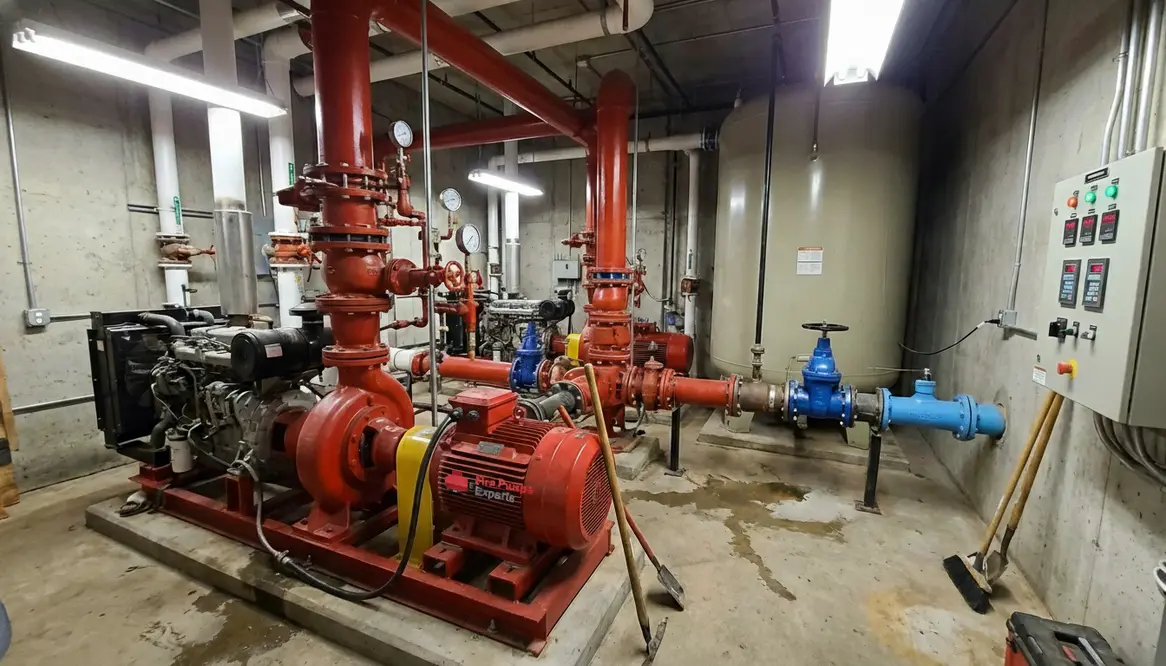
I choose pumps based on reliability first, then efficiency. Electric motor driven pumps work well where power is robust. However, in facilities with critical uptime, I often pair them with a diesel backup. That way, a grid hiccup does not turn into a headline.
Valves and test infrastructure
Valves are the unsung heroes. I use listed backflow preventers, check valves with low head loss, and isolation valves placed where humans can reach them without acrobatics. Additionally, I plan for testing. A test header or flow meter loop lets the team verify performance without guessing.
Storage tanks and conditioning
Storage tanks deserve respect. I size them for duration, not just peak flow. Moreover, I design fill controls that keep levels ready without cycling the supply into exhaustion. In Fresno’s climate, I also consider temperature and algae control, because biology never sleeps.
In many projects involving a fire pump multiple water sources Fresno layout, I treat the tank as both a buffer and a stabilizer, smoothing out the quirks of municipal pressure and seasonal variability.
Common pitfalls I see in Fresno facilities and how I avoid them
Overconfidence in municipal pressure
First, I see systems that rely too heavily on municipal pressure that looks great at 2 a.m. and not so great at 2 p.m. during peak use. Therefore, I validate supply curves with real data and build a buffer with on site storage.
Control logic that confuses operators
Second, I find control logic that is more complicated than a time travel movie. If it needs a whiteboard and three engineers to explain, it will fail at the worst time. I keep sequences simple, test them, and document them so operators can act with confidence.
Maintenance that lives only in a binder
Third, I encounter maintenance plans that live in a binder and nowhere else. I tie testing to schedules, alarms, and accountability. Consequently, the system stays ready instead of becoming a museum piece.
What does compliance look like for fire pump multiple water sources Fresno?
It looks like alignment with NFPA 20 for installation, NFPA 25 for inspection and testing, and local amendments that reflect Fresno’s conditions. I coordinate with the authority having jurisdiction early, because surprises belong in movies, not inspections.
I document everything. Calculations, drawings, sequences, and test results. Moreover, I make sure signage is clear and durable. When a technician walks in at 3 a.m., they should not need a treasure map to find the right valve.
When you are standing in a mechanical room built around a fire pump multiple water sources Fresno configuration, clean documentation and labeling often make the difference between a quick, confident response and a long, nervous phone call to someone who is asleep.
At a glance: design priorities and field checks
Design priorities
- Define a clear primary and secondary water source
- Ensure stable suction conditions for the pump
- Use simple, fail safe control logic
- Provide adequate on site storage duration
- Plan accessible valves and test points
Field checks I perform
- Verify actual pressures across different times of day
- Confirm automatic source transfer works under load
- Test alarms and status signals to BMS
- Run full flow tests and record curves
- Inspect tank levels, fills, and turnover
FAQ
Bringing it all together
When I design these systems, I aim for something almost invisible. Not because it hides, but because it simply works, every time, without fuss. If your facility in Fresno depends on multiple water sources, I can help you shape a system that behaves like a seasoned professional, not an improv act.
If you want a deeper technical reference on fire pumps and related standards, one useful resource is https://firepumps.org. Combine that kind of guidance with site specific data, clear priorities, and a fire pump multiple water sources Fresno strategy, and your building stands a much better chance of staying calm when everything around it is not.