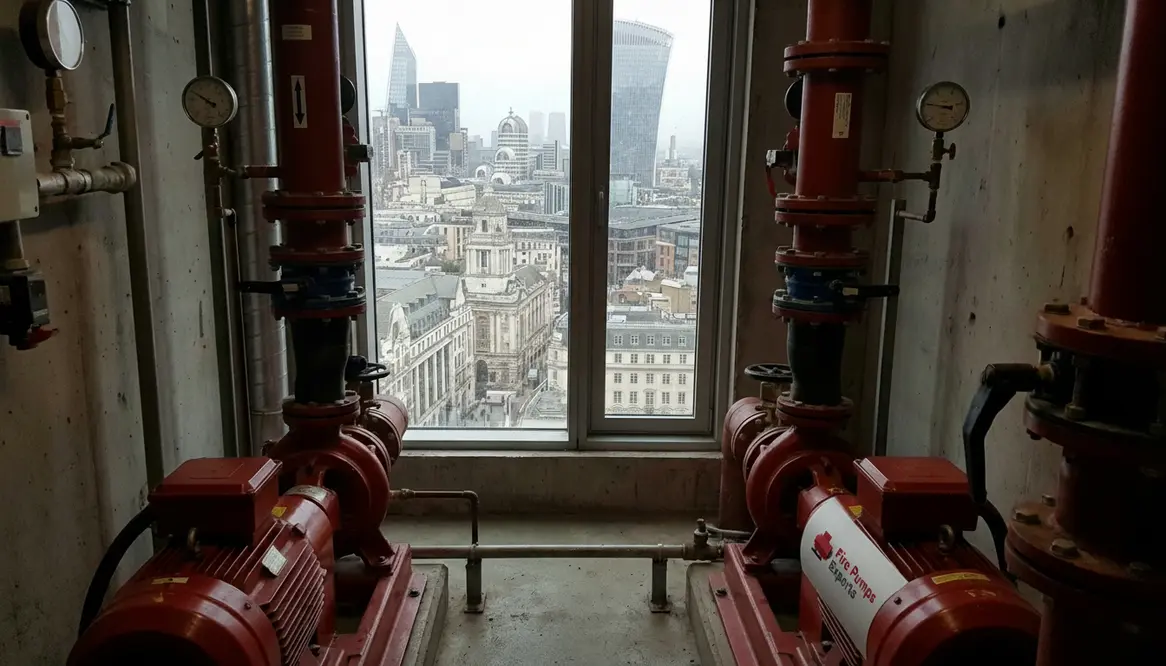
Fire Pump Urban London Buildings Design Guide
I have spent years around complex building systems, and I can tell you this: when it comes to fire pump urban London buildings, there is no room for guesswork. London rises upward and outward at the same time, stacking people, commerce, and risk into tight vertical spaces. And while the skyline may look elegant, the demands behind those walls are anything but simple. So today, I am walking you through how I approach fire pump selection in these dense environments, with a calm head, a sharp eye, and yes, the occasional raised eyebrow when things get unnecessarily complicated.
Understanding the Real Demands of High Density London Buildings
First, I always start with context. London buildings are not just tall. They are layered with mixed uses, historic constraints, and modern expectations. Therefore, I consider water supply variability, pressure loss across height, and the sheer demand during peak occupancy.
In many commercial towers, simultaneous system demand is not a theory. It is a certainty. Offices, retail spaces, and industrial facilities often operate together. As a result, I size pumps not just for code compliance, but for realistic worst case scenarios.
And yes, I have seen designs that look perfect on paper but struggle in real life. That is a bit like casting a superhero who cannot run. Impressive suit, wrong outcome.
How Do I Size a Fire Pump for High Rise Performance?
I approach sizing with precision. First, I calculate required flow and pressure based on the building’s highest risk zones. Then, I factor in elevation, friction loss, and system redundancy.
However, I do not stop there. London infrastructure can be unpredictable, so I always account for fluctuations in incoming water supply. Consequently, I often recommend split systems or boosted configurations to maintain steady performance.
Key considerations I always include:
- Maximum building height and vertical zoning
- Sprinkler and standpipe demand overlap
- Water storage capacity and refill rates
- Future expansion potential
Because if there is one thing developers love, it is changing plans halfway through. Keeps everyone awake.
Fire Pump Urban London Buildings Design Constraints I See Most
Space is always tight. Always. Therefore, I prioritize compact pump layouts without sacrificing accessibility. Maintenance teams need room to work, not perform gymnastics.
Additionally, noise control matters more than people expect. In mixed use developments, a poorly isolated pump can turn into an unwanted nightclub bassline. Not ideal at 3 AM.
Power supply is another constraint. I often evaluate both electric and diesel options, sometimes integrating both for redundancy. Each choice depends on building use, risk profile, and regulatory expectations.
Choosing Between Electric and Diesel Pumps Without Guessing
|
Electric Pumps Efficient and clean Lower maintenance requirements Dependent on reliable power supply |
Diesel Pumps Independent operation during outages Higher maintenance needs Requires ventilation and fuel storage planning |
In London, I often lean toward electric systems when infrastructure supports them. However, I never ignore risk. If power reliability is questionable, diesel becomes more than a backup. It becomes essential.
Compliance and Standards That Actually Matter
I always align with British Standards and local authority requirements. However, compliance alone is not the finish line. It is the starting point.
For example, I look closely at testing accessibility, monitoring systems, and long term reliability. Because a system that passes inspection but fails during an emergency is about as useful as a locked fire exit.
Moreover, I coordinate with fire engineers early. This prevents costly redesigns later. And trust me, nothing slows a project down faster than realizing your pump room cannot physically fit the equipment you approved months ago.
Fire Pump Urban London Buildings Installation Strategy
Installation is where theory meets reality. Therefore, I stay involved beyond design. I review layouts, ensure proper alignment, and confirm that vibration control measures are in place.
Additionally, commissioning is critical. I verify flow rates, pressure consistency, and system response times. If something feels off, I investigate immediately. Because small issues tend to grow, and they rarely do so quietly.
And yes, I have seen installations where someone thought “close enough” was acceptable. It never is.
Future Proofing Without Overengineering
Designing for tomorrow’s risks
I believe in balance. Overengineering wastes resources, while underdesign creates risk. So I plan for scalability where it makes sense.
This might include space allocation for additional pumps, adaptable control systems, or flexible piping layouts. As a result, buildings can evolve without requiring full system replacement.
London is constantly changing. Your fire protection system should be ready to keep up, not struggle to catch its breath. That is why I treat the phrase fire pump urban London buildings as more than a keyword; it is a reminder that density, height, and heritage all collide in one demanding environment.
Whether I am reviewing a retrofit of a heritage block or a new glass tower on the skyline, I apply the same mindset: anticipate change, respect constraints, and size every fire pump urban London buildings installation as if the worst day is guaranteed to arrive.
FAQ
Below are some of the questions I am asked most often when working on fire pump urban London buildings across high rise and mixed use developments.
Final Thoughts and Next Steps
If you are planning or upgrading a system for a major commercial property, do not treat fire pump selection as a checkbox exercise. I approach every project with precision, foresight, and a healthy respect for what can go wrong. If you want a system that performs when it matters most, now is the time to get it right. Reach out, and let us design something that stands strong when everything else is under pressure, especially in the demanding context of fire pump urban London buildings where height, density, and regulation all meet in one place.