EN 12845 Fire Pump Requirements Guide
EN 12845 Fire Pump Requirements Explained
If I am protecting a commercial plant, a warehouse, or a major property building, I do not treat fire pumps like background equipment. I treat them like the quiet giant in the room. EN 12845 requirements set the rules for how those pumps should perform, how they should be installed, and how they should support a sprinkler system when the heat is on. In plain terms, the standard helps me make sure water gets where it must, fast and with enough pressure. That matters because, in a fire, “almost enough” is just a polite way of saying “not enough.”
Why this guide matters
A sprinkler system can look perfect on drawings and still fail on the day it is needed. EN 12845 requirements give a framework so the pump, water supply, and controls behave properly under stress, not just under test conditions.
What EN 12845 Fire Pump Requirements Mean in Practice
When I work through EN 12845 requirements, I focus on function first. The system must supply the sprinkler design demand without drama, delay, or weak pressure. The pump must match the building risk, the water source, and the expected flow demand. In a big facility, that means I cannot just bolt in a pump and hope for the best like some action movie hero waiting for the steam to clear.
The standard also looks at redundancy. So, if one pump fails, the system still has a path forward. That is why many commercial and industrial sites use duty and standby arrangements. Also, the water supply must be reliable enough to support the full system for the required duration. I always treat that as the backbone of the whole setup.
Key performance ideas from the standard
- Sprinklers receive enough water, at enough pressure, for long enough.
- The water source and pump arrangement tolerate single-point failure where required.
- Controls and alarms tell me what the system is doing, instead of leaving me guessing.
How I Size a Fire Pump for a Commercial Site
First, I look at the sprinkler design data. Then I check the water source, the required pressure, the flow rate, and the site layout. After that, I compare the building’s hazard level with the pump duty point. This is where EN 12845 requirements become very practical. They do not ask me to guess. They ask me to prove the system will do the job.
Simple checklist I run through
- Required sprinkler flow and pressure
- Water tank size or stable supply source
- Pump performance at the duty point
- Backup supply and pump arrangement
- Control system and alarm signals
Also, I make sure the pump does not sit too close to the edge of its working range. If it does, the system can look fine on paper and still misbehave in real life. Nobody wants a fire pump that acts like it is auditioning for a role in a disaster film.
Common sizing mistakes
- Chasing catalog curves instead of the real duty point
- Ignoring future expansion of the system
- Forgetting elevation differences across large sites
Habits that actually help
- Verifying hydraulic calculations against real pump curves
- Allowing for voltage drop and motor performance
- Documenting the chosen duty point where everyone can find it
What EN 12845 Requires for Pump Installation
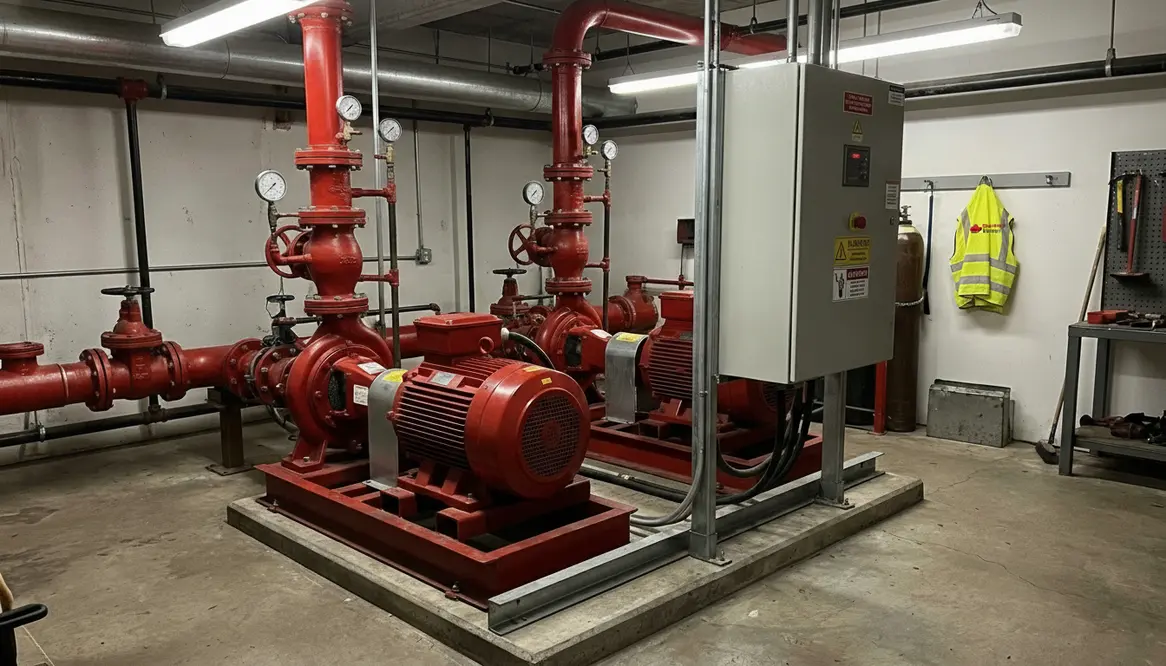
Installation matters as much as pump selection. I need the pump room to stay accessible, protected, and dry. The controls must be easy to reach, and the pipework must support smooth flow with low loss. I also want enough space for inspection and maintenance, because a cramped pump room turns simple service into a wrestling match.
Dual view: design and operation
| Design focus | Operational focus |
| Match pump size to sprinkler demand | Confirm the pump starts when needed |
| Keep suction conditions stable | Monitor alarms and pressure readings |
| Provide suitable backup support | Test the system on a set schedule |
In addition, I pay close attention to suction arrangement and water supply quality. A pump can only perform well if it gets steady feed water. So, the installation has to avoid air leaks, poor layout, and avoidable pressure loss. That is not fancy engineering talk. That is just good sense with serious consequences.
Installation points I never ignore
- Clear access routes to the pump room
- Non-flood-prone pump location where practical
- Properly supported suction and discharge pipework
- Ventilation that suits the drive arrangement
How I Test and Maintain EN 12845 Fire Pumps
I never treat testing as a box ticking game. Regular checks keep the system honest. The pump must start automatically, reach the right pressure, and keep running as expected. Then I confirm alarms, power supply, and any transfer functions. If the pump starts acting strange, I want to know before the building does.
Maintenance also keeps compliance alive. Over time, seals wear, valves drift, and controls age. Therefore, I review the pump room, pressure settings, power source, and water supply on a planned schedule. I also document every test. Records matter because they show the system has not been left to meditate in the corner for six months.
Typical test plan highlights
- Routine start tests with results logged
- Verification of starting method and power supply condition
- Checking alarm reporting and signal paths
- Review of visible leaks, vibration, and noise changes
Where to Get Help With EN 12845 Requirements
If I manage a commercial or industrial property, I do not try to improvise fire pump compliance. I use a specialist who understands the standard, the building risk, and the site conditions. That is where trusted support makes the process much smoother. For more guidance, I recommend reviewing EN 12845 fire pump requirements for commercial and industrial facilities. It can help me line up design, installation, and long term care without wasting time or money.
Good support turns EN 12845 requirements from a checklist into a working strategy. It keeps the focus on how the pump behaves under real fire conditions, not just how it looks in a specification table.
FAQ
Conclusion
If I want real fire protection, I do not leave pump compliance to chance. I make sure the design, installation, testing, and upkeep all align with EN 12845 requirements. That gives my commercial or industrial site a far better chance of performing when it counts most. So, if I am planning a new system or reviewing an old one, now is the time to act, check the details, and make the pump room work as hard as the building itself.