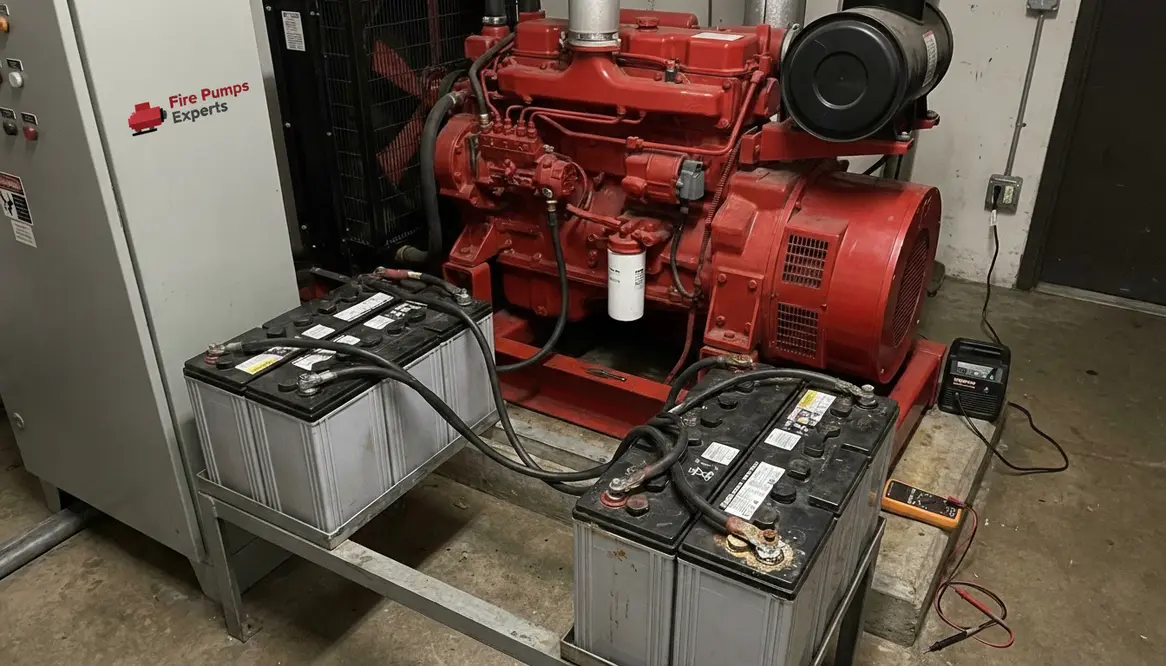
When I look at a diesel fire pump that fires up on one diesel fire pump battery bank but stays stubborn on the other, I do not guess. I trace the problem with care. In a fire pump battery system, both banks should act like twins at a black tie event, dressed the same and ready to perform. When one bank works and the other fails, the issue usually lives in charging, wiring, bad cells, loose terminals, or a control problem inside the diesel fire pump starting circuit. In commercial and industrial buildings, that matters fast, because the pump must start when the system needs it most.
For facilities that protect large properties, hospitals, warehouses, high rise buildings, and plant sites, I treat this as a serious reliability issue. The pump may still seem fine during a normal test, yet one weak bank can turn a routine start into a failure. That is where the real story begins.
I start with the simple things, because the simple things cause plenty of drama. First, I check the voltage on both banks under rest and under load. Then I inspect each battery for swelling, corrosion, low fluid level if the battery type allows it, and loose cable ends. After that, I test the charger on both sides. One bank may charge fully, while the other quietly sits there like it is waiting for a plot twist.
Next, I look at the selector switch, crossover wiring, and the starting contactors. If the pump starts from one bank only, the problem may not even be the battery itself. It may be the path between the battery and the starter. A clean battery can still fail if a cable has high resistance or if a terminal has hidden damage. Electricity, as usual, enjoys a bit of mischief.
The reason one side works and the other does not often comes down to uneven wear. Batteries age at different rates. A bank that runs hotter, sits under a weak charger, or lives with a poor connection will wear out faster. Also, one bad battery in a series string can drag the whole bank down. So even if most of the bank looks healthy, one weak unit can ruin the start.
Sometimes the real issue sits in the charger. If the charger on one side undercharges, that bank never reaches the right state. If it overcharges, the bank may dry out or fail early. Either way, the pump starts acting like it is auditioning for a movie scene it did not rehearse for. In a fire protection system, I never let that slide.
I use a clear process. First, I test the bank voltage. Then I perform a load test. After that, I check cable resistance and verify that the starting motor pulls proper current. I also compare both banks side by side, because the best clue is often the difference between them.
Battery Bank A
Starts the pump cleanly
Shows proper charge voltage
Delivers stable current under load
Battery Bank B
May show weak voltage
May drop fast under load
May have a bad cell or bad connection
That side by side check saves time. It also keeps me from blaming the wrong part. And in fire pump service, the wrong part can cost more than money. It can cost confidence in the entire system.
When I service a diesel fire pump battery system for a commercial or industrial site, I focus on the whole start chain. That means batteries, charger, terminals, cables, control panel, starter, and engine cranking speed. I also verify that the setup matches the manufacturer guidance and the site’s fire protection needs.
If a facility wants a deeper system review, I would point them to a trusted https://kordfire.com/fire-pump/ los angeles fire pump service resource for local support and to diesel electrical system support for related power issues. For buildings with sprinkler integration, I also recommend reviewing fire sprinkler service options so the full protection system stays aligned. A fire pump does not like being the only adult in the room.
I replace batteries when they fail load testing, show uneven cell performance, or cannot hold charge after a proper charge cycle. I replace damaged cables when resistance stays high after cleaning and tightening. I also replace a charger that cannot maintain both banks evenly. At some point, testing turns into hope, and hope is not a maintenance plan.
If the starter or control relay shows signs of heat damage, I replace that too. The goal is simple. I want both banks to deliver equal confidence, not one hero bank carrying the whole show while the other bank takes a nap.
Usually one bank has a weak battery, bad connection, bad charger, or wiring issue in the diesel fire pump battery system.
Yes. A damaged cable or a terminal with hidden damage can block enough current to stop the start, even when the battery looks fine at rest.
Yes. They should show similar voltage, charge performance, and load performance, so your diesel fire pump battery banks behave like dependable twins under demand.
Yes. A weak or uneven charger often causes one bank to fail load testing. If it undercharges or overcharges, the diesel fire pump battery will not deliver the cranking power you need.
I recommend regular checks during scheduled fire pump maintenance for commercial and industrial sites, with attention to the specific diesel fire pump starting circuit and any crossover wiring.
If your diesel fire pump starts on one bank but not the other, do not wait for the system to get dramatic. I would inspect the batteries, charger, cables, and starter path right away, then document the findings and fix the weak point fast. For commercial and industrial facilities, this is not just maintenance. It is readiness. If you want the fire pump battery system to answer the call every time, I suggest you act now and verify both battery banks before the next test day arrives.