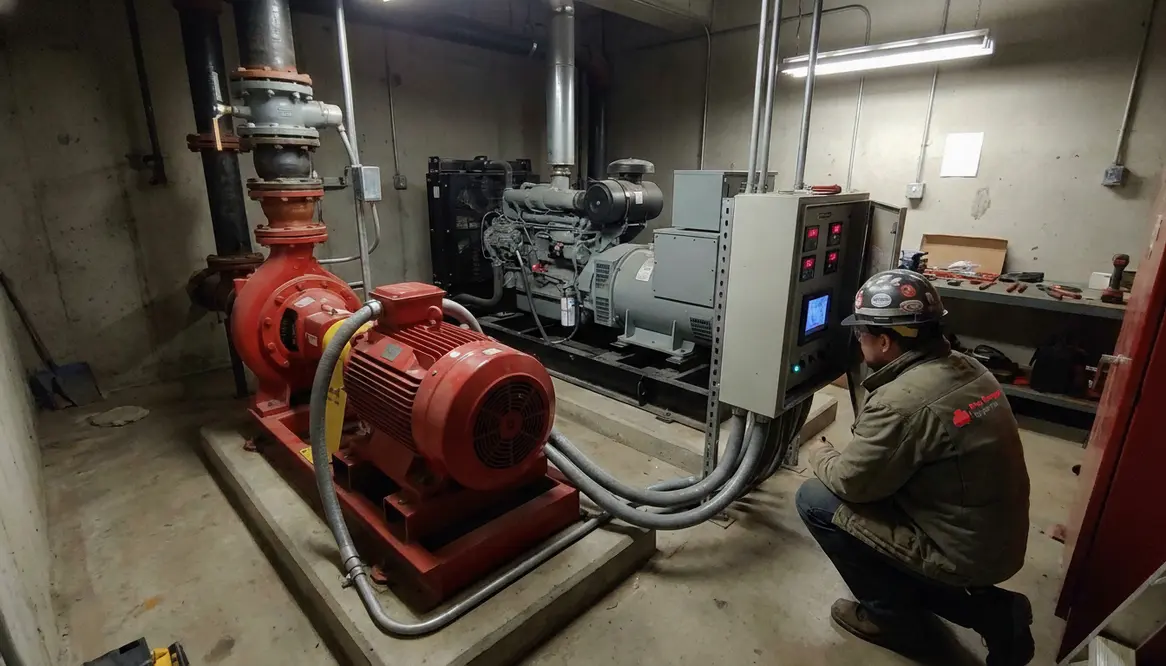
Starting Capacity Matters
Fire pump generator capacity problems during starting can turn a serious safety system into a nervous one fast. I have seen how a fire pump generator sizing mistake can trip up a whole building, and nobody wants that drama when seconds matter.
Emergency Power Should Feel Ready
When fire pump emergency power has to kick in, the system should feel calm and ready, not like it just woke up after a double shift. And yes, the fire pump motor can be a hungry beast during startup, so I focus on what really helps commercial and industrial facilities keep pressure steady when the load hits hard.
Think In Bursts
The hard part is not steady operation. It is the instant the motor asks for more power than the electrical system expects.
When I look at starting problems, I usually begin with the same truth: the fire pump motor demands a large burst of power at startup. That burst can pull voltage down fast. As a result, the generator may slow, the controller may complain, and the pump may fail to reach the speed needed for proper flow.
In commercial and industrial buildings, that moment matters. A fire pump is not a comfort item. It is the backup that stands between a small problem and a very expensive headline. If the generator cannot handle the starting current, the whole system can stumble.
Think of it like trying to start a freight train with a scooter battery. Cute idea. Bad outcome.
I start with the pump data, then I review the motor nameplate, controller type, and the generator response curve. That is the core of fire pump generator sizing. The goal is simple: the generator must support the starting surge without letting voltage and frequency fall too far.
In practice, I check these points:
- Motor starting current and locked rotor amps
- Voltage dip limits during start
- Generator kW and kVA capacity
- Load recovery time after start
- Any other loads tied into the same source
Also, I never ignore ambient conditions. Heat, elevation, and aging equipment can all trim generator output. So, a unit that looked fine on paper can get a little dramatic in real life. Paper is polite. Reality has opinions.
Fire pump emergency power must do one job very well: start the pump and keep it running without hesitation. Therefore, I look at the transfer path, starting method, and controller settings. I also check whether the emergency source serves only the pump or shares duty with other critical loads. Shared loads can create a bad hair day for the system.
Dual view of the starting problem
First, I think like the electrical side. The generator must deliver enough inrush power, keep voltage stable, and recover quickly after start.
Second, I think like the fire protection side. The pump must reach full operating speed fast enough to protect the building, even if the grid has already failed.
That balance matters most in major properties and industrial sites. A large warehouse, plant, or high rise cannot afford slow recovery or weak voltage.
For a useful overview of pump system planning, I also recommend reviewing los angeles fire pump system guidance as a reference point for commercial setups.
I reduce start trouble by controlling the system, not by hoping for luck. Hope is fine for lottery tickets. It is not a strategy for fire safety.
Here is what I usually do:
- Keep generator size aligned with actual motor demand
- Limit other connected loads during pump startup
- Use proper cable sizing to cut voltage drop
- Inspect controller settings and starting sequence
- Test the system under real load, not just no load
Moreover, I pay close attention to transient response. A generator may have enough steady power, yet still dip too much the instant the pump starts. That dip can cause nuisance alarms, stalled starts, or repeated attempts that waste time and stress equipment. I would rather see one clean start than three nervous ones.
I also look at maintenance history. Loose connections, weak fuel delivery, poor battery health, and old controls can all mimic a sizing problem. So, I do not blame the generator too early. Sometimes the issue is the system around it.
Testing tells the truth. Charts help, but live checks tell me what the building really gets. During service, I watch the start time, voltage behavior, frequency drop, and pump stability. If the motor starts hard or the generator hesitates, I dig deeper.
For larger facilities, I prefer routine checks that reflect real operating conditions. That means I want proof that the emergency source can carry the pump during a true outage. I also look at the broader fire and power setup, including coordination with electrical support equipment.
For that reason, I often compare notes with resources like commercial electrical services and sprinkler system support for major buildings when I review overall building readiness.