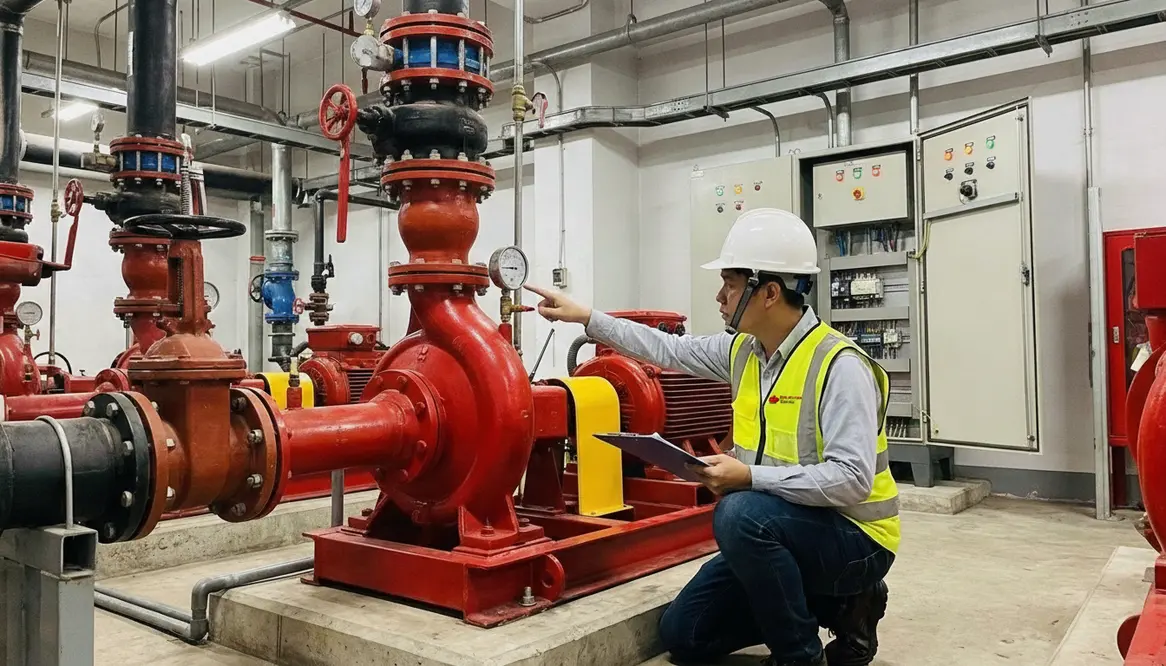
Fire Fighting Commissioning: Testing and Handover
A system that works under pressure
When I talk about fire fighting commissioning, I mean the point where a fire protection system stops being a bundle of parts and starts behaving like a real guardian. It is the final proof that pumps, pipes, valves, alarms, and controls all work together as one team. And yes, that team needs to perform under pressure, because in this business, “close enough” is just a fancy way of saying “not good enough.”
The bridge to handover
For commercial and industrial facilities, plus major property buildings, commissioning is where risk gets trimmed down and confidence goes up. I see it as the bridge between installation and handover. If that bridge is weak, the whole project starts to wobble.
No “mystery fittings”
This is not the time for mystery fittings or “we thought that was fine” moments. Those belong in sitcoms, not on a fire protection site.
What fire fighting commissioning checks first
I always begin with a full review of the design, the install, and the approved specs. This step matters because it tells me whether the system matches the job on paper before I ask it to prove itself in real life. Then I check the main parts one by one.
Here is what I focus on first:
- Pump set alignment and power supply
- Tank levels and water source reliability
- Hydrant and hose reel flow paths
- Valve positions, labels, and access
- Alarm signals, panels, and fault responses
After that, I confirm that each item is installed in the right place and ready for stress testing. This is not the time for mystery fittings or “we thought that was fine” moments. Those belong in sitcoms, not on a fire protection site.
How I test pumps, hydrants, and controls
Testing is the part where theory meets reality. I run the system under normal and peak load conditions, and I watch for pressure drops, flow issues, false alarms, and control failures. If one part slips, the whole response chain can slow down.
For pumps, I check start up, shutdown, churn pressure, duty performance, and standby changeover. For hydrants, I confirm pressure at the outlet and steady water delivery. For controls, I test the alarm panel response, fault indication, and automatic start functions. In other words, I make sure the system does not freeze when the moment gets serious.
Also, I always compare results with the project specs and the relevant standard. For a useful technical reference, I often point teams to the AS 2419 fire pump and hydrant performance guide. It helps keep everyone aligned with the numbers that matter.
Fire fighting commissioning for major property buildings
In large commercial and industrial sites, commissioning takes a deeper approach. A single test point does not tell the full story. I need to look at the whole network, because a tower, warehouse, or plant building behaves like a living system. One weak zone can affect the rest.
The split that keeps everything under control
Mechanical side
Pipe pressure, pump duty, valve sequence, water supply, and discharge performance.
Electrical side
Panel logic, power backup, alarm wiring, fault alerts, and auto start controls.
This split helps me catch problems fast. It also keeps the process neat, which is a pleasant surprise in a field where cables often look like they lost a fight with a blender.
What handover documents must include
Once testing passes, I move to handover. This step matters just as much as the tests, because a system without clear documents turns into a future headache. I want the facility team to know exactly what they have, how it works, and what to do next.
I prepare and review:
- Test records and pressure results
- As built drawings
- Equipment schedules and model details
- Maintenance guides and service intervals
- Training notes for site staff
- Compliance certificates and sign offs
If the records are clean, future servicing becomes easier. If they are messy, then every visit starts with detective work. And nobody wants to play Sherlock with a fire pump room at 7 a.m.
Where fire fighting commissioning can go wrong
I have seen the same few problems show up again and again. First, teams skip a proper pre test inspection and go straight to live testing. That saves time for about five minutes and creates trouble for weeks. Second, some sites forget to coordinate with building operations, so alarms trigger at awkward times. Nothing says “great morning” like an unexpected siren during a meeting.
Other common issues include air trapped in lines, poor valve labeling, low battery backup, and weak water supply. However, most of these problems show up early if I test with care and patience. That is why fire fighting commissioning is not just a box to tick. It is a controlled process that protects the building before the building ever needs to protect itself.
FAQ
Quick answers, because even the best fire fighting commissioning plan deserves clarity.
Conclusion
Good fire protection does not happen by luck. It happens when testing is careful, records are clear, and handover is complete. If you manage a commercial, industrial, or major property building, I recommend treating commissioning as a serious final step, not a quick formality. Build it well, test it fully, and hand it over with confidence. If you want a system that stands ready when it counts, now is the time to act. That is the real point of fire fighting commissioning: the part that turns promises into proof.