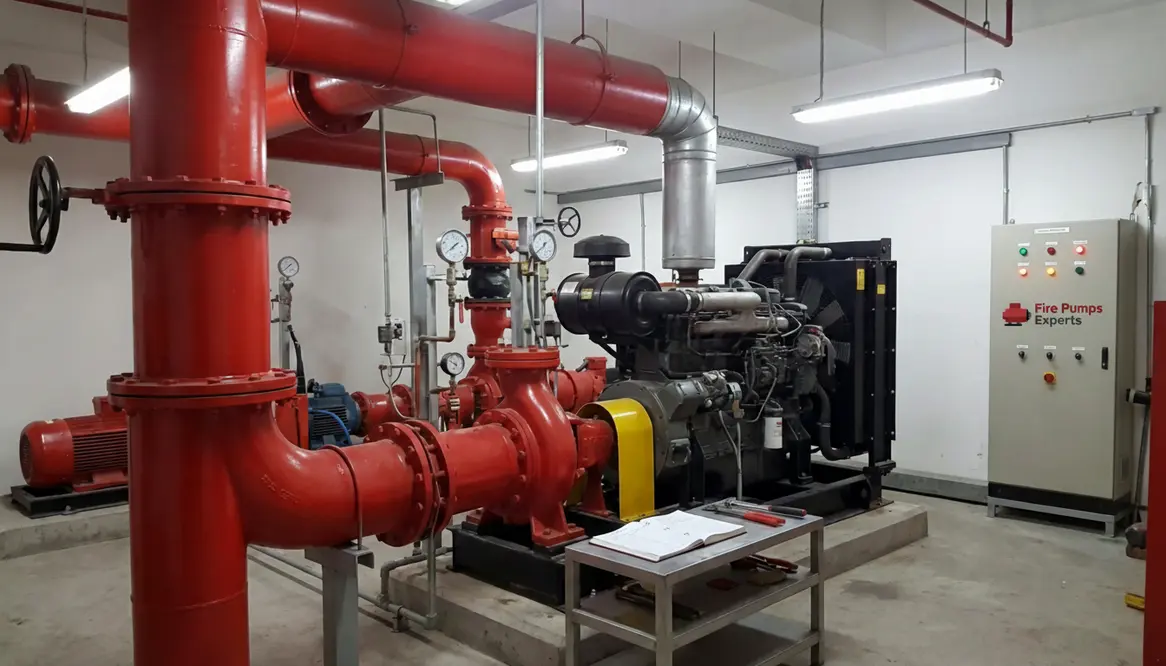
Commercial Office Park Fire Pump System Design
I have spent years around fire protection systems, and I can tell you this with calm certainty. When it comes to commercial office park fire pump systems, the difference between a smooth emergency response and a costly disaster often comes down to design decisions made long before anyone hears an alarm. In multi building office sites, the challenge is not just moving water. It is moving it intelligently, consistently, and without hesitation. And yes, much like assembling a superhero team, every component needs to show up ready to perform when the moment calls.
Understanding water demand across multiple buildings
First, I always look at demand. Not just one building, but the entire site working as a single living system. Each structure may have different hazards, sprinkler densities, and standpipe needs. Therefore, I calculate peak demand scenarios that could realistically occur at the same time. Because let us be honest, emergencies rarely RSVP in advance.
Additionally, I account for future expansion. Office parks grow. New tenants arrive with new risks. So I design capacity with a margin, ensuring the system does not age into obsolescence. In other words, I plan like someone who expects the unexpected, not like someone hoping it never happens.
How do I size a fire pump for a multi building office site?
I start with total flow and pressure requirements. Then I layer in friction loss across the entire underground loop. After that, I evaluate elevation differences between buildings, because water, much like people on a Monday morning, does not like climbing uphill without encouragement.
Moreover, I select a pump that operates efficiently near its rated capacity, not at the extreme edges. This ensures reliability during prolonged events. I also coordinate with municipal supply data, verifying whether the city can support baseline demand or if the pump must carry more of the load.
Finally, I consider redundancy. In larger campuses, I often recommend multiple pumps or backup drivers. Because one pump is good. Two pumps are peace of mind.
Designing underground loops that actually perform
The underground fire main is the silent backbone of the system. If it fails, everything else becomes decoration. So I design looped configurations instead of dead end lines whenever possible. This allows water to reach buildings from multiple directions, maintaining flow even if part of the system is compromised.
Furthermore, I carefully size piping to balance velocity and pressure loss. Too small, and friction eats your pressure. Too large, and costs climb without meaningful benefit. It is a balancing act, not unlike choosing the right coffee size. Go too small, regret it. Go too large, question your life choices halfway through.
I also integrate sectional valves. These allow maintenance or isolation without shutting down the entire campus. In a multi building site, downtime is not just inconvenient. It is unacceptable.
Commercial office park fire pump systems and control strategies
Control systems bring intelligence into the equation. I specify controllers that respond quickly to pressure drops while avoiding unnecessary cycling. Smooth starts and stable operation extend equipment life and improve reliability.
In addition, I integrate monitoring systems that feed data to facility teams. Real time alerts, performance trends, and remote diagnostics allow proactive maintenance. Because waiting for something to fail is a strategy best left in action movies, not in real facilities.
Key control features and benefits
Key Control Features I Prioritize
- Automatic start based on pressure thresholds
- Soft start or reduced voltage options
- Remote monitoring integration
- Clear status indicators for operators
Operational Benefits
- Reduced wear on pump components
- Faster response during emergencies
- Improved system transparency
- Lower long term maintenance costs
Power supply choices that keep systems alive
Power is where many designs quietly succeed or fail. I evaluate whether electric pumps, diesel pumps, or a combination best fits the site. Electric pumps offer efficiency and simplicity, while diesel units provide independence from the grid.
Therefore, in critical office parks, I often recommend a layered approach. If the grid goes down, the system should not shrug and call it a day. It should keep working without hesitation.
I also ensure fuel storage, ventilation, and testing protocols meet strict standards. Because a backup system that cannot start is just a very expensive paperweight.
Commercial office park fire pump systems and long term reliability
Design does not end at installation. I think about how the system will behave five, ten, even twenty years down the road. That means planning for testing access, maintenance clearances, and component replacement.
Additionally, I coordinate with facility teams to ensure they understand the system. A well designed pump setup is only as good as the people maintaining it. So I aim for clarity, not complexity.
And yes, I build in testing connections and flow measurement tools. Because guessing performance is not a strategy. Measuring it is.
FAQ: Fire pump design for multi building office sites
When planners start working through commercial office park fire pump systems, the same concerns come up repeatedly: capacity, reliability, and future expansion. These questions offer a quick reference for teams trying to avoid unpleasant surprises years down the line.
Final thoughts and next steps
Designing fire pump systems for multi building office sites is not about checking boxes. It is about creating a system that performs without hesitation when it matters most. If you are planning or upgrading a facility, now is the time to get it right. Reach out, ask the hard questions, and invest in a design that stands the test of time. Because in this field, reliability is not optional. It is everything.
Thoughtful planning, informed decisions, and clear communication turn commercial office park fire pump systems from a line item in a budget into a quiet, reliable guardian for every person who walks through those doors each day.