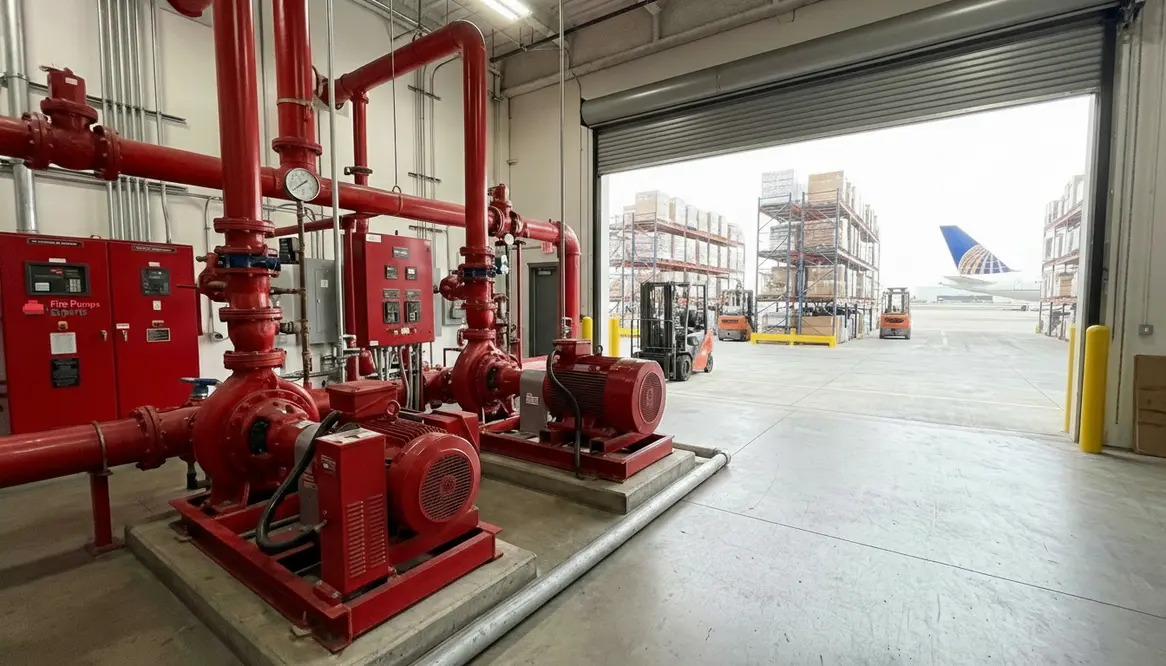
Fire Pump Design for Airport Warehouse El Segundo
I have spent years around industrial fire protection, and few environments demand more precision than facilities near active runways. When I design a fire pump airport warehouse El Segundo system, I know I am working in a place where logistics never sleep and risk never takes a coffee break. Between jet fuel in the air, high value inventory on racks, and tight compliance rules, every decision matters. So today, I am going to walk you through how I approach fire pump design for these unique warehouse spaces, with a calm, steady hand and just enough humor to keep things human.
Understanding Risk Near the Runway
First things first, proximity changes everything. Warehouses in El Segundo sit shoulder to shoulder with one of the busiest airports in the world. That means increased exposure to fuel transport, aircraft support equipment, and constant movement.
Because of that, I always start with hazard classification. High piled storage, flammable liquids, and dense logistics layouts all push systems toward higher demand. And yet, local water supply does not always cooperate. So I design as if the system must carry the load alone when things get serious.
Also, let’s be honest, nothing humbles a designer faster than a system that looked great on paper but struggles in the field. So I plan for real world pressure drops, not wishful thinking.
What Makes a Fire Pump System Work Here
I focus on reliability first, performance second, and efficiency third. In that order. Because a fire pump that saves energy but fails under pressure is about as useful as a screen door on a submarine.
Key components I prioritize
- Diesel or electric pumps: I often recommend diesel backups due to grid vulnerability near critical infrastructure
- Redundant controllers: Because one brain is good, two are better
- Seismic bracing: California does not play around
- Pressure maintenance pumps: To prevent nuisance starts and extend system life
In addition, I carefully match pump curves to system demand. Oversizing might sound safe, but it can create unstable pressure swings. And undersizing well, that is a risk I am not willing to take.
How I Design for Fire Pump Airport Warehouse El Segundo Compliance
Compliance is not just a checklist. It is a living framework that evolves with codes, inspections, and operational changes.
I align every design with NFPA 20 and NFPA 13 standards, while also accounting for California amendments and local authority requirements. However, I do not stop there. I coordinate with airport authorities when needed, especially when water supply or access routes intersect with aviation operations.
Moreover, I build systems that inspectors can understand quickly. Clean layouts, accessible valves, and labeled components make a huge difference. After all, in an emergency, no one wants to play hide and seek with a control panel.
Balancing Water Supply and System Demand
Water supply in El Segundo can be strong, but it is not infinite. So I evaluate flow test data carefully and design around realistic conditions.
Supply Side Focus
- Analyze municipal flow data
- Account for peak demand periods
- Plan for pressure fluctuations
- Include storage tanks when needed
Demand Side Strategy
- Calculate worst case sprinkler demand
- Factor in hose allowances
- Evaluate future expansion needs
- Maintain steady pressure curves
By balancing both sides, I create systems that perform consistently, not just under ideal conditions. And consistency is what keeps both property and people safe.
Can One Fire Pump Handle Future Expansion?
Short answer yes, but only if I plan for it from day one.
I often design with growth in mind because warehouses evolve. Storage gets denser, tenants change, and operations scale. So I leave room in the system for higher demand, either through pump capacity or infrastructure that supports adding another unit.
Think of it like casting a superhero franchise. You do not just plan for one movie. You plan for the trilogy.
Designing for Maintenance Without Disruption
A system that cannot be maintained easily will eventually fail. That is just reality.
So I create layouts that allow testing, inspection, and repairs without shutting down the entire facility. Isolation valves, test headers, and clear access paths are not optional extras. They are essential.
Furthermore, I coordinate with facility managers to align maintenance schedules with operational demands. Because in a logistics hub, downtime costs more than just money. It costs trust.
FAQ Quick Answers
These are the questions I hear most often when planning a fire pump airport warehouse El Segundo installation. Keeping them in mind early makes design and approvals a lot smoother.
Conclusion
If you are planning or upgrading a fire pump airport warehouse El Segundo system, I encourage you to take a thoughtful, forward looking approach. The right design protects more than assets. It protects continuity, reputation, and peace of mind. If you want a system that performs when it matters most, reach out and let’s design something that works as hard as your operation does.