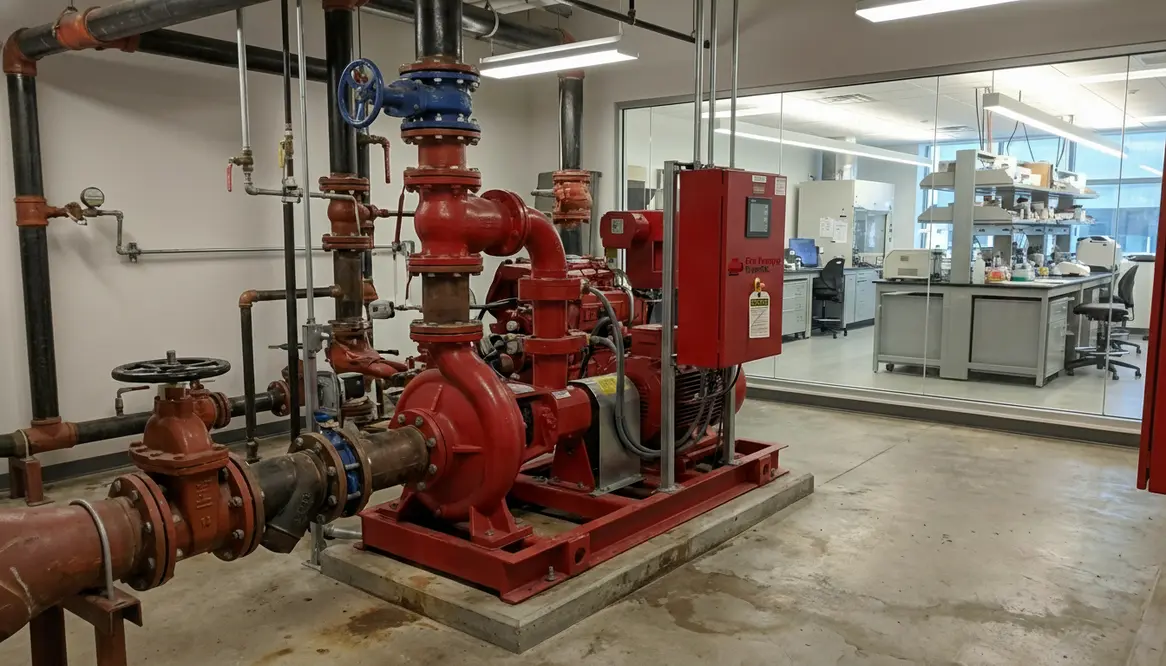
Fire Pump Design for Laboratory Campus Protection
I’ve spent enough time around laboratories and research facilities to know one thing for certain: these places are where brilliance meets risk. You’ve got volatile chemicals, sensitive equipment, and experiments that sometimes feel like they belong in a Marvel origin story. That’s exactly why commercial campus fire protection is not just a requirement, it’s a quiet guardian standing in the background. And at the heart of that system sits the fire pump, doing its job without applause, like a great bass player in a jazz band.
Why Laboratories Demand Specialized Fire Pump Systems
Laboratories are not your average office buildings. Instead, they operate with higher stakes and tighter tolerances. A small fire in a lab can escalate quickly due to flammable liquids, pressurized gases, and electrical equipment working overtime.
Because of this, I always emphasize that fire pumps in these environments must deliver consistent pressure and immediate response. Unlike standard buildings, labs cannot afford delays. Consequently, the pump system must handle sudden surges in demand while maintaining stability across multiple zones.
Moreover, redundancy becomes essential. If one component fails, another must step in without hesitation. Think of it like a backup singer who somehow hits the high notes even better than the lead. Not optional. Absolutely necessary.
What Fire Pump Capacity Does a Research Facility Need?
This is the question I hear most often, and the answer is both simple and nuanced. The required capacity depends on the size of the facility, the hazard classification, and the type of research conducted.
However, in most commercial and industrial research campuses, I look for systems that can support high demand sprinkler systems and specialized suppression setups simultaneously. Therefore, pumps often need higher flow rates and stronger pressure ratings than those in typical commercial buildings.
In addition, laboratories with hazardous materials may require systems that integrate with foam or chemical suppression. That means the pump must not only deliver water but do so in a way that supports hybrid fire protection strategies.
So while there’s no one size fits all answer, there is a consistent truth: undersizing a fire pump in a lab is like bringing a squirt gun to a dragon fight. It’s not going to end well.
Design Considerations That Actually Matter
When I approach fire pump design for laboratory settings, I focus on performance under pressure. Literally.
Here’s what I prioritize:
- Reliable power sources since outages cannot interrupt fire protection
- Corrosion resistant materials because chemicals in the environment can degrade components over time
- Advanced control systems that allow for precise monitoring and fast diagnostics
- Strategic placement to minimize response time across large campuses
Additionally, integration with broader commercial campus fire protection systems ensures everything works in sync. A fire pump alone is powerful, but connected to a well designed system, it becomes unstoppable.
Balancing Safety and Continuity in Active Research Spaces
Here’s the tricky part. Laboratories cannot simply shut down every time there’s a system test or maintenance check. Research timelines are tight, funding is tighter, and nobody wants to explain to investors why their breakthrough cure was delayed by a sprinkler test.
Therefore, I always recommend designing fire pump systems that allow for testing and maintenance without disrupting operations. This often includes bypass systems, sectional controls, and remote monitoring.
Meanwhile, automation plays a bigger role than ever. Smart controllers can detect issues early, reducing the need for intrusive inspections. It’s like having a security guard who never sleeps and never asks for coffee breaks.
Key Benefit
- Continuous protection without downtime
- Early detection of system issues
- Improved compliance with safety standards
- Reduced manual intervention
Impact on Facilities
- Research remains uninterrupted
- Lower risk of equipment damage
- Smoother inspections and audits
- Operational efficiency improves
Compliance and Codes Without the Headache
Let’s be honest. Fire codes are not exactly light reading. They’re dense, detailed, and about as relaxing as assembling furniture without instructions.
That said, laboratories and research facilities must meet strict standards, often exceeding typical commercial requirements. Therefore, I always align fire pump systems with national and local codes, as well as industry specific guidelines.
Additionally, documentation matters just as much as installation. Inspectors want proof, not promises. So keeping detailed records of performance tests, maintenance, and upgrades becomes part of the system itself.
In the end, compliance is not just about avoiding fines. It’s about ensuring that when something goes wrong, the system responds exactly as designed.
How I Future Proof Fire Pump Systems for Growing Campuses
Research campuses evolve constantly. New labs open, equipment changes, and risk profiles shift. Because of this, I never design a fire pump system just for today.
Instead, I build with expansion in mind. That means allowing room for increased capacity, modular upgrades, and integration with future technologies. Consequently, facilities can grow without needing a complete overhaul of their fire protection infrastructure.
And let’s face it, nobody wants to rip out a perfectly good system just because the campus added a new wing. That’s like replacing your entire kitchen because you bought a new toaster. Overkill, to say the least.
Campus-Wide Strategy For Commercial Protection
A single laboratory is challenging enough, but most research hubs operate as full campuses with multiple buildings, shared utilities, and interconnected life safety systems. That’s where campus-level planning for commercial campus fire protection changes from a technical task to a strategic one.
A well planned fire pump installation considers how water and pressure are distributed to every corner of the property, including future buildings that haven’t even made it out of the architect’s sketchbook. Looping mains, sectional valves, and clearly defined hydraulically remote areas all feed into how the pump is sized and controlled. When done properly, a single station can act as the backbone for a resilient commercial campus fire protection strategy without turning into an overcomplicated monster that nobody wants to operate.
FAQ: Fire Pump Needs for Laboratories
Conclusion
When I look at laboratories and research campuses, I see innovation wrapped in complexity. That’s why the right fire pump system is not optional, it’s foundational. If you’re planning or upgrading a facility, now is the time to invest in a solution that protects both people and progress. Connect with experts who understand commercial campus fire protection and build a system that works as hard as your team does every single day.