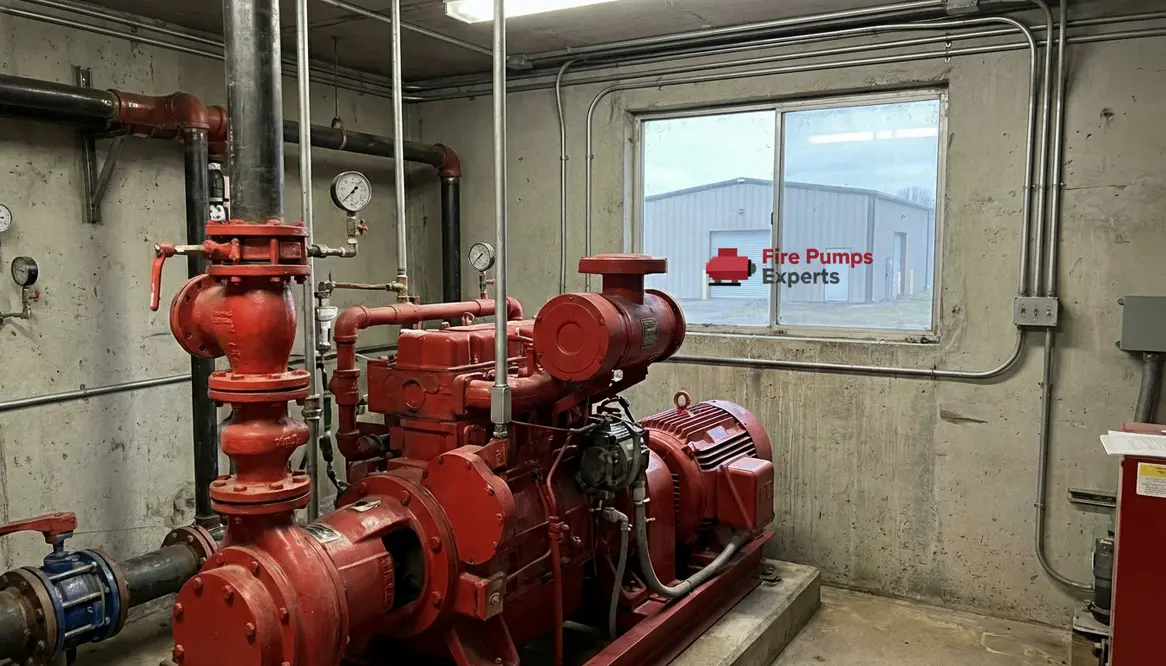
Fire Pump Requirements for Detached Commercial Buildings
I have spent years around complex fire protection systems, and I can tell you this right away: when it comes to detached commercial buildings, the margin for error is slim. Whether I am reviewing plans for warehouses, industrial yards, or even projects involving correctional facility fire pumps, the same truth applies. Water must move fast, pressure must hold steady, and systems must perform without hesitation. Because when a fire starts, nobody gets a second draft.
So let’s walk through what really matters in fire pump requirements for detached commercial buildings, without the fluff, and with just enough personality to keep you awake.
What Fire Pump Requirements Apply to Detached Commercial Buildings
When I assess a detached commercial structure, I immediately look at water supply reliability. If municipal pressure cannot meet demand, a fire pump becomes non negotiable. In fact, most codes, including NFPA 20, require a pump when flow and pressure fall below system needs.
However, it is not just about adding a pump and calling it a day. I focus on three essentials:
Flow demand: The system must support sprinkler density and hose allowance simultaneously.
Pressure requirements: The highest and most remote point still needs adequate pressure.
Redundancy: Because systems fail, and fire does not wait politely.
Additionally, detached buildings often lack shared infrastructure. Therefore, each structure must stand on its own. No borrowing pressure from the neighbor like it is a cup of sugar.
How I Determine the Right Fire Pump Setup
Now, here is where things get interesting. Selecting the right fire pump is part science, part experience, and a little bit of healthy skepticism.
I typically evaluate site conditions first. For example, elevation changes can quietly sabotage pressure calculations. Then, I match pump type to demand.
Common Pump Types I Use
- Electric driven pumps for stable power environments
- Diesel driven pumps for backup reliability
- Vertical turbine pumps for underground water sources
Key Design Considerations
- Available water supply consistency
- Distance from water source
- System pressure loss over long pipe runs
Moreover, I always plan for real world conditions. Because on paper, everything works beautifully. In reality, someone forgets to open a valve, and suddenly your perfect design is starring in a disaster movie.
Why Detached Buildings Demand Independent Fire Protection
Detached commercial buildings create a unique challenge. Unlike connected structures, they cannot rely on shared fire protection infrastructure. As a result, I treat each building like its own ecosystem.
For instance, long distances between buildings can cause pressure drops that compromise sprinkler performance. Therefore, dedicated fire pumps become essential, not optional.
In projects involving correctional facility fire pumps, this independence becomes even more critical. Security constraints often limit access, which means systems must operate flawlessly without constant human intervention.
Additionally, emergency response times may vary depending on site layout. So I design systems that can hold the line until help arrives. Think of it as giving the building its own firefighting muscle.
Power Supply and Reliability Planning
Let me be blunt. A fire pump without reliable power is just expensive decoration.
That is why I always build redundancy into power sources. Electric pumps are efficient, but they depend on grid stability. Therefore, I often pair them with diesel backups or generators.
Furthermore, I consider automatic transfer switches essential. Because in an emergency, no one wants to flip switches manually like they are in an old Frankenstein movie.
I also review fuel storage, maintenance access, and testing protocols. A pump that cannot be tested regularly is a liability waiting to happen.
Installation and Layout That Actually Works
Even the best equipment fails if installed poorly. So I pay close attention to layout and accessibility.
First, I ensure the pump room meets clearance requirements. Technicians need space to work, and equipment needs room to breathe. Then, I position components to minimize friction loss.
Equally important, I protect the system from environmental risks. Flooding, freezing, and debris can all compromise performance. Therefore, I design with the local climate in mind.
And yes, I always think about maintenance crews. Because if servicing the pump feels like navigating a maze, it will not get done properly.
What mistakes should I avoid when planning a fire pump system
I see the same mistakes over and over, and they are completely avoidable.
First, undersizing the pump. People try to save money upfront, but that shortcut comes back with interest.
Second, ignoring future expansion. Commercial sites grow, and your fire system should grow with them.
Third, poor coordination between disciplines. Fire protection, electrical, and civil teams must align. Otherwise, you end up with systems that technically work but practically struggle.
Finally, skipping routine testing plans. A fire pump is not a set it and forget it system. It needs attention, like a classic car or a houseplant you swear you will not forget to water this time.
FAQ: Fire Pump Requirements for Detached Commercial Buildings
These are the questions I hear most often when owners and designers start talking about detached sites and correctional facility fire pumps, long pipe runs, and water supplies that are only impressive on paper.
Final Thoughts and Next Steps
Designing fire pump systems for detached commercial buildings is not about checking boxes. It is about building reliability into every layer of the system. I approach each project with that mindset, ensuring performance under pressure when it matters most. If you are planning or upgrading a facility, now is the time to get it right. Reach out to https://firepumps.org and let us help you design a system that works when everything else does not.