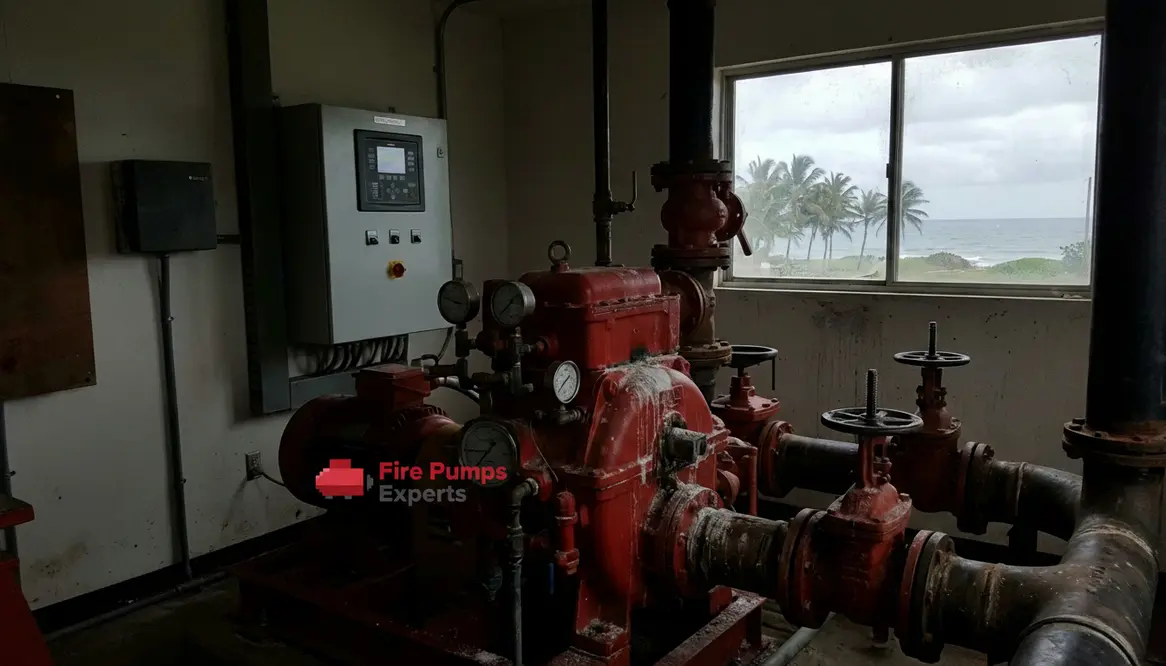
Fire Pump Efficiency vs Reliability Carlsbad
How do you balance energy-conscious design with systems that absolutely must work at 3 a.m.? In Carlsbad, that question is not academic. It is the backbone of every serious fire protection strategy.
I have spent years walking mechanical rooms where the hum of a fire pump feels like a quiet promise. In Carlsbad, that promise has to balance two forces that rarely get along perfectly. On one side, we have performance and energy savings. On the other, we have dependability when everything is on the line. The phrase fire pump efficiency vs reliability Carlsbad is not just industry jargon. It is the daily tug of war behind every commercial and industrial fire protection system I help design or evaluate.
And yes, like choosing between a sports car and a pickup truck, you cannot always have both extremes. Although, if Tony Stark designed fire pumps, we might be having a different conversation.
In Carlsbad, the real tension behind fire pump efficiency vs reliability Carlsbad is shaped by salt air, humidity, and real-world emergencies, not just design charts and sales brochures.
Designing well is not about chasing perfect test numbers. It is about creating systems that will not hesitate, stall, or quit when the building needs them most.
What matters more in Carlsbad facilities, efficiency or reliability?
I will answer this directly. Reliability wins. Every time.
However, that does not mean efficiency is optional. In large commercial campuses and industrial buildings, energy costs stack up fast. So, while reliability remains the non negotiable foundation, I still design with efficiency in mind.
Because of this, I approach each system with a simple mindset. The pump must start instantly, run without hesitation, and deliver required pressure under worst case conditions. After that, and only after that, I optimize.
Additionally, Carlsbad presents unique environmental factors. Coastal air, humidity, and temperature swings can quietly degrade components. Therefore, reliability is not just about design. It is about survival in a real environment.
Why “good enough” reliability is not actually enough
Fire pumps live quiet lives until the one moment they do not. There is no acceptable failure rate when lives, property, and business continuity hang in the balance. That is why in the conversation about fire pump efficiency vs reliability Carlsbad facility owners need to recognize that reliability is not a dial you casually turn down to save a few kilowatts.
Understanding the core of fire pump efficiency vs reliability Carlsbad
When I talk about fire pump efficiency vs reliability Carlsbad, I am really talking about design priorities.
Efficient systems
Efficient systems aim to reduce energy consumption during testing and operation. They use tighter tolerances, advanced controls, and sometimes variable speed drives. On paper, they look beautiful.
Reliable systems
Reliable systems, on the other hand, are built like old school trucks. They may consume more energy, but they start every time. They tolerate wear. They forgive less than perfect conditions.
Here is where things get interesting. The more complex a system becomes, the more potential failure points I introduce. So while a high efficiency design might impress during a presentation, I always ask one question.
Will it still work at 3 a.m. during an emergency?
If the answer is not a confident yes, I simplify.
The hidden tradeoff behind complexity
Every extra control module, sensor, or logic sequence can improve efficiency on a spreadsheet. It can also become the single point of failure in an emergency. That is why, when weighing fire pump efficiency vs reliability Carlsbad facilities need to respect the reality that the simplest workable solution is often the most trustworthy one.
How I balance performance and durability in real projects
Efficiency focus
- Optimized pump curves
- Reduced energy draw during testing
- Advanced control panels
- Precision aligned components
Reliability focus
- Proven pump models
- Redundant power sources
- Simplified controls
- Corrosion resistant materials
In practice, I blend both sides carefully. For example, I might choose a slightly less efficient pump if it has a longer track record in industrial environments. Similarly, I often favor mechanical simplicity over digital complexity.
Because when things go wrong, and they eventually do, simple systems are easier to diagnose and fix. No one wants to scroll through error codes like they are debugging a spaceship.
Why overshooting efficiency can backfire
Chasing maximum efficiency can create hidden risks. I have seen systems that perform beautifully during acceptance testing but struggle months later.
First, tighter tolerances mean components wear faster under imperfect conditions. Second, advanced electronics can fail due to heat, moisture, or power fluctuations. In coastal regions like Carlsbad, that risk increases.
Moreover, maintenance teams in large facilities need systems they can understand quickly. If a design requires specialized knowledge just to reset a controller, downtime increases.
And in fire protection, downtime is not just inconvenient. It is unacceptable.
Efficiency that quietly erodes reliability
There is a point where shaving off more energy use means leaning on thinner margins, more delicate parts, or hyper-sensitive controls. For fire pump efficiency vs reliability Carlsbad facilities that cross that line may not see problems immediately, but corrosion, vibration, and power quality issues will eventually expose the weak links.
Design choices that strengthen reliability without sacrificing too much efficiency
I rely on a few guiding principles that consistently deliver strong results.
- I select pumps that operate near their best efficiency point during real demand, not just theoretical scenarios
- I prioritize diesel or dual power setups for critical facilities to ensure operation during outages
- I specify materials that resist corrosion, especially near coastal air
- I keep control systems intuitive and robust rather than overly complex
Additionally, I design with maintenance in mind. Easy access, clear layouts, and standard components go a long way. Because even the best system fails if no one can service it properly.
Think of it like this. A slightly less efficient system that runs flawlessly for 20 years beats a high efficiency system that needs constant attention. Every time.
How local conditions in Carlsbad shape fire pump decisions
Carlsbad is not just another location on a map. Its coastal environment quietly influences every mechanical system.
Environmental pressures on fire pumps
Salt air accelerates corrosion. Temperature swings affect seals and electronics. Therefore, I lean toward designs that tolerate these conditions without constant adjustment.
Furthermore, many commercial and industrial properties here operate around the clock. That means systems must handle continuous readiness without performance drift.
So when evaluating fire pump efficiency vs reliability Carlsbad, I always factor in the environment first, then the building demand, and finally the operational realities.
FAQ: Fire Pump Design in Commercial and Industrial Facilities
Final thoughts and next steps
If you are managing a commercial or industrial property in Carlsbad, the balance between performance and dependability is not something to leave to chance. I can help you evaluate your system, identify risks, and design a solution that works when it truly matters. Reach out today and let us build a fire protection system that does not just look good on paper but performs when everything is on the line.
If you want to understand more about standards, testing intervals, and best practices that influence fire pump efficiency vs reliability Carlsbad facility teams can review trusted technical resources such as https://firepumps.org alongside site-specific engineering guidance.