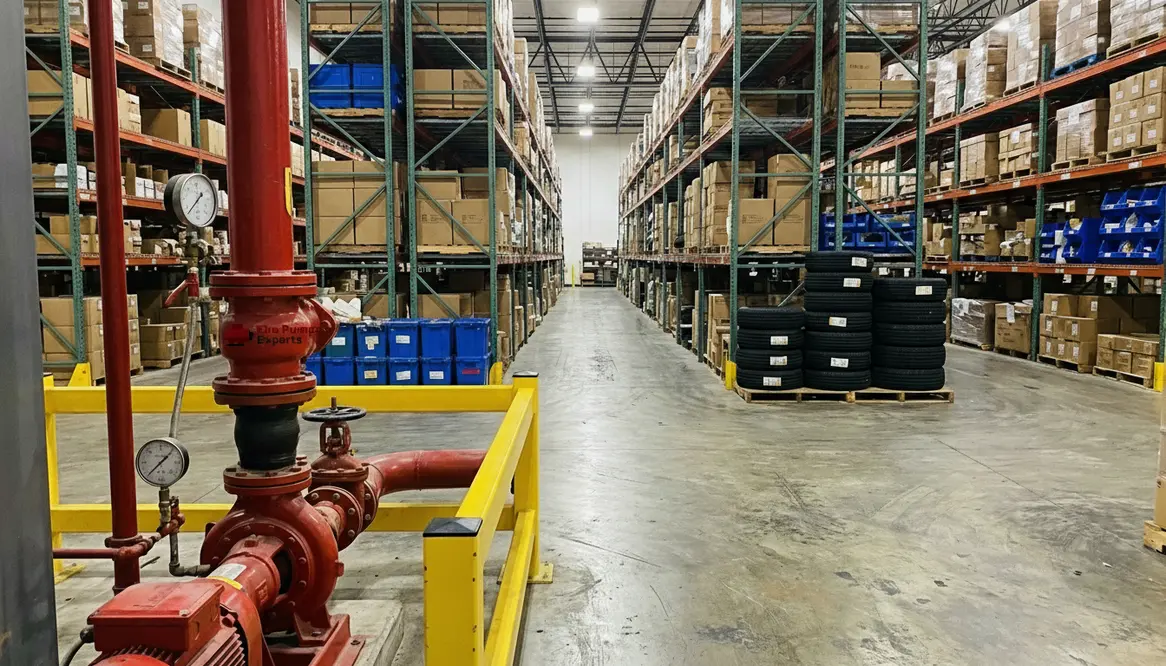
Fire Pump Needs for Inventory Dense Warehouses
I have walked through enough auto parts warehouses to know one thing for certain. When shelves are stacked to the rafters with rubber, oil, plastics, and metal, the fire risk is not theoretical. It is patient. Waiting. That is exactly why Fire pump needs for inventory-dense storage spaces deserve careful attention from day one. In these environments, suppression systems cannot hesitate, and neither should the people responsible for designing them. Because when something sparks, you do not want a system that behaves like it just woke up from a nap.
Why Auto Parts Warehouses Demand More Than Basic Fire Protection
Auto parts warehouses carry a unique mix of materials. On one hand, you have heavy steel components. On the other, you have flammable liquids, packaging, and synthetic materials that burn fast and hot. As a result, standard fire protection setups often fall short.
Moreover, high stacking creates vertical fire spread. Flames do not politely stay on one shelf. They climb. They accelerate. And before long, what began as a small ignition turns into a warehouse wide problem.
Therefore, I always emphasize designing systems that assume the worst case scenario. Not because I enjoy drama, but because fire certainly does.
What Makes Fire Pump Systems Essential in High Density Storage Facilities?
The answer is simple. Pressure and reliability. Sprinkler systems rely on consistent water flow, and in large scale warehouses, municipal supply often cannot keep up. That is where fire pumps step in and take control.
In addition, these systems ensure that water reaches the highest racks with enough force to suppress flames quickly. Without that pressure, even the best sprinkler layout becomes little more than decorative plumbing.
I like to think of a fire pump as the quiet bodyguard of the building. You rarely notice it. But when trouble arrives, it moves fast and does not ask for permission.
Core Components That Keep the System Running Smoothly
Every effective system depends on a few critical parts working together. If one fails, the entire chain weakens. So I focus on coordination and durability.
Pump Unit
This is the engine of the system. It boosts water pressure and maintains flow during emergencies.
Controller
It acts as the brain. It detects pressure drops and starts the pump automatically.
Power Supply
Electric or diesel driven, it must remain dependable even when the grid does not.
Jockey Pump
It maintains system pressure during normal conditions and prevents unnecessary starts.
Valves and Piping
They guide water efficiently, ensuring it reaches the right zones without delay.
Testing Systems
These allow routine checks without disrupting operations, which is essential in busy facilities.
Together, these components create a system that responds instantly. And in fire protection, instant beats impressive every single time.
Designing for Fire pump needs for inventory-dense storage spaces
Design is where many projects either shine or stumble. Warehouses are not uniform, and neither are their risks. Rack height, aisle width, and stored materials all influence how a fire behaves.
Because of this, I always account for flow demand and duration. A short burst of water is not enough. The system must sustain pressure long enough to control the fire until responders arrive.
Additionally, zoning plays a major role. By dividing the warehouse into sections, the system can concentrate water where it is needed most. This improves efficiency and reduces strain on the pump.
And yes, I have seen designs that ignore these principles. They look fine on paper. In reality, they perform like a sports car with no fuel. Stylish. Useless.
Maintenance That Actually Prevents Disaster
A fire pump system is not a set it and forget it investment. It requires routine testing and inspection to stay reliable. Fortunately, the process is straightforward when done consistently.
For instance, weekly churn tests verify that the pump starts correctly. Meanwhile, monthly inspections check valves, controllers, and fuel levels. Over time, these small actions build confidence that the system will perform when needed.
Neglect, on the other hand, creates silent failure points. And unlike a squeaky door, a failing fire pump does not announce itself until it is too late.
I often tell facility managers this. If your system has not been tested recently, it is not ready. It is just hoping for the best. Hope is not a strategy. It is a wish.
Integrating Fire Pumps with Modern Warehouse Operations
Today’s warehouses are smarter than ever. Automation, robotics, and data systems drive efficiency. So it only makes sense that fire protection evolves alongside them.
Modern fire pump systems can integrate with monitoring platforms, providing real time alerts and performance data. As a result, teams can respond faster and address issues before they escalate.
Furthermore, predictive maintenance tools help identify wear patterns. This reduces downtime and extends system life. It is like giving your fire pump a regular health check, minus the waiting room magazines from 2003.
Ultimately, integration ensures that fire protection is not an afterthought. It becomes part of the operational backbone.
Planning Fire pump needs for inventory-dense storage spaces From Day One
The most effective protection in auto parts warehouses starts long before the first pallet is delivered. Fire pump sizing, water supply, and storage configuration should be coordinated in the early planning stages so you are not retrofitting a critical life safety system into a space built only for throughput and racking density.
When Fire pump needs for inventory-dense storage spaces are considered early, it becomes easier to route mains, provide test headers, and allocate space for tanks, generators, or diesel fuel systems. That early effort quietly pays off when the building is full, production is humming, and the pump room is doing its job without drama.
Ignoring Fire pump needs for inventory-dense storage spaces until late in the project usually leads to compromises: tight pump rooms, awkward pipe routing, or reduced redundancy. Those shortcuts may not show up on a tour, but they will show up when something overheats, shorts, or spills in the worst possible corner of the warehouse.
FAQ: Fire Pump Systems for Auto Parts Warehouses
Below are common questions that come up when designing or upgrading Fire pump needs for inventory-dense storage spaces in auto parts and similar high-rack warehouses.
Final Thoughts and Next Steps
When I look at a warehouse filled with valuable inventory, I see more than shelves and parts. I see responsibility. Investing in the right fire pump system is not just about compliance. It is about control, safety, and continuity. If your facility handles dense storage, now is the time to evaluate your setup, close any gaps, and ensure your system performs without hesitation. Because when fire shows up, readiness is everything.