Fire Pump Requirements for Civic Centers Guide
A practical walkthrough of Fire Pump Requirements for Civic Centers, written from the perspective of someone who has spent years inside the walls, not just reading the codes.
I have spent years walking through large civic spaces where thousands gather, often without giving a second thought to what protects them behind the walls. And yet, one of the quiet heroes of these environments is guided by Fire Pump Requirements for Civic Centers. Within the first moments of planning a multifunction public building, I always anchor my approach in those standards. They are not just codes on paper. They are the difference between controlled response and chaos when seconds matter. So today, I will walk you through how I think about fire pump planning in these complex, high occupancy spaces, with a steady pace and just enough humor to keep us both awake.
What makes fire pump planning different for multifunction public buildings?
When I look at a civic center, I do not see one building. I see a concert hall, a conference hub, maybe a retail strip, and occasionally a food court that smells suspiciously like burned popcorn. Each space carries its own fire risk profile. Therefore, I must design a system that adapts rather than reacts.
Because of that, I focus on demand variability. A packed arena has very different needs compared to an empty exhibition hall. Consequently, the fire pump system must handle peak demand without hesitation. I often overspecify capacity slightly, not out of paranoia, but because real life rarely follows neat engineering assumptions.
Additionally, I consider system zoning early. It allows me to isolate risks while maintaining pressure consistency across the structure. That way, one incident does not compromise the entire building.
A layered building, a layered risk profile
Fire Pump Requirements for Civic Centers force me to think in layers: assembly spaces, back-of-house areas, underground parking, and rooftop amenities. Each layer nudges the hydraulic calculations, pump sizing, and zoning strategy in subtle ways. Miss one, and the whole balance shifts.
The trick is designing for that layered reality without turning the system into a maze. Clear zoning, straightforward riser layouts, and honest conversations with the operations team all matter more than squeezing in the latest exotic widget.
Designing for scale without overcomplicating the system
Big buildings tempt big solutions. However, I have learned that complexity can become its own hazard. So, I aim for systems that are powerful yet intuitive.
I typically start with clear hydraulic calculations. Then, I align pump selection with actual building demand instead of theoretical extremes. As a result, the system performs efficiently under real conditions.
Moreover, I ensure redundancy is built in, but not excessive. A backup pump is essential. Five backup pumps? That starts to feel like assembling the Avengers for a kitchen fire.
What I prioritize:
- Reliable primary pump capacity
- Clear control panel access
- Simple maintenance pathways
What I avoid:
- Over layered control logic
- Hidden equipment rooms
- Unnecessary system duplication
Fire Pump Requirements for Civic Centers and how I apply them in real projects
I treat Fire Pump Requirements for Civic Centers as a living framework rather than a checklist. Codes give direction, but interpretation brings them to life.
For instance, water supply reliability is non negotiable. Therefore, I always assess municipal supply limitations first. If the supply cannot meet demand, I integrate storage tanks or secondary sources. This ensures continuity even during peak usage or unexpected outages.
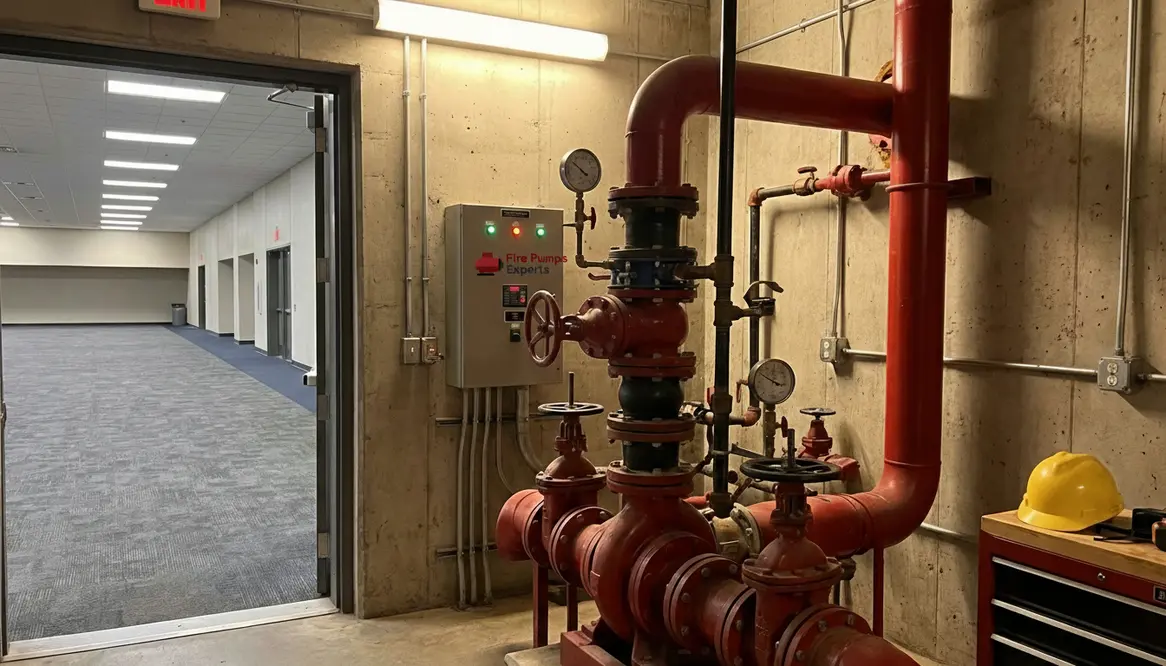
Furthermore, I pay close attention to pump room placement. Accessibility matters not only for maintenance crews but also for emergency responders. I have seen designs where pumps were tucked away like forgotten gym memberships. That approach never ends well.
In addition, I align system controls with building automation. This allows real time monitoring and faster response. And yes, it also gives facility managers something impressive to show during inspections.
Where the codes meet real-world corridors
In the field, Fire Pump Requirements for Civic Centers show up in small but critical details: clear pump room signage, doors that actually open wide enough for equipment removal, drainage that does not turn a test into an indoor water feature, and sensor placement that does not constantly trigger false alarms during events. These are the places where theoretical compliance either earns its keep or falls flat.
Power supply planning that actually holds up under pressure
A fire pump without reliable power is like a superhero without powers. It looks impressive, but it will not save the day.
So, I always design with dual power sources. Primary electrical feeds handle normal operation, while backup generators take over instantly when needed. Consequently, the system remains active even during widespread outages.
Moreover, I separate power routing from other building systems whenever possible. This reduces the risk of cascading failures. Because in large civic centers, one failure can ripple faster than a viral tweet.
What reliable power looks like on paper and in practice
On drawings, it is clean one-line diagrams and tidy schedules. In practice, it is transfer switches with clear labeling, generator fuel strategies that outlast a long storm, and routing that keeps fire pump feeders out of harm’s way when other systems start failing. Done right, no one notices. Done wrong, everyone will.
Maintenance strategy starts at the design table
I do not wait until installation is complete to think about maintenance. Instead, I build that thinking into the design itself.
For example, I ensure there is enough space around pumps for servicing. I also specify components that are widely available, avoiding rare parts that require a treasure hunt to replace.
Additionally, I integrate testing protocols into the system layout. Routine testing becomes easier when connections and drains are logically placed. As a result, compliance becomes part of daily operations rather than an annual scramble.
Designing a system people will actually maintain
When I apply Fire Pump Requirements for Civic Centers, I picture the technician doing a weekly churn test at 6 a.m. before an event. Clear sightlines, safe access platforms, valves that do not require acrobatics, and drain discharge that behaves itself all play a role. A system that is easy to maintain is a system that stays ready.
How I future proof fire pump systems in large civic spaces
Buildings evolve. A convention center today might host esports tournaments tomorrow. So, I plan for flexibility.
I often include capacity margins that allow for expansion. Likewise, I design piping layouts that can accommodate additional zones without major reconstruction. This approach saves both time and cost down the road.
And yes, I also consider technology upgrades. Smart monitoring tools are becoming standard. Therefore, I ensure systems can integrate with future platforms without needing a complete overhaul.
Making room for tomorrow’s ideas
Future proofing is not about predicting the exact event mix twenty years from now. It is about leaving space in pump rooms, oversizing key headers sensibly, mapping out stub-outs for future zones, and making sure the control architecture can accept new data points. Done well, Fire Pump Requirements for Civic Centers become a launchpad for upgrades instead of a ceiling.
FAQ
Conclusion
When I plan fire pump systems for multifunction public buildings, I am not just meeting codes. I am shaping resilience into the structure itself. If you are developing or upgrading a major commercial property, now is the time to align with proven strategies and dependable standards. Visit https://firepumps.org and take the next step toward a system that performs when it matters most. Because in this line of work, reliability is not optional. It is everything.