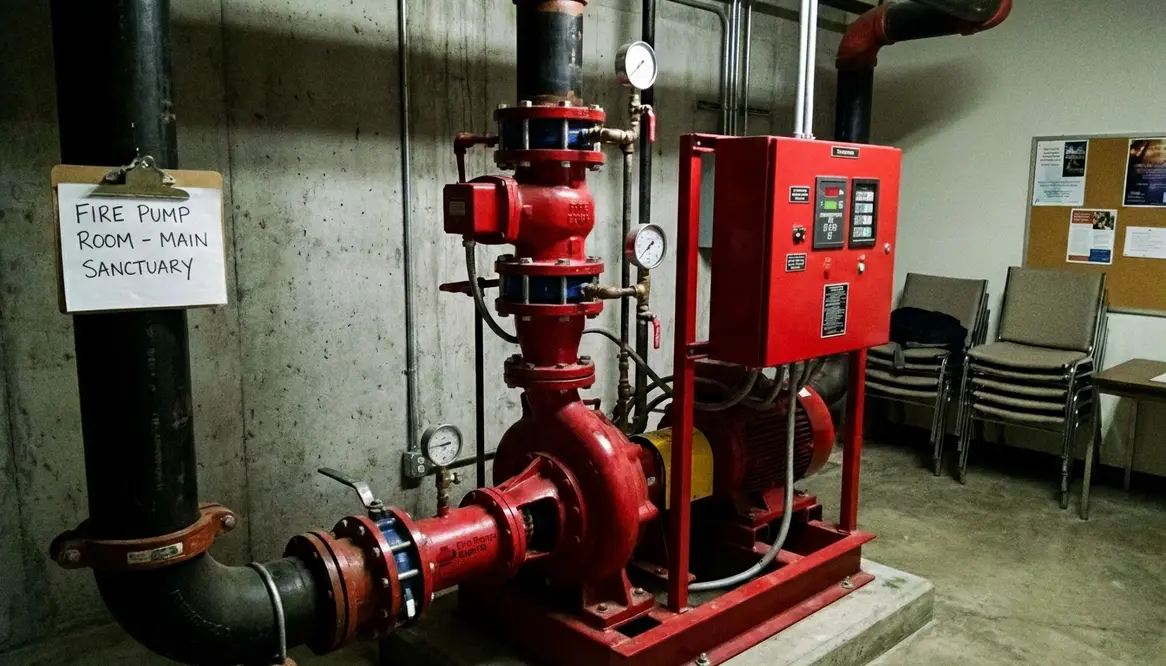
Fire Pump Requirements for Religious Facilities
What Fire Pump Requirements Apply to Religious Facilities
Why religious facilities face commercial-grade fire pump rules
I have spent enough time around commercial properties to know one thing for certain. When people gather in large numbers, whether for worship, work, or a midnight movie premiere, safety systems must quietly stand ready. That includes tenant-occupied building fire pumps, which often play a critical role in religious facilities that operate like complex commercial environments.
Now, while a place of worship may feel serene, the codes governing it are anything but relaxed. In fact, they are structured, detailed, and very much aligned with broader commercial fire protection standards. So let us walk through what really applies, without turning it into a snooze fest. I promise to keep things moving, like a well tuned pump system.
At a glance
- Large sanctuaries behave like assembly occupancies.
- Education wings and offices bring in business and educational standards.
- Mixed-use spaces echo the same logic behind tenant-occupied building fire pumps.
- Reliability, backup power, and long-term growth planning are not optional extras.
How fire pump requirements apply to religious facilities
In short, religious facilities fall under commercial building classifications when they meet certain size, occupancy, or height thresholds. Therefore, they must comply with fire codes such as NFPA 20 for fire pumps and NFPA 13 for sprinkler systems.
However, the real trigger is not the label on the building. It is how the space functions. Large sanctuaries, multi story education wings, and assembly halls often demand higher water pressure than municipal systems can provide. As a result, fire pumps become essential.
Additionally, if the building includes mixed use spaces like offices, daycare areas, or event halls, the requirements grow more complex. That is where systems similar to tenant-occupied building fire pumps come into play, ensuring consistent performance across all occupied zones.
Understanding fire pump triggers in large assembly spaces
Let me paint a picture. Imagine a sanctuary filled to capacity during a holiday service. The sprinkler system must respond instantly and effectively. However, if the incoming water supply cannot meet demand, a fire pump is not optional. It is required.
Most jurisdictions mandate fire pumps when:
- Water pressure from the city supply is insufficient
- The building exceeds certain height limits
- The sprinkler system demand surpasses available flow
- Standpipe systems are installed for firefighting operations
Moreover, these requirements mirror those found in other large scale properties. So while the building may host sermons instead of sales meetings, the infrastructure expectations remain firmly commercial.
Design considerations that go beyond the basics
This is where things get interesting. Fire pump design is not just about meeting minimum code. It is about ensuring reliability under real world conditions.
For example, religious campuses often expand over time. One building becomes three, then five, and suddenly you have a small village. Consequently, the fire pump system must account for future demand, not just current needs.
Additionally, backup power becomes critical. If a storm knocks out electricity during a packed event, the fire pump must still operate. That is why diesel driven pumps or generator backed electric systems are common in these environments.
And let us be honest. Nobody wants their fire protection system behaving like a temperamental coffee machine that only works when it feels inspired.
Key components every compliant system must include
Core equipment
- Fire pump unit sized to demand
- Controller for automatic operation
- Dedicated power source
- Pressure maintenance jockey pump
Supporting features
- Test header for inspections
- Backflow prevention devices
- Alarm integration
- Proper ventilation and drainage
Each element works together like a well rehearsed choir. If one part misses a note, the entire performance suffers. Therefore, precision in design and installation is not just recommended. It is essential.
Inspection, testing, and ongoing compliance
Even the best system will fail if it is neglected. That is why inspection and testing requirements are strict and ongoing.
Weekly churn tests, monthly inspections, and annual flow tests are standard. Additionally, documentation must be maintained and readily available for authorities having jurisdiction.
Facilities that operate daily or host large gatherings must take this seriously. After all, a fire pump is not a decorative piece. It is a working system that must perform on demand, every time.
In many ways, maintaining these systems is similar to managing tenant-occupied building fire pumps in large commercial complexes. The stakes are high, and the margin for error is very small.
Common pitfalls I see and how to avoid them
I have seen a few recurring issues that can turn a compliant system into a liability.
- Undersized pumps that cannot meet peak demand
- Poor coordination between sprinkler and pump design
- Lack of backup power planning
- Inadequate maintenance schedules
However, these problems are avoidable. With proper planning, experienced design teams, and regular testing, facilities can stay ahead of issues rather than reacting to them.
And trust me, reacting to a failed fire pump is not the kind of excitement anyone is looking for.
Frequently asked questions about fire pumps in religious facilities
The same logic that drives tenant-occupied building fire pumps often shows up in questions from facility teams, finance committees, and design professionals trying to balance cost, compliance, and safety.
Conclusion
If you manage or develop a large scale religious facility, do not leave fire protection to chance. A properly designed and maintained fire pump system protects lives, property, and continuity. I encourage you to approach it with the same care you would any major commercial asset. When you are ready to ensure your system meets every requirement, partner with experts who understand complex properties and deliver solutions that perform when it matters most. In many ways, the mindset should be no different than for tenant-occupied building fire pumps: design for the real risk, verify performance, and never assume that “good enough” will be good enough on the day the system is actually needed.