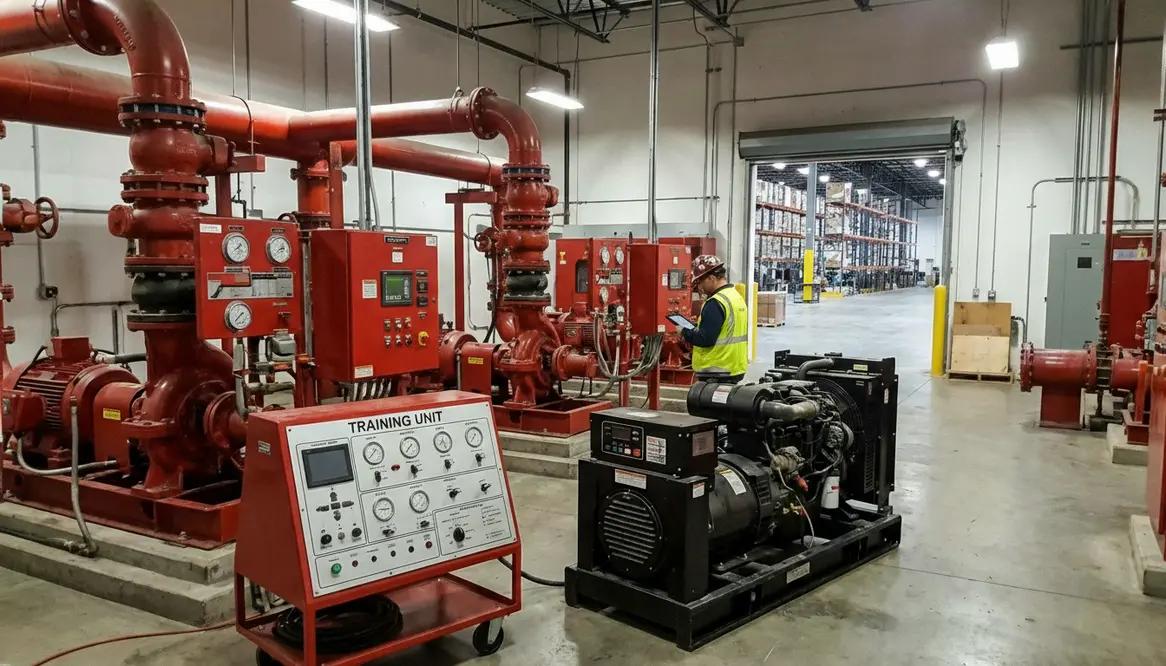
Fire Pump Systems for Multi Use Industrial Parks
I have spent years around fire protection systems, and if there is one thing I know, it is this: when things go wrong, they go wrong fast. That is exactly why I often point clients toward training center fire pumps early in the planning phase. In multi use industrial parks, where warehouses sit beside manufacturing lines and data centers hum quietly in the background, fire risk does not just exist, it multiplies. And while most people think of sprinklers first, I always remind them that without a reliable pump system behind it, that sprinkler is just… well, decorative plumbing.
How do fire pump systems support complex industrial environments?
I get this question a lot, and honestly, it is a good one. Multi use industrial parks are not simple spaces. One building may store chemicals, while the next houses robotics, and another runs cold storage 24 hours a day. Because of that, water demand varies wildly.
So, I design fire pump systems that adapt. These systems boost water pressure exactly where and when it is needed. Moreover, they ensure that even the farthest hydrant or highest sprinkler head gets consistent flow. Without that, coverage becomes uneven, and that is a risk no facility manager wants to explain later.
Think of it like assembling the Avengers. Each hero has a role, but without coordination, it is chaos. A well designed fire pump system brings that coordination, minus the capes.
Designing for scale, redundancy, and reliability
When I approach an industrial park, I never design for average conditions. I design for worst case scenarios. Because, let’s be honest, fires do not politely stay small.
Capacity
I calculate peak demand across multiple buildings operating simultaneously. Then I add a buffer. Not a guess, but a calculated margin that accounts for system aging and expansion.
Redundancy
If one pump fails, another must step in instantly. Therefore, I often specify duplex or triplex pump setups. Yes, it costs more upfront, but downtime during a fire event is not exactly a budget friendly situation.
Power reliability
Electric pumps are efficient, but I pair them with diesel backups. Because when the grid goes down, the fire does not take a coffee break.
As a result, the system becomes less of a single machine and more of a coordinated safety network.
Where training center fire pumps fit into real world readiness
I have seen beautifully engineered systems fail for one simple reason: people did not know how to use them. That is where training center fire pumps make a real difference.
These systems allow teams to simulate real conditions without real consequences. Operators learn how pressure changes under load. Maintenance crews understand early warning signs. And managers gain confidence that their investment actually performs.
Furthermore, hands on exposure reduces response time during emergencies. Instead of guessing, teams act. And in fire protection, seconds matter more than opinions.
Key components that make or break performance
Not all fire pump systems are created equal. I pay close attention to the details that often get overlooked.
Pump types
Centrifugal pumps dominate industrial settings because they handle high flow rates efficiently. However, I match the pump type to the hazard level, not just the building size.
Controllers
Modern controllers provide real time diagnostics. They do not just start the pump, they tell you how it is feeling. Think of it as giving your system a voice.
Water supply
I always verify whether the municipal supply can handle peak demand. If not, I integrate storage tanks to stabilize flow.
Testing infrastructure
Flow test headers and monitoring tools ensure the system performs as designed, not just as promised on paper.
Each component plays a role, and when one underperforms, the entire system feels it.
Compliance is not a checkbox, it is a strategy
It is tempting to treat compliance like a finish line. Install the system, pass inspection, move on. I strongly disagree with that approach.
Codes evolve. Facility use changes. Equipment ages. Therefore, I build systems that exceed minimum standards and allow room for future adjustments.
Additionally, I encourage routine testing schedules that go beyond annual requirements. Because catching a problem during a scheduled test beats discovering it during an actual emergency. Every time.
And yes, inspectors appreciate it too. Not that we do it for the applause, but it does not hurt.
Future ready systems for growing industrial parks
Industrial parks rarely stay static. New tenants arrive, operations expand, and risk profiles shift. So, I design fire pump systems with scalability in mind.
I leave room for additional pumps. I plan for higher demand. I integrate smart monitoring that connects with building management systems. Consequently, operators gain visibility across the entire network.
It is a bit like upgrading from a flip phone to a smartphone. Once you see the data in real time, you wonder how you ever managed without it.
Why training center fire pumps raise the bar
In multi use industrial parks, the gap between a designed system and a dependable system is almost always human familiarity. The best hardware on earth cannot compensate for teams that hesitate, misread alarms, or fumble through procedures in the middle of an emergency.
That is why I am a strong advocate for training center fire pumps that mirror field conditions as closely as possible. When operators can throttle valves, start and stop pumps, watch gauges swing, and hear the sound of a pump loading up under supervised conditions, nerves start to fade and muscle memory takes over.
In a well run training environment, people learn how the system behaves when something is slightly off. Small pressure drops, odd controller messages, or unusual cycling patterns become familiar warning signs, not confusing noise in the background. That kind of awareness stops minor issues from turning into catastrophic failures.
The result is simple: by the time a real alarm rings in an industrial park, your team has already “been there” multiple times inside the training room. They know which screens to check, which valves to verify, and when to call for additional support. The adrenaline is still there, but the uncertainty is not.
From concept to commissioning in industrial parks
Hazard profiling across mixed occupancies
A multi use industrial park might have flammable liquids in one corner, palletized storage in another, a clean room next door, and an office building tagged on for good measure. Each of those brings different density requirements, water demands, and failure consequences.
During design, I map those hazards in layers. Instead of just asking “How big is the building?” I ask “What is actually happening inside it?” A modest floor area with high challenge storage can need more robust pumping than a vast but lightly loaded structure. Pretending those are equal is how systems come up short when it matters most.
Hydraulic pathways that actually make sense
I look at pipe routing the same way traffic engineers look at highways. Dead ends, choke points, and awkward loops create bottlenecks. In a fire event, that means the pump is working hard, but the water is stuck in line somewhere upstream of the hazard.
Looped mains, thoughtfully placed sectional valves, and clearly defined zones keep pressure losses predictable. When a section is isolated for maintenance, the rest of the site should not be left limping along. That balance between flexibility and reliability separates solid engineering from purely theoretical layouts.
Commissioning with intent
Commissioning is not just a ceremonial “flip the switch and hope” moment. It is the time to push the system, provoke it a bit, and verify that real world behavior matches what the calculations promised. I like to see how the pumps react when hydrants flow hard at the far edge of the park, when multiple sprinkler systems open, and when power transfers between sources.
That is also a perfect time to introduce the on site team to the equipment. Walking them through start sequences, alarm responses, and routine checks on day one pays off for years. Pairing that commissioning experience with ongoing work at a facility that uses training center fire pumps keeps everyone’s skills sharp instead of letting them fade quietly in the background.
FAQ: Fire Pump Systems for Industrial Parks
Final thoughts and next steps
Fire pump systems are not just equipment, they are insurance in motion. If you manage or develop a multi use industrial park, now is the time to evaluate whether your system can handle real world demands. I encourage you to invest in smart design, proper training, and ongoing testing. When everything is on the line, preparation is not optional. Reach out today and make sure your system is ready before it ever needs to prove it. For additional technical resources and guidance, you can review material available at https://firepumps.org and adapt those insights to the unique mix of hazards in your own industrial park.