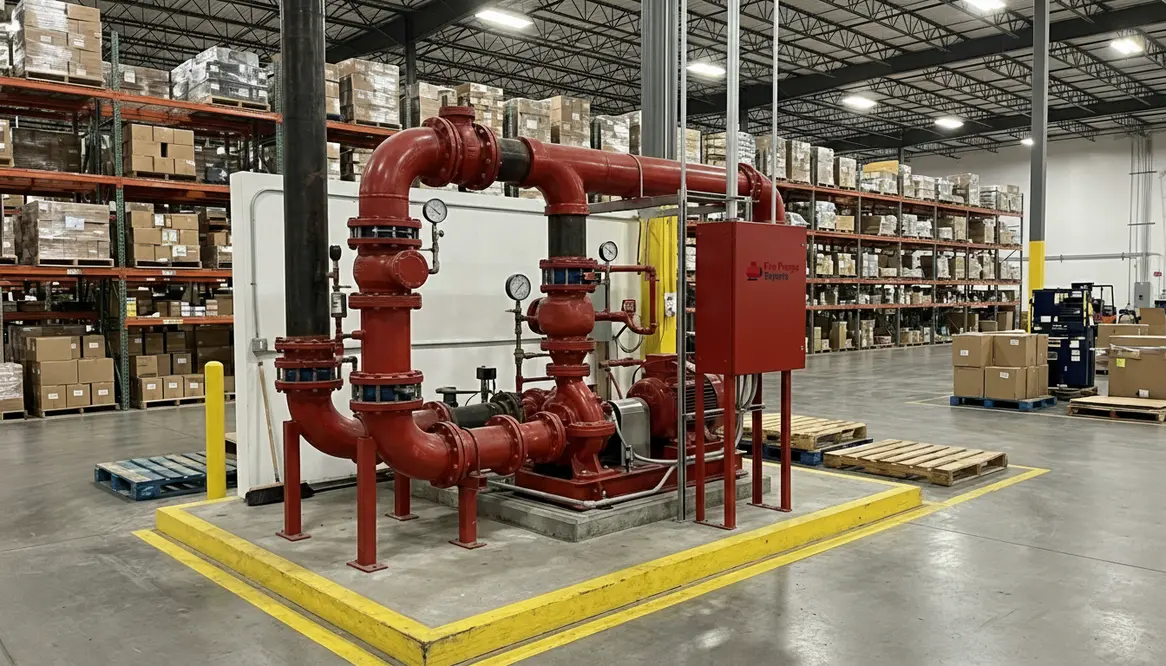
Fire Pump Selection for Distribution Warehouses
I have walked through more distribution warehouses than I can count, and I can tell you this much right away: fire protection is never the place to cut corners. When I talk with facility managers, the conversation always circles back to one thing, buyer intent for system selection. They want reliability, compliance, and performance that holds up when everything else is going wrong. And frankly, that is exactly what a fire pump is supposed to deliver. No drama. No surprises. Just water, pressure, and peace of mind.
What makes a fire pump right for a distribution warehouse?
A distribution warehouse is not your average building. High ceilings, dense storage racks, and fast moving operations create a unique fire risk profile. So, I always look at three core factors first: pressure demand, flow requirements, and system compatibility.
Because warehouses often rely on ESFR or in rack sprinkler systems, the pump must handle high flow rates without hesitation. At the same time, it needs to maintain steady pressure across long pipe runs. And yes, if you think that sounds like asking a lot, you are right. But that is the job.
Additionally, I consider how the pump integrates with existing fire protection infrastructure. Electric or diesel driven systems each bring their own strengths. The right choice depends on power reliability and operational priorities. This is where buyer intent for system selection becomes more than a phrase. It becomes a decision framework.
Top fire pump types I trust in large scale facilities
Over the years, I have seen trends come and go, but a few pump types consistently prove themselves in distribution environments.
Split case pumps are my go to for large warehouses. They deliver high flow rates efficiently and are easier to maintain. When uptime matters, and it always does, these pumps rarely disappoint.
Vertical turbine pumps shine when the water source sits below ground, such as tanks or wells. They are powerful, space efficient, and built for demanding conditions.
End suction pumps have their place in smaller or less complex facilities. However, in massive distribution centers, they often fall short on capacity.
And then there is the driver choice. Electric pumps are clean and reliable when power is stable. Diesel pumps, on the other hand, keep running when the grid decides to take a nap. If you have ever watched a storm roll in and knock out power, you already know which one earns a quiet nod of respect.
How I match fire pump performance to warehouse hazards
Not all warehouses carry the same risk. Some store consumer goods. Others handle flammable materials that would make a Hollywood explosion look modest.
So, I start with hazard classification. Then, I align the pump performance curve with sprinkler system demand. This step is critical. Too little capacity, and the system underperforms. Too much, and you risk damaging components or overspending.
Moreover, I evaluate peak demand scenarios. Fires do not politely wait for optimal conditions. The pump must perform at full capacity without hesitation. That is why I always emphasize real world testing over theoretical specs.
Key performance considerations
- Flow rate consistency under load
- Pressure stability across zones
- Compatibility with suppression systems
- Redundancy and backup capabilities
Operational priorities
- Ease of maintenance access
- Energy or fuel efficiency
- Compliance with NFPA standards
- Integration with monitoring systems
Smart features that actually matter in modern fire pumps
Now, I know what you are thinking. Do I really need smart controls in a fire pump system? Short answer, yes. Long answer, absolutely yes.
Modern fire pumps come equipped with advanced controllers that monitor performance in real time. They alert operators to issues before they become failures. And in a warehouse setting, where downtime can ripple through supply chains like a plot twist in a Marvel movie, early warnings are invaluable.
Furthermore, remote monitoring allows facility teams to track system health without being physically present. That is not just convenient. It is strategic.
However, I always caution against overcomplicating the system. Technology should enhance reliability, not introduce new points of failure. Think of it like adding gadgets to a car. At some point, you just want it to start and drive.
How do I choose the best fire pump for my facility?
I approach this question with a methodical mindset. First, I assess the building layout and hazard level. Then, I calculate system demand based on sprinkler design. After that, I evaluate water supply conditions.
Next, I compare pump types and driver options. This is where buyer intent for system selection becomes highly specific. It is no longer about general preferences. It is about matching performance to risk.
Finally, I consider long term maintenance and compliance. A pump is not a one time purchase. It is an ongoing responsibility. Choosing the right system means fewer headaches down the road.
If you want a deeper technical reference while you are mapping out your options, resources like https://firepumps.org can help frame conversations with your design and inspection teams so that buyer intent for system selection stays aligned with actual code requirements and on site realities.
FAQ
Conclusion
Choosing the right fire pump is not just a technical decision. It is a commitment to safety, continuity, and operational confidence. I always advise taking a strategic approach, grounded in real data and practical needs. If you are evaluating options for your facility, now is the time to align performance with purpose. Connect with experienced fire protection professionals who understand large scale systems and can guide you toward a solution that works when it matters most, and keep buyer intent for system selection front and center from the first hydraulic calculation to the final acceptance test.