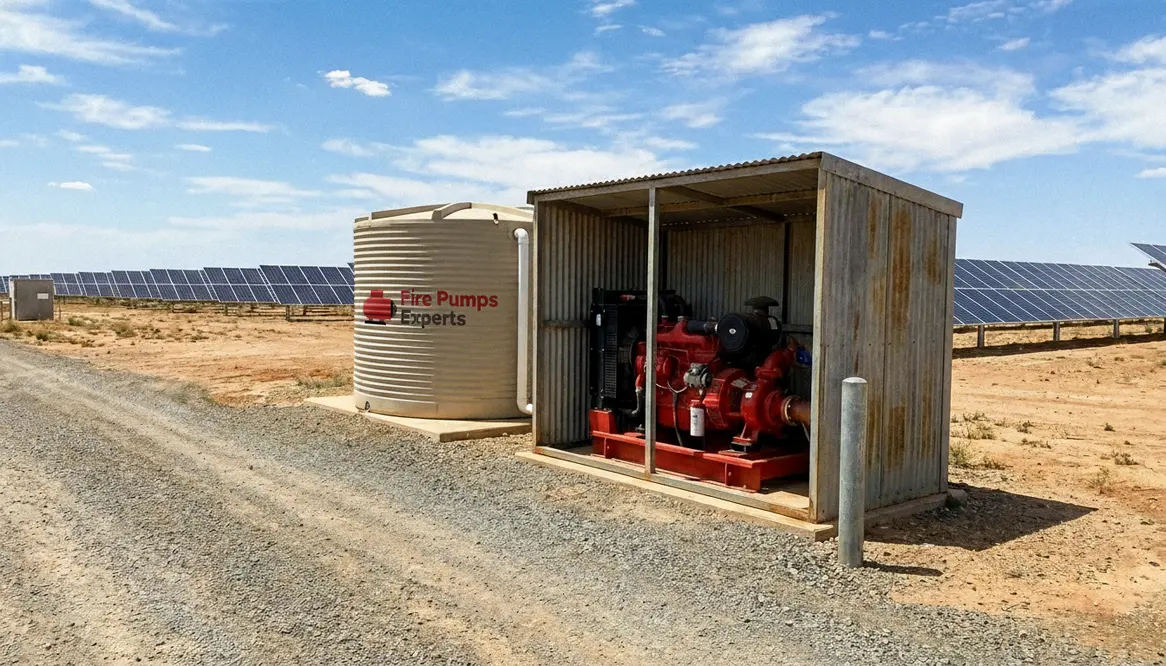
Fire Pump Solar Facility Australia Design Guide
I have spent enough time around large scale infrastructure to know one thing for certain. Fire does not care how green your energy is. Solar farms, battery storage yards, and hybrid renewable sites across Australia still face the same blunt reality. Risk exists, and it needs to be managed. That is where fire pump solar facility Australia design steps in, not as an afterthought, but as a core system that protects millions in assets and keeps operations steady. And yes, it does this quietly, like a good bodyguard who never asks for applause.
Understanding fire pump system design in renewable energy sites
When I design fire pump systems for renewable facilities, I do not treat them like standard commercial buildings. Instead, I account for open land, remote access, and high value electrical infrastructure. Solar arrays stretch far and wide, while battery energy storage systems sit like silent power vaults waiting to be respected.
Because of this, I prioritize reliability over cleverness. A fire pump must start instantly, deliver consistent pressure, and operate even when the main power supply is compromised. Therefore, diesel driven pumps often take center stage, backed by electric units where grid stability allows it.
Additionally, I consider water supply early. Rural Australia does not always offer generous mains pressure. So, I design with dedicated water tanks sized for extended firefighting duration. In other words, hope for the best, but design like the nearest help is miles away.
What makes fire pump solar facility Australia design unique?
Short answer. Environment, scale, and risk profile. Longer answer. Australia brings heat, dust, and isolation into the equation, and none of those are friendly to mechanical systems.
First, high ambient temperatures can affect pump performance. So, I ensure proper ventilation and derating considerations. Second, dust infiltration becomes a quiet enemy. Therefore, filtration and enclosure design matter more than most people expect.
Then there is the layout. Solar farms are not compact. Consequently, I design ring main systems that maintain pressure across long distances without significant loss. It is a bit like trying to keep good WiFi across a massive house, except the stakes are higher and the consequences far less forgiving.
These realities shape how every fire pump solar facility Australia system is arranged, protected, and maintained, from siting decisions to the smallest enclosure vent.
Core components I prioritize for reliability
Every system I design revolves around a few non negotiables. These are not glamorous, but they are the backbone of performance.
Left column
- Diesel and electric fire pumps with automatic start
- Jockey pumps to maintain pressure stability
- Dedicated fire water storage tanks
- Ring main distribution piping
Right column
- Hydrants and monitors placed for wide coverage
- Control panels with fail safe logic
- Fuel storage with extended run capacity
- Remote monitoring for unmanned sites
Moreover, I integrate redundancy wherever possible. Because if one component fails, the system should not politely give up. It should adapt and keep going. Think of it like a backup generator for your backup generator. Overkill? Maybe. Necessary? Absolutely.
Designing for compliance and Australian standards
I never treat compliance as a checkbox exercise. Instead, I use it as a baseline and then build upward. Australian standards such as AS 2419 and AS 2941 guide hydrant systems and fire pump installations. However, renewable facilities often push beyond typical scenarios.
So, I work closely with fire engineers and local authorities to align system performance with real world risks. For example, battery storage areas may require higher flow rates or specialized suppression strategies. Meanwhile, solar panel zones demand coverage that accounts for rapid fire spread across cable trays.
Additionally, documentation matters. Clear schematics, accessible isolation points, and straightforward controls ensure that when firefighters arrive, they do not waste time decoding a puzzle. And trust me, no one enjoys solving riddles during an emergency.
How I optimize fire pump solar facility Australia systems for long term performance
Design is only half the story. The other half is making sure the system still works years down the line. Therefore, I focus on durability and maintainability from day one.
For instance, I select corrosion resistant materials suited to Australian conditions. Then, I ensure that components are accessible for routine testing. Because if maintenance crews cannot reach it easily, it will eventually be ignored. And ignored systems tend to fail at the worst possible moment.
Furthermore, I incorporate remote monitoring. This allows operators to track pressure levels, pump status, and fault alerts without being physically present. In large renewable sites, this is not a luxury. It is essential.
And yes, I always plan for regular testing schedules. Weekly churn tests and periodic full flow tests keep the system honest. After all, a fire pump that has not been tested is just a very expensive decoration.
When these basics are embedded early, a fire pump solar facility Australia installation can run quietly in the background for years, ready for the one day it is truly needed.
Common mistakes I see and how I avoid them
Over the years, I have seen patterns. Some of them are avoidable, yet they show up more often than they should.
One common issue is undersized water storage. Designers sometimes assume municipal supply will compensate. In remote renewable sites, that assumption can fail quickly. So, I always design for independence.
Another mistake is poor zoning. Without proper segmentation, a single incident can compromise the entire network. Therefore, I divide systems into manageable sections with isolation valves.
Lastly, I often see fire systems treated as secondary to energy production. That mindset needs to change. Because when protection fails, production stops. It is that simple.
FAQ
Conclusion
If you are planning or upgrading a renewable energy site, I would not leave fire protection as an afterthought. A well designed system protects your investment, supports compliance, and keeps operations running when it matters most. Work with specialists who understand large scale infrastructure and the realities of Australian conditions. When you are ready to build a system that performs under pressure, literally and figuratively, take the next step and design it right the first time.
For deeper technical examples and reference material, resources such as https://firepumps.org can provide additional context on performance expectations, testing, and configuration options relevant to any serious fire pump solar facility Australia project.