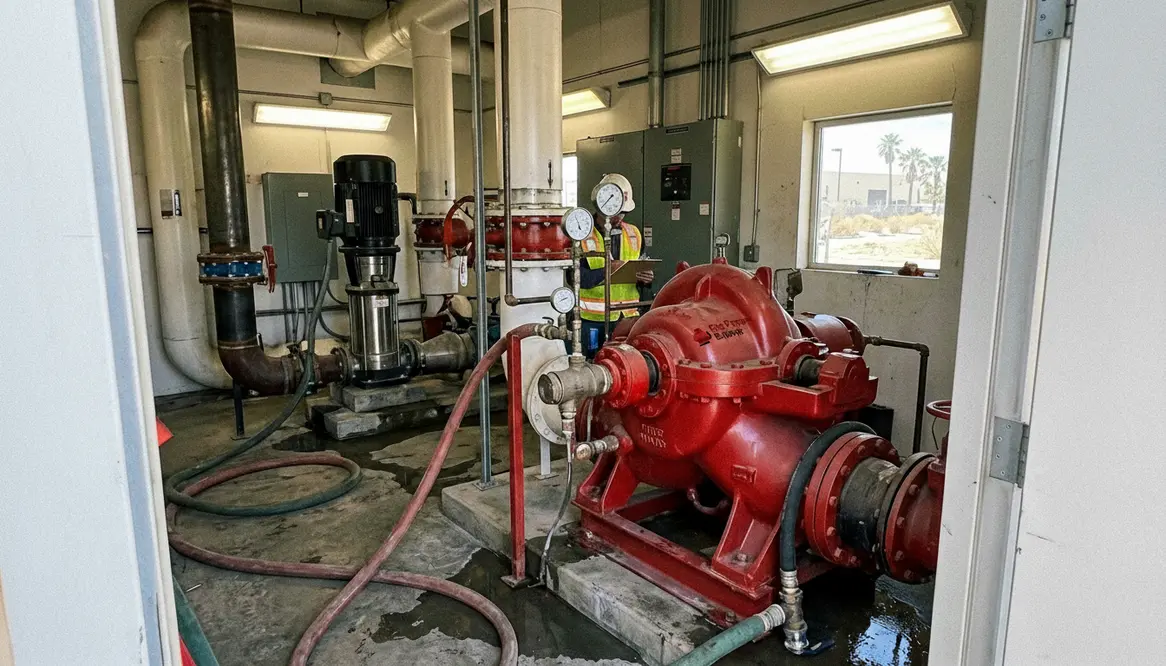
Fire Pump Types Flow Testing Ventura Explained
I have spent enough time around pump rooms to know one thing for certain. Not all fire pumps behave the same when the gauges start moving. And when we talk about fire pump types flow testing Ventura, that difference becomes more than academic. It becomes the line between confidence and guesswork. In Ventura’s commercial and industrial buildings, where system demand is rarely gentle, understanding how each pump type responds during testing is essential. So let me walk you through it, calmly and clearly, with just enough humor to keep us both awake.
Why Pump Type Shapes Flow Test Results
Flow testing is not just about hitting numbers. It is about understanding how water moves under pressure, and more importantly, how your system behaves under stress. Different pump types produce different pressure curves. As a result, the same test setup can yield very different outcomes depending on the pump behind it.
For example, a centrifugal pump tends to deliver a smooth and predictable drop in pressure as flow increases. Meanwhile, a vertical turbine pump may hold pressure longer before dropping off more sharply. Because of this, interpreting results without knowing the pump type is like judging a marathon runner and a sprinter by the same stopwatch. It is technically possible, but deeply misleading.
How Do Fire Pump Types Influence Flow Testing Ventura Results?
Let me answer this the way most facility managers wish someone had on day one. Each pump type has its own personality. Some are steady and reliable. Others are a little dramatic, like that one coworker who treats every email like a crisis.
Horizontal split case pumps
Horizontal split case pumps offer stable curves and are often easier to test. Their results tend to be consistent, which makes them a favorite in large commercial properties.
Vertical inline pumps
Vertical inline pumps, however, can be sensitive to system pressure fluctuations. Therefore, even small changes in demand can skew readings if the test is not carefully controlled.
Vertical turbine pumps
Vertical turbine pumps add another layer. Because they pull water from a source below, their performance depends heavily on suction conditions. So if your water supply shifts even slightly, your test results will follow.
End suction pumps
And then there are end suction pumps, which are compact and efficient but sometimes less forgiving during high demand testing. They do their job well, but they expect you to pay attention.
Reading the Curve Without Fooling Yourself
Now here is where things get interesting. Flow testing is not just about collecting numbers. It is about reading the curve those numbers create. And that curve tells a story.
However, if you do not factor in pump type, you might misread that story entirely. A pressure drop that looks alarming on one pump may be completely normal on another. Consequently, I always advise looking at manufacturer curves alongside your test data.
Think of it like comparing a sports car and a pickup truck. Both can move fast, but they are built for different reasons. Judging them by the same standard misses the point entirely.
Side by Side Comparison of Pump Behavior
Stable Performers
- Horizontal split case pumps maintain smooth pressure transitions
- Predictable flow makes trend analysis easier
- Ideal for large scale commercial systems
- Less sensitive to minor system changes
Dynamic Responders
- Vertical turbine pumps react to water source conditions
- Inline pumps fluctuate with system pressure shifts
- End suction pumps require tighter monitoring
- Results can vary if setup is not precise
Common Testing Pitfalls I See Too Often
I have seen more than a few test reports that made me raise an eyebrow. Not because the numbers were wrong, but because the interpretation missed the mark.
First, people sometimes ignore suction conditions. That is a mistake, especially with turbine systems. Next, some assume all pressure drops signal a problem. In reality, certain drops are expected and even healthy.
Then there is the classic issue of rushing the test. Flow testing is not a fast food drive through. It takes time to stabilize readings. And yet, I still see teams moving from point to point like they are late for a movie.
Finally, failing to document environmental conditions can lead to confusion later. Temperature, supply levels, and even valve positions all play a role. So yes, details matter. They always do.
Applying Insights to Real Ventura Facilities
In Ventura, commercial and industrial properties often operate under demanding conditions. High occupancy loads, complex layouts, and critical operations mean fire protection systems cannot afford surprises.
Because of this, understanding fire pump types flow testing Ventura becomes a practical advantage. It allows facility managers to anticipate how their systems will behave, rather than reacting after the fact.
Moreover, aligning test results with the correct pump characteristics ensures compliance without overcorrecting. That balance saves time, reduces unnecessary adjustments, and keeps systems ready when it matters most.
If you need a deeper technical reference while planning fire pump types flow testing Ventura programs, resources like https://firepumps.org can complement manufacturer data and local code requirements.
FAQ
These quick answers focus on practical issues facility teams face during fire pump types flow testing Ventura projects and annual checks.
Conclusion
If you manage a commercial or industrial facility in Ventura, you already know the stakes are high. Understanding how your pump type shapes testing results is not optional. It is essential. So take control of your system performance, eliminate guesswork, and ensure your fire protection stands ready. Connect with experienced professionals who understand these nuances and can guide your next flow test with precision and confidence.