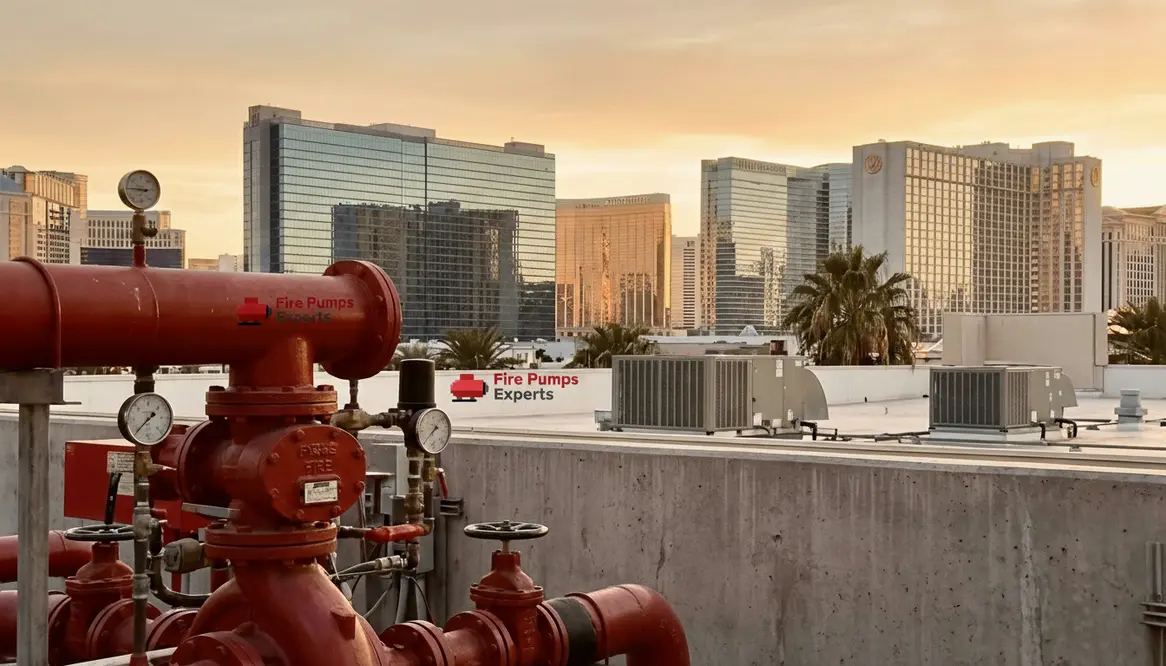
Fire Pumps for Las Vegas Commercial Properties
I have spent enough time around commercial buildings to know one thing for certain. When things go wrong, they go big. That is exactly why our Kern County property managers often look beyond their own region and study high risk environments like Las Vegas. Because if you can protect a property in a city built on neon, heat, and high occupancy, you can protect it anywhere. And right at the center of that protection sits a quiet hero. The fire pump. Not flashy. Not glamorous. But when the stakes rise, it performs like the final act in an action movie. No explosions required.
How fire pumps protect large Las Vegas commercial properties
Let me answer this the way most people would type it into a search bar. Fire pumps ensure that water reaches every critical corner of a building when pressure alone cannot do the job. In a city like Las Vegas, where high rise hotels, sprawling casinos, and industrial complexes dominate the skyline, municipal water pressure often falls short.
So, what happens next? The fire pump steps in. It boosts water pressure, feeding sprinkler systems and standpipes with enough force to control or extinguish a fire quickly. Without it, even the best designed sprinkler system becomes little more than a polite suggestion.
And yes, polite suggestions do not stop fires. If they did, we would all just hang up a sign that says please do not burn.
Why Las Vegas is a proving ground
Las Vegas loads buildings with people, power, and nonstop operations. For smart operators and Kern County property managers watching from a distance, it becomes a kind of laboratory for understanding how fire pumps behave under relentless demand.
If a fire pump can keep up with 24/7 hotels and casinos, it can more than handle office towers, industrial parks, and mixed use properties in calmer markets.
The unique risks of Las Vegas commercial and industrial buildings
Las Vegas is not just bright lights and late nights. It is also extreme heat, dense occupancy, and complex building layouts. These factors create a perfect storm for fire risk. Therefore, fire protection systems must work harder and faster.
For example, high occupancy means more people to protect and more potential ignition sources. Meanwhile, large industrial facilities often house equipment that runs hot and heavy. Add in the desert climate, and you get conditions where fire can escalate quickly.
High risk factors at a glance
- Extreme temperatures that dry out materials and speed up fire spread
- Layered spaces: gaming floors, theaters, kitchens, back of house corridors
- Industrial systems that run nonstop and generate heat
- Guests and staff constantly on the move
Because of this, fire pumps are not optional upgrades. They are essential infrastructure. They provide consistent pressure regardless of demand, which is critical during peak emergencies when multiple systems activate at once.
Why smart property leaders think like Kern County property managers
I have noticed something interesting. The best property leaders do not wait for problems. They anticipate them. Much like experienced Kern County property managers, they focus on prevention, system reliability, and long term safety.
They invest in fire pumps because they understand a simple truth. Fire damage is not just about flames. It is about downtime, liability, and reputation. A single incident can shut down operations, disrupt tenants, and trigger costly repairs.
From Las Vegas to Kern County
The same mindset that protects a mega casino also protects a logistics hub, a hospital, or a downtown office. Leaders who think like Kern County property managers treat fire pumps as non negotiable, not nice to have.
So instead of reacting, they build systems that respond instantly. Fire pumps become part of a broader strategy that protects assets and keeps operations running smoothly. Think of it as having a security team that never sleeps and never asks for a coffee break.
Core components that make fire pumps reliable
Not all fire pumps are created equal. Their performance depends on several key components working together seamlessly. Let me break it down in a way that feels less like a manual and more like a behind the scenes tour.
Power and control
Driver system
Electric or diesel driven, this powers the pump. Diesel systems often shine during power outages.
Controller
This acts as the brain, automatically starting the pump when pressure drops.
Water movement and supply
Pump assembly
This is the muscle, moving water at high pressure through the system.
Water supply connection
This ensures a steady source, whether from tanks or municipal lines.
When these components work together, the result is immediate and powerful. Water flows exactly where it is needed, when it is needed, without hesitation.
If you want to see how this plays out in real world systems, exploring a dedicated fire pump service program shows exactly how inspection, testing, and maintenance keep these components aligned and ready.
Maintenance is where real protection lives
Here is where things get real. Installing a fire pump is only half the story. Maintenance is what keeps it ready for the moment that matters.
Regular testing ensures the system responds instantly. Weekly churn tests, annual flow tests, and routine inspections all play a role. While it may sound repetitive, this consistency is what prevents failure.
Testing rhythms that matter
- Weekly churn tests to confirm automatic starting and basic performance
- Monthly checks for electric driven systems where required
- Annual flow tests to validate pressure, flow, and real capacity
- Routine visual inspections to catch corrosion, leaks, or damage early
Because when a fire starts, there is no time for troubleshooting. There is only time for performance.
And let us be honest. A fire pump that fails during an emergency is about as useful as a superhero who forgets their powers at home.
How fire pumps support compliance and business continuity
Fire pumps do more than fight fires. They help properties meet strict safety codes and insurance requirements. In Las Vegas, compliance is not optional. It is enforced, monitored, and expected.
By maintaining a properly designed and tested fire pump system, property owners reduce risk exposure. This leads to lower insurance complications and fewer regulatory issues.
Continuity, not just compliance
More importantly, it protects business continuity. When systems perform as expected, damage is minimized. Operations resume faster. Tenants stay confident. And the building maintains its value.
For Kern County property managers taking notes from Las Vegas properties, reliable fire pumps are one of the quiet foundations of long term cash flow and fewer late night phone calls.
Common questions about fire pumps
Before calling a contractor or updating a capital plan, many owners and Kern County property managers ask the same core questions. Here are straightforward answers.
Final thoughts and next steps
Fire pumps are not just equipment. They are a commitment to safety, reliability, and smart property management. If you manage or own a commercial or industrial facility, now is the time to evaluate your system. Partner with experts who understand high demand environments and can tailor solutions to your needs. Because when protection is built right from the start, everything else runs smoother. And that peace of mind is worth every drop of pressure.
Whether you are responsible for a Las Vegas high rise or a regional portfolio managed with the care of seasoned Kern County property managers, the principle is the same: a well designed, well maintained fire pump turns a worst case scenario into a controlled event instead of a headline.