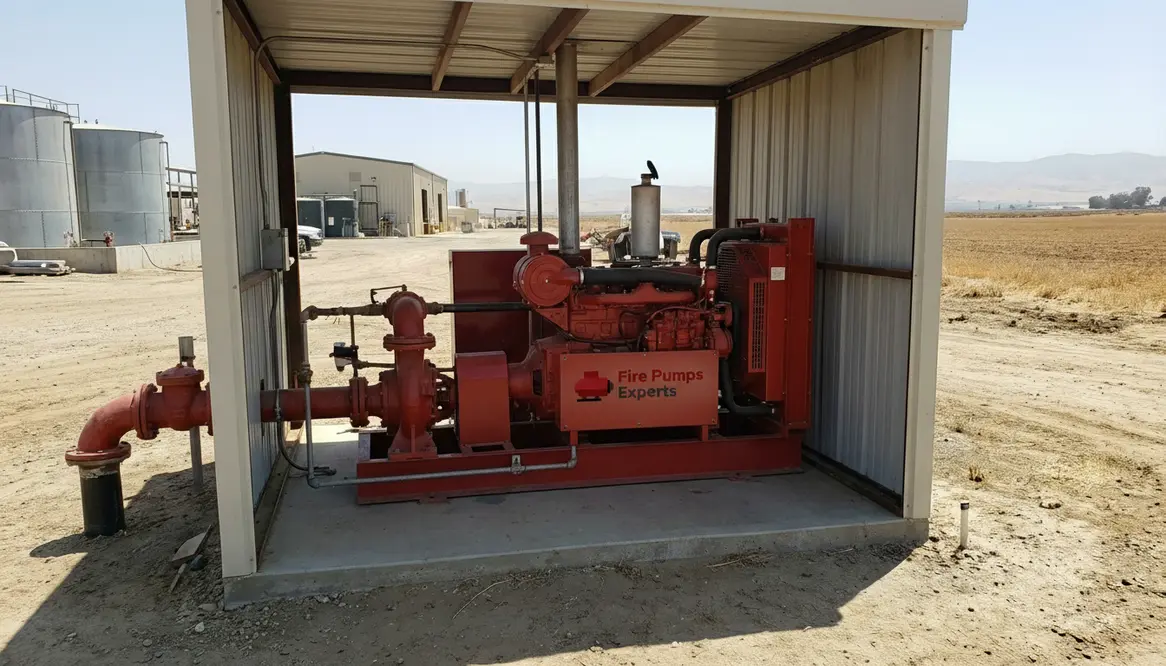
Fire Pumps for Wildfire Prone Kern County Sites
Designing fire pump systems in Kern County means planning for wind, heat, dust, and industrial chaos — all on the same afternoon.
I have spent enough time around Kern County facilities to know one thing for certain. Fire does not wait for permission. And in a region where heat, dry winds, and heavy industrial activity meet, wildfire-prone area fire protection is not a luxury. It is a baseline requirement. Agricultural operations and processing plants carry unique risks, from fuel storage to dust accumulation. So when I talk about fire pumps in this environment, I am not talking theory. I am talking about systems that must perform without hesitation, even when conditions resemble something out of a summer blockbuster disaster scene.
In Kern County, wildfire-prone area fire protection is less about checking code boxes and more about making sure the pump, power, and water supply will still be standing and functional while everything around them is trying to burn or blow away.
Why fire pumps matter in Kern County agricultural and processing facilities
Fire pumps serve as the backbone of any serious fire protection system. Without adequate pressure and flow, sprinklers and hydrants are little more than decoration. And while that might look nice on a blueprint, it will not impress a fire inspector or save a facility.
In Kern County, facilities often sit far from municipal water systems. Therefore, I rely heavily on dedicated fire pumps to ensure consistent performance. Crops, processing equipment, and storage areas all increase fire load. Moreover, dust from grain or other materials can ignite faster than you would expect. Think less slow burn and more instant action movie explosion.
Because of this, I always evaluate pump capacity based on worst case scenarios, not average days. That means planning for peak demand during high heat and high wind conditions, which is exactly when wildfire-prone area fire protection systems are pushed to their limits.
Wildfire context for Kern County facilities
Kern County does not offer gentle reminders when it comes to wildfire exposure. Fields become fuel beds, access roads turn into choke points, and utility power becomes a suggestion, not a guarantee. In that setting, a well-sized, well-protected fire pump is the difference between a controllable incident and a headline-worthy disaster.
How do I size a fire pump for high risk processing operations?
I start with hazard classification. Agricultural processing facilities often fall into higher hazard categories due to combustible materials and operational heat sources. Then I calculate required flow and pressure based on system demand.
However, I do not stop there. I factor in water supply reliability, elevation changes, and system losses. If the system depends on a storage tank, I ensure the pump can maintain pressure even as water levels drop. Because in a real emergency, nobody pauses the fire to refill a tank.
Core sizing steps
- Confirm hazard classification and applicable standards.
- Calculate system demand for sprinklers, hydrants, and monitors.
- Account for elevation, friction loss, and future expansions.
- Validate performance at worst credible wildfire and process scenarios.
Redundancy that actually matters
Additionally, I consider redundancy. A backup pump or secondary power source can mean the difference between control and catastrophe. It is not dramatic to say that redundancy saves buildings. It does.
Key design considerations for wildfire-prone area fire protection systems
Designing for wildfire-prone area fire protection requires a different mindset. I am not just protecting the inside of a facility. I am defending the perimeter as well.
First, I ensure that pumps can support exterior suppression systems such as hydrants and monitor nozzles. These systems create defensive barriers against approaching flames. Next, I look at placement. Pumps and controllers must be protected from heat and debris. A pump that fails due to external exposure is like bringing a flashlight to a blackout with dead batteries.
Then, I prioritize materials and enclosures that withstand harsh environments. Dust, heat, and vibration are constants here. So equipment must be rugged, not delicate.
What I focus on
- Reliable water sources
- Proper pump sizing
- Durable components
- Backup power integration
What I avoid
- Undersized systems
- Single point failures
- Unprotected equipment placement
- Ignoring seasonal risk changes
Perimeter defense and water supply planning
Wildfire-prone area fire protection planning also means thinking about perimeter hose stations, yard hydrants, and monitor placements the way a wildfire will approach your site: across fields, along fence lines, and carried by wind across roofs and conveyors. The fire pump has to be able to feed that exterior defense while still supporting interior systems.
Power sources and reliability in remote industrial sites
Power loss during a fire event is not rare. In fact, it is expected. That is why I often recommend diesel driven fire pumps for agricultural and processing facilities. Electric pumps are efficient, but they depend on grid stability. And in Kern County, grid stability during extreme conditions can be optimistic at best.
Diesel systems offer independence. However, they require proper maintenance and fuel management. So I ensure that fuel supplies remain clean and sufficient for extended operation. I also verify automatic start systems function without hesitation. Because when a fire starts, nobody wants to manually troubleshoot an engine. That is not the time for a learning experience.
When planning wildfire-prone area fire protection in truly remote zones, I also look at combinations of diesel drivers, on-site generation, and controls that stay simple enough for operators to understand under pressure. The most sophisticated system in the world is useless if nobody can start it when the sky turns orange.
Linking pump reliability with code-driven design
Standards such as NFPA 20 fire pump design and installation guidance exist for a reason: they give you a baseline for reliability. In Kern County conditions, I treat that baseline as the floor, not the ceiling, and pair it with field-proven choices in drivers, controllers, and test procedures.
Maintenance strategies that actually prevent failure
I have seen perfectly designed systems fail due to poor maintenance. So I treat maintenance as part of the design, not an afterthought.
Regular testing under load conditions is critical. Weekly churn tests are useful, but they are not enough. I schedule full flow tests to confirm performance matches design expectations. Additionally, I inspect controllers, valves, and fuel systems consistently.
Moreover, I train on site personnel. A well trained team can spot early warning signs before they become system failures. And honestly, a little attention here saves a lot of money and stress later. Nobody enjoys surprise repairs, especially during peak production season.
Maintenance priorities in wildfire season
- Increase inspection frequency during peak heat and wind periods.
- Confirm that strainers, suction sources, and tanks are free of debris.
- Verify that exterior valves used for perimeter defense actually operate.
- Run additional pump tests ahead of forecasted red flag conditions.
FAQ quick answers for facility owners
What type of fire pump is best for remote facilities?
Diesel fire pumps are often best due to their independence from electrical grids.
How often should fire pumps be tested?
Weekly no flow tests and annual full flow testing are standard, with additional checks as needed.
Do agricultural facilities require high capacity pumps?
Yes, due to combustible materials and large open areas, higher capacity is usually necessary.
Can one pump handle both interior and exterior protection?
It can, but I often recommend designing for combined demand to ensure adequate coverage.
What is the biggest risk in these systems?
Undersizing and lack of maintenance are the most common and costly issues.
Final thoughts and next steps
If I were responsible for a facility in Kern County, I would not treat fire pumps as a checkbox item. I would treat them as mission critical infrastructure. The right system, designed with real world risks in mind, protects assets, operations, and lives. If you are evaluating or upgrading your system, now is the time to act. Reach out, assess your risks, and build a solution that performs when it matters most.
Start with an honest look at your wildfire-prone area fire protection needs: water sources, pump capacity, power reliability, and maintenance culture. Then make deliberate upgrades instead of emergency purchases. Fires will not wait for a convenient time, but your planning can make sure your systems are ready when they arrive.
The goal is simple: when the sky is full of smoke and embers are landing in your fields, your fire pumps should feel boringly predictable. That is what good wildfire-prone area fire protection looks like in practice.