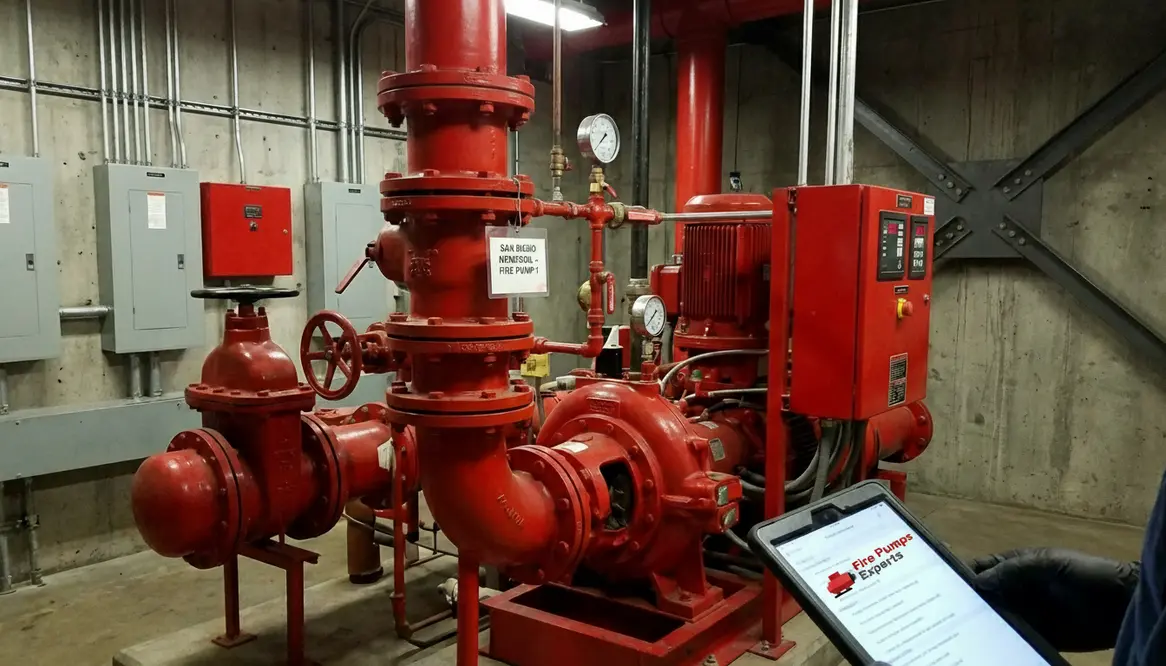
Hospital Fire Pump Selection San Diego Guide
I have spent years around critical infrastructure, and if there is one place where failure is not an option, it is a hospital. In a city like San Diego, where seismic activity, dense populations, and strict codes intersect, hospital fire pump selection San Diego becomes more than a technical choice. It becomes a matter of trust. Not just in equipment, but in the people who choose it. And while fire pumps are not exactly Hollywood stars, they are the quiet heroes behind the curtain, doing their job without applause, always there in the background when everything else feels chaotic.
What makes fire pump selection different for healthcare facilities
Hospitals operate on a different level. Lives depend on continuous function, and therefore redundancy is not a luxury, it is a requirement. Unlike standard commercial buildings, healthcare facilities must meet stricter codes such as NFPA 20 and NFPA 99. These are not casual suggestions. They are enforced with the kind of seriousness you would expect from a surgeon holding a scalpel.
Because of this, I always look at three core elements first: capacity, reliability, and compliance. Capacity ensures enough water flow under worst case scenarios. Reliability means the system performs even during power loss. Compliance ties it all together so inspectors do not show up with raised eyebrows and clipboards.
The San Diego twist on hospital fire protection
San Diego brings its own twist. Seismic considerations influence anchoring and piping. Salt air near coastal zones impacts material longevity. So while the pump might look standard on paper, its environment tells a more complicated story and shapes every decision around hospital fire pump selection San Diego projects depend on for resilience.
hospital fire pump selection San Diego requirements you cannot ignore
Let me be clear. Ignoring local codes in San Diego is like ignoring a red light on a busy street. You might get away with it once, but it is not a strategy.
In this region, I always account for California specific amendments to national codes. These often tighten requirements around seismic bracing and emergency power systems. Hospitals, in particular, must maintain fire protection even during disasters. Therefore, backup generators are not optional accessories. They are part of the core system.
Water supply and system ecosystem
Additionally, water supply reliability matters. Some facilities rely on municipal supply, while others integrate onsite storage tanks. Each approach changes pump sizing and configuration. So I do not just pick a pump. I design around the entire ecosystem.
And yes, inspectors in San Diego are thorough. Think less casual walkthrough, more detective solving a mystery where the culprit is non compliance. When you are working through hospital fire pump selection San Diego authorities will absolutely notice whether you treated the codes like suggestions or like life safety rules.
How I choose the right pump type and configuration
Not all fire pumps are created equal. Choosing between horizontal split case, vertical turbine, or inline pumps depends on the building layout and water source.
Here is how I typically break it down.
Pump type considerations
- Horizontal split case for reliability and easy maintenance
- Vertical turbine when pulling from underground or tanks
- Inline pumps for space constrained mechanical rooms
Operational priorities
- Consistent pressure across multiple floors
- Redundant controllers for fail safe operation
- Ease of servicing without disrupting hospital activity
However, I do not stop at type selection. I evaluate driver options as well. Electric motors are common, but diesel engines provide independence from the grid. In a hospital, I often lean toward redundancy by combining both approaches. Because when the lights go out, the fire pump still needs to show up for work.
Every time I walk through hospital fire pump selection San Diego facilities ask for, I picture the worst possible day for that hospital and make sure the configuration still performs like it is just another boring Tuesday.
Designing for long term performance, not just installation day
It is easy to focus on installation day. Everything is shiny, tested, and signed off. But I always think five, ten, even twenty years ahead. Hospitals expand. Systems age. Regulations evolve.
Therefore, I prioritize accessibility. Can technicians reach components easily. Are replacement parts readily available. Is the system scalable if the facility adds new wings. These questions matter just as much as initial performance.
San Diego corrosion and coastal challenges
Additionally, corrosion protection becomes critical in San Diego. Coastal environments accelerate wear, so material selection and coatings are not afterthoughts. They are part of the strategy.
And let us be honest. Maintenance teams appreciate systems that do not require acrobatics to service. No one wants to feel like they are auditioning for an action movie just to inspect a valve.
Can one system handle both compliance and efficiency
Yes, but it takes thoughtful design. Efficiency does not mean cutting corners. Instead, it means aligning system performance with actual demand.
I use data driven calculations to avoid oversizing. An oversized pump may seem safer, yet it can create pressure issues and increase wear. On the other hand, undersizing is simply unacceptable.
Moreover, modern controllers and monitoring systems allow real time diagnostics. These tools help detect issues early, reducing downtime and preventing costly failures. In a hospital setting, that is not just convenient. It is essential.
So the goal becomes balance. Meet every code requirement while optimizing performance. It is less about compromise and more about precision, especially when planning hospital fire pump selection San Diego facilities can rely on through utility failures, earthquakes, and everything in between.
FAQ about fire pump systems in healthcare facilities
Hospitals ask a lot of the same questions when they start looking at fire pump upgrades or new construction. A few of the most practical ones are below, and for deeper technical dives there are resources like https://firepumps.org that expand on standards and best practices.
Conclusion
Choosing the right fire pump system is not just a technical decision. It is a responsibility. When I approach hospital fire pump selection San Diego, I focus on performance, compliance, and long term reliability. If you are planning or upgrading a healthcare facility, now is the time to get it right. Work with experts who understand the stakes, because in this line of work, second chances are not part of the design.