Kern County Fire Pump Readiness Guide
What Facility Managers Should Know About Fire Pump Readiness in Kern County
A practical readiness checklist for the mechanical rooms you trust with your entire facility.
I have spent enough time around mechanical rooms to know one simple truth. When a fire pump fails, it never does so politely. It waits for the worst possible moment, like a villain with perfect timing. And while we are talking about Kern County, I often draw a surprising parallel to New Jersey fire pump compliance. Why? Because the discipline, structure, and rigor seen there set a tone that every serious facility manager should respect, no matter the zip code. The same mindset applies here, where heat, dust, and heavy industrial use push systems harder than most people realize.
What Does Fire Pump Readiness Actually Mean in Kern County?
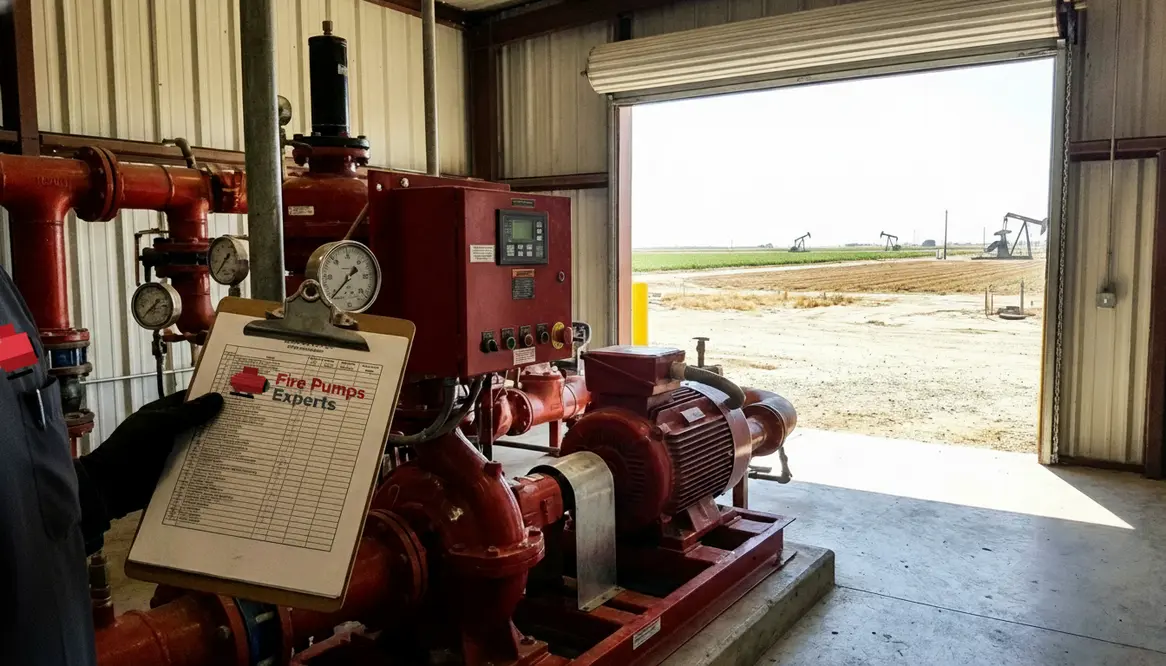
Let me answer that plainly. Fire pump readiness means your system works immediately, without hesitation, under real emergency conditions. Not in theory. Not on paper. It means water moves at the right pressure the second it is needed.
In Kern County, conditions add extra pressure. High temperatures can affect equipment performance. Agricultural dust and industrial debris can interfere with components. Therefore, readiness is not just about installation. It is about consistency.
Readiness in Real Terms
Think about what happens when the alarm sounds: the controller has to start, the pump has to spin, suction has to be clear, discharge pressure has to hit design numbers, and all of this must happen in seconds, not minutes.
The Classic Car Analogy
I like to think of it like maintaining a classic car. It may look impressive parked outside, but if it cannot start on demand, it is just an expensive decoration. And no facility manager wants their fire protection system to be the equivalent of a movie prop.
Environmental Stressors That Push Your System Harder
Why Kern County Is Not a Mild Environment
Now, let us talk about what makes Kern County unique. Unlike milder regions, you are dealing with heat swings, dry conditions, and large scale commercial operations. As a result, fire pumps here face constant strain.
For example, extreme heat can impact motor efficiency and lubrication. At the same time, sediment buildup can quietly reduce flow performance. These are not dramatic failures. Instead, they are slow declines that often go unnoticed until testing day, or worse, an emergency.
Consequently, I always recommend a proactive mindset. If something can degrade, it will. That is not pessimism. That is experience talking.
Borrowing Discipline From New Jersey Fire Pump Compliance
This is where the mindset of New Jersey fire pump compliance earns its repeated mention. The emphasis on structured testing, documentation, and accountability is not geography-specific. In Kern County, the same discipline turns an already stressed fire pump into a reliable one.
If you are serious about readiness, treat your hot, dusty, high-demand environment with the same rigor that a high-regulation jurisdiction expects. Your pump does not care what the local zip code is. It only responds to how well it is maintained and tested.
Key Maintenance Habits That Actually Make a Difference
What I Focus On Weekly
- Run churn tests and listen for irregular sounds
- Check pressure readings for consistency
- Inspect for leaks or vibration changes
What I Review Monthly
- Controller performance and alarms
- Fuel levels for diesel systems
- Valve positions and accessibility
Annual Flow Testing: Where Assumptions Go to Be Tested
Meanwhile, annual flow testing remains essential. This is where many systems reveal their true condition. Numbers do not lie, even if we wish they would. I have seen pumps that looked pristine but failed to meet performance benchmarks. That is a tough conversation to have, especially when people assumed everything was fine.
If you want to see how design, testing, and compliance tie together on a broader scale, it is worth comparing your program to resources like the NFPA 20 overview at https://kordfire.com/how-nfpa-20-regulates-fire-pump-systems/. It is a useful reference point when you are tightening your own procedures.
How Compliance Thinking Sharpens Readiness
Here is where I circle back to New Jersey fire pump compliance. While the regulations differ, the philosophy matters. Structured inspection schedules, documented testing, and accountability create reliability.
In Kern County, adopting that same discipline can elevate your entire operation. Instead of reacting to problems, you anticipate them. Instead of scrambling during inspections, you walk in prepared.
Structured Programs Reduce Panic
There is a certain calm that comes with knowing your system is ready. It is like having a well rehearsed team before opening night. No panic. No guessing. Just execution.
Compliance Mindset, Kern County Reality
Treat your Kern County program with the same seriousness that New Jersey fire pump compliance demands. Different codes, same goal: a pump that starts, runs, and delivers every single time.
Common Mistakes I See in Large Facilities
Even experienced teams slip into patterns that create risk. However, most of these mistakes are avoidable.
- Skipping minor anomalies during routine checks
- Delaying repairs because the system still runs
- Relying too heavily on visual inspections
- Underestimating the impact of environmental buildup
Treat Every Irregularity as a Clue
On the other hand, the best facility managers treat every irregularity as a clue. Not a nuisance. A clue. Something is always telling you a story inside that pump room. You just have to listen.
Also, let me add a bit of humor here. Ignoring a small issue in a fire pump system is like ignoring a strange noise in your car while turning up the radio. It works for a while. Until it really does not.
Why Performance Testing Is Your Reality Check
Performance testing separates assumptions from facts. While routine checks keep things stable, flow testing tells you if your system can actually deliver under pressure.
In large commercial and industrial facilities, demand is higher. Therefore, the margin for error is smaller. A slight drop in performance can have serious consequences.
Because of this, I always emphasize accurate data collection. Numbers should be tracked over time. Trends matter. If performance dips even slightly year over year, it signals wear or obstruction.
Think of it like tracking your health. One reading may not mean much. However, a pattern tells the real story.
FAQ: Fire Pump Readiness in Kern County
Facility managers who keep New Jersey fire pump compliance in mind often ask similar questions when they adapt that same mindset to Kern County conditions. Here are some of the most common ones.
Conclusion
Fire pump readiness is not a checkbox. It is a commitment. In Kern County, where conditions challenge every system, that commitment matters even more. If you want confidence instead of uncertainty, take action now. Schedule proper testing, review your maintenance habits, and bring in experts who understand large scale facilities. When the moment comes, your system should not hesitate. And neither should you.