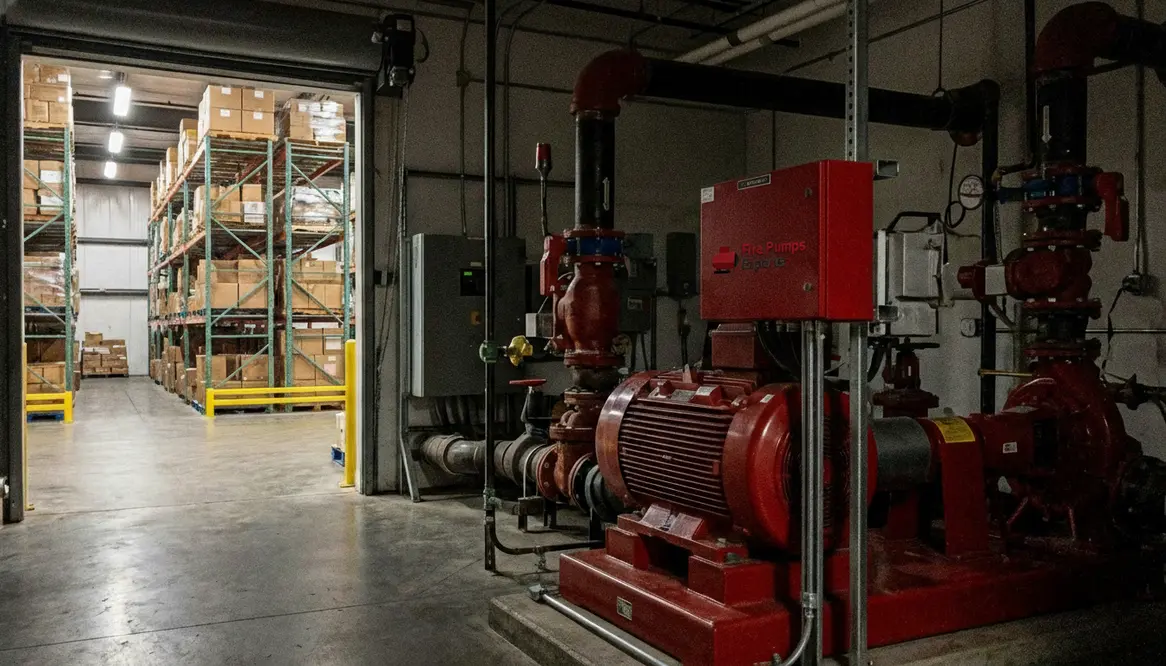
Shopping Center Fire Pumps for Warehouses
What protects a mall’s storefronts can also save a warehouse full of high-value inventory. The same mindset behind shopping center fire pumps belongs in the aisles, racks, and loading docks where your operation never sleeps.
I have spent years around commercial properties where the quiet hum of protection systems matters more than most people realize. When I talk about shopping center fire pumps, I am not just talking about retail spaces. I am talking about the backbone of fire protection design that also carries over into warehouses and distribution centers.
These massive facilities may not have window displays or food courts, but they carry something just as critical: high value inventory and nonstop operations. And when fire enters the picture, things can escalate faster than a movie plot twist in an action film.
That is why the same level of attention you would give to shopping center fire pumps belongs in every warehouse pump room. The stakes are different, but the expectation is the same: when it is time to move water, that system had better answer on the first ring.
What fire pump requirements apply to warehouses and distribution centers?
Right out of the gate, let me answer the question I hear most often. Warehouses and distribution centers typically require fire pumps when municipal water supply cannot meet system demand. That demand depends on sprinkler design, building size, and stored commodities.
In many cases, high pile storage and rack systems demand significant water pressure. Therefore, I often see fire pumps sized to support densities far beyond standard office buildings. Additionally, codes like NFPA 20 and NFPA 13 guide everything from pump selection to system layout.
However, it is not just about compliance. It is about reliability. Because when a facility runs 24 7, downtime is not just inconvenient. It is expensive. The logic that justifies robust shopping center fire pumps applies directly here: when the public is not around, the inventory, equipment, and schedule become the VIPs.
Code compliance meets real-world operation
NFPA standards establish the guardrails, but real-world conditions fine-tune the details. Long hose runs, elevation differences, and complex branch lines can all nudge pump sizing upward. In other words, it is not enough to ask, “What does the code say?” You also have to ask, “What does this building do every single day?”
That is why many owners lean on specialists who live and breathe fire pump systems. If you want a good example of how a professional team approaches this, look at the way Kord Fire handles fire pump systems, testing, and maintenance for complex commercial buildings.
How do storage types change fire pump sizing decisions
Now here is where things get interesting. Not all warehouses are created equal. A building storing paper goods behaves very differently from one packed with plastics. And plastics, frankly, burn like they have something to prove.
Because of this, fire pump requirements scale with hazard classification. For example, higher hazard commodities demand greater flow and pressure. As a result, I often recommend systems that anticipate future storage changes rather than just current needs.
Moreover, ceiling heights play a role. Taller storage means more water demand and sometimes the need for in rack sprinklers. Consequently, your fire pump must keep up without breaking a sweat. Think of it like casting for a superhero movie. You do not hire someone who struggles to lift groceries.
Designing past the “right now” problem
If there is one lesson I have learned from both warehouse projects and shopping center fire pumps, it is this: today’s hazard is rarely tomorrow’s hazard. Storage gets taller, products change, and suddenly that “perfectly sized” pump is sprinting uphill. Smart owners budget for the building they will have in ten years, not just the one on this year’s permit drawings.
Design considerations I always prioritize for large scale facilities
When I approach a warehouse or distribution project, I focus on a few critical elements that ensure performance under pressure. These same principles show up when I am reviewing shopping center fire pumps: different occupancies, same obsession with reliability.
Water Supply Stability
I verify the reliability of the incoming water source. If it fluctuates, the pump must compensate without hesitation.
Pump Type Selection
Electric or diesel driven pumps each have advantages. Electric offers simplicity, while diesel adds independence during power loss.
System Redundancy
In mission critical facilities, I often include backup pumps. Because relying on a single unit is like trusting one elevator in a skyscraper.
Controller Integration
Modern controllers provide monitoring and diagnostics. Therefore, facility managers gain insight before issues escalate.
Maintenance Access
I design layouts that allow easy servicing. Because if it is hard to reach, it will be ignored. And that never ends well.
Future Expansion
I plan for growth. Warehouses evolve, and your fire protection should not become obsolete after one renovation.
Why warehouse fire protection mirrors shopping center fire pumps in complexity
At first glance, a warehouse seems simpler than a retail complex. Fewer people, fewer aesthetics, fewer distractions. However, the fire protection demands can be even more intense.
Similar to shopping center fire pumps, these systems must handle variable demand across large footprints. Additionally, both environments require precise coordination between sprinklers, alarms, and water delivery.
That said, warehouses often push systems harder due to storage density. Therefore, I treat them with the same level of engineering care, if not more. Because unlike a mall, a warehouse does not close early when things go wrong.
The invisible backbone of continuity
When a retail center loses a day of business, it stings. When a distribution hub or warehouse goes down, it can ripple through an entire supply chain. That is why owners who already invest in robust shopping center fire pumps often apply the same philosophy to their storage facilities: one common standard for protection, regardless of what is under the roof.
Common mistakes I see and how to avoid them
I have seen enough missteps to fill a highlight reel. Some are minor. Others are the kind that make you question every decision leading up to them.
- Undersizing the fire pump to save a little money upfront, only to discover during testing that the system wheezes at peak demand.
- Ignoring future storage changes and then scrambling for costly retrofits when new product lines or higher racks show up.
- Skipping or watering down routine testing and maintenance until small issues quietly stack into a full-blown failure risk.
On the other hand, facilities that invest in proper design and routine testing tend to avoid these pitfalls. It is not glamorous work. No one is filming documentaries about pump rooms. But it works, and it is the same mindset that keeps shopping center fire pumps ready behind the scenes of the weekend rush.
Turning lessons learned into design decisions
The practical takeaway is simple: size with margin, test with discipline, and design like the building will change. If you treat your warehouse pumps with the same respect you would give to shopping center fire pumps in a high-profile retail project, your system will be far better prepared for the day it is truly needed.
FAQ about fire pump requirements for warehouses
The same questions surface again and again when owners and facility managers start planning or reviewing their warehouse fire pump needs. Here are clear, straightforward answers.
Final thoughts and next steps
When I look at a warehouse or distribution center, I do not just see shelves and forklifts. I see risk, responsibility, and the need for precision. A properly designed fire pump system protects more than property. It protects continuity, reputation, and peace of mind.
If you are planning or upgrading a facility, now is the time to act. Reach out, ask the right questions, and build a system that performs when it matters most. Take the same care you would bring to shopping center fire pumps in a flagship retail project and apply it to the quieter, harder-working spaces that keep your operation running.
In the end, warehouses and distribution centers are where promises to customers are kept. Giving those buildings a resilient fire pump system is one of the most practical, high-impact ways to make sure those promises survive whatever sparks fly.