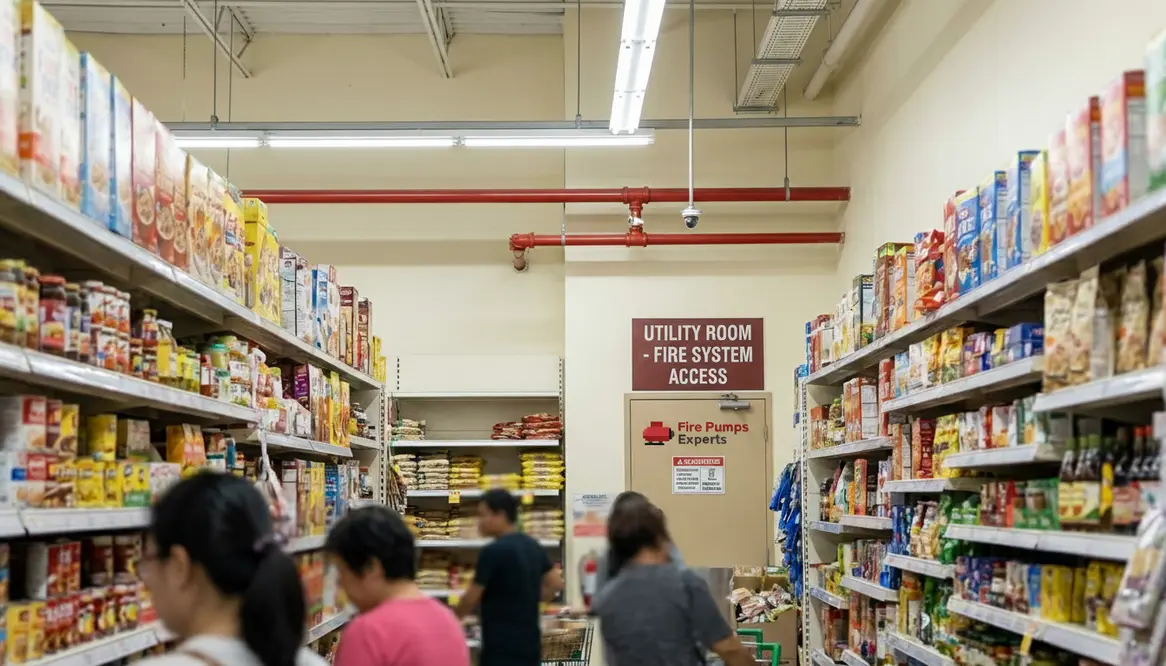
Supermarket Fire Pump Requirements for Retail Safety
Why the quiet machinery in the back room decides how a busy retail floor handles its worst day.
I have walked through enough crowded retail floors to know one truth: when hundreds or even thousands of people gather under one roof, fire protection stops being a checklist and becomes a responsibility that carries real weight. Early on, I learned that understanding supermarket fire pump requirements is not just about compliance. It is about control, reliability, and buying precious time when everything else moves too fast. In high occupancy retail spaces, that system becomes the quiet guardian in the background, ready to step in when alarms turn from noise into urgency.
What makes fire protection in high occupancy retail spaces different?
Let me answer this plainly. It is the sheer unpredictability. Unlike controlled industrial environments, retail spaces are dynamic. People move constantly, displays change weekly, and seasonal layouts can shift like a Marvel plot twist.
Because of that, I focus on systems that adapt. Sprinklers alone are not enough. Detection, suppression, and water delivery must work together seamlessly. Moreover, occupancy density increases risk exposure, which means fire systems must respond faster and more aggressively.
And yes, that is where fire pump standards for supermarkets and large retail environments quietly do their job. They ensure that water pressure does not drop when demand spikes. Without that, even the best sprinkler design becomes a fancy ceiling decoration.
Why supermarkets push systems harder
Supermarkets and big box stores stack fuel for fire in every aisle: cardboard packaging, plastics, textiles, seasonal decor, and promotional setups that were absolutely not designed by someone thinking about sprinkler patterns. That is why supermarket fire pump requirements lean heavily toward maintaining pressure during worst case scenarios, not average days.
You have long travel distances, high ceilings, and changing product mixes. All of that demands a pump sized and configured for the most demanding layout the store might ever see, not just the layout that exists during commissioning.
Designing systems that actually perform under pressure
I have seen designs that look perfect on paper but fall apart in real scenarios. So I take a different approach. I start with flow demand, not aesthetics.
First, I calculate peak water demand across multiple zones. Then, I layer redundancy into the system. After that, I ensure the pump can sustain pressure even if part of the system fails. Consequently, the system does not just meet code, it performs when it matters.
Retail environments also introduce obstacles like high shelving and storage racks. These can block sprinkler discharge patterns. Therefore, I align pump capacity with real world obstructions, not ideal conditions.
It is a bit like preparing for a concert. You do not test sound at half volume and hope for the best when the crowd arrives. You prepare for full intensity from the start.
How do supermarket fire pump requirements impact system reliability?
They are the backbone. Without them, everything else becomes uncertain.
When I apply supermarket fire pump requirements, I focus on three things. Consistent pressure, backup power, and durability. These pumps must operate even during power loss, which is why diesel or generator backed systems often come into play.
Additionally, I make sure the pump starts instantly. Delays of even a few seconds can allow fire to grow beyond initial containment. So reliability is not just a feature, it is the entire point.
Think of it like Batman. You may not see him all the time, but when things go wrong, you want him ready, not stuck in traffic.
Key reliability checkpoints
- Verified suction supply with adequate capacity and quality
- Automatic start sequences tested under real load
- Backup power sized for full fire duration, not just startup
- Clear access for technicians during an emergency, not just during inspections
When supermarket fire pump requirements are treated as the baseline for performance rather than a hurdle to clear, reliability becomes baked into every decision: from pipe sizing to controller selection.
Balancing safety with business continuity
Retail operators worry about downtime, and I get it. Every hour closed means lost revenue. However, cutting corners on fire protection is like skipping brakes to make a car lighter. It might seem efficient until it really, really is not.
So I design systems that allow maintenance without shutting down operations. For example, sectional controls and isolation valves let teams service parts of the system while the rest remains active. Meanwhile, monitoring systems provide real time insights without manual checks.
Safety priorities
- High flow capacity
- Redundant pump systems
- Fast activation response
- Coverage for dense layouts
Operational needs
- Minimal disruption
- Easy maintenance access
- Energy efficiency
- System monitoring
By aligning both sides, I help businesses stay open and protected at the same time. It is not magic. It is thoughtful engineering.
Integrating fire pumps into large scale retail infrastructure
Integration is where many projects stumble. A fire pump cannot exist as an afterthought. It must connect seamlessly with alarms, sprinklers, and building management systems.
Therefore, I coordinate early with architects and engineers. I ensure space allocation, ventilation, and fuel access are all addressed before construction progresses too far. As a result, the system becomes part of the building’s DNA, not an awkward add on.
Another key factor is testing. I insist on full load testing under realistic conditions. Not partial checks. Not assumptions. Real performance data. Because when a system is finally needed, there are no second chances or convenient rewrites.
Common mistakes I see and how to avoid them
I have seen enough patterns to spot trouble early. One of the biggest mistakes is underestimating demand. Designers sometimes rely on minimum standards instead of actual risk levels. That shortcut can cost dearly.
Another issue is poor maintenance planning. A great system today can become unreliable in a year if no one takes care of it. So I build maintenance schedules into the design phase, not as an afterthought.
Finally, some teams ignore future expansion. Retail spaces evolve. If the system cannot scale, it becomes obsolete faster than last season’s fashion trend.
Modern supermarket fire pump requirements also push designers to think beyond current shelving plans and occupancy. The smart move is to overspec the backbone of the system slightly, so future mezzanines, added cold storage, or new high-rack areas do not force a complete redesign.
FAQ: Fire protection for high occupancy retail spaces
Final thoughts and next steps
When I look at a high occupancy retail space, I do not just see shelves and shoppers. I see a living system that needs protection at every level. If you are planning or upgrading a commercial property, now is the time to take fire protection seriously. Work with experts who understand real world demands, not just codes. Because when the moment comes, preparation is not optional. It is everything. Reach out and build a system that stands ready, anchored by supermarket fire pump requirements that are treated as a foundation for resilience, not just another line in the specification.