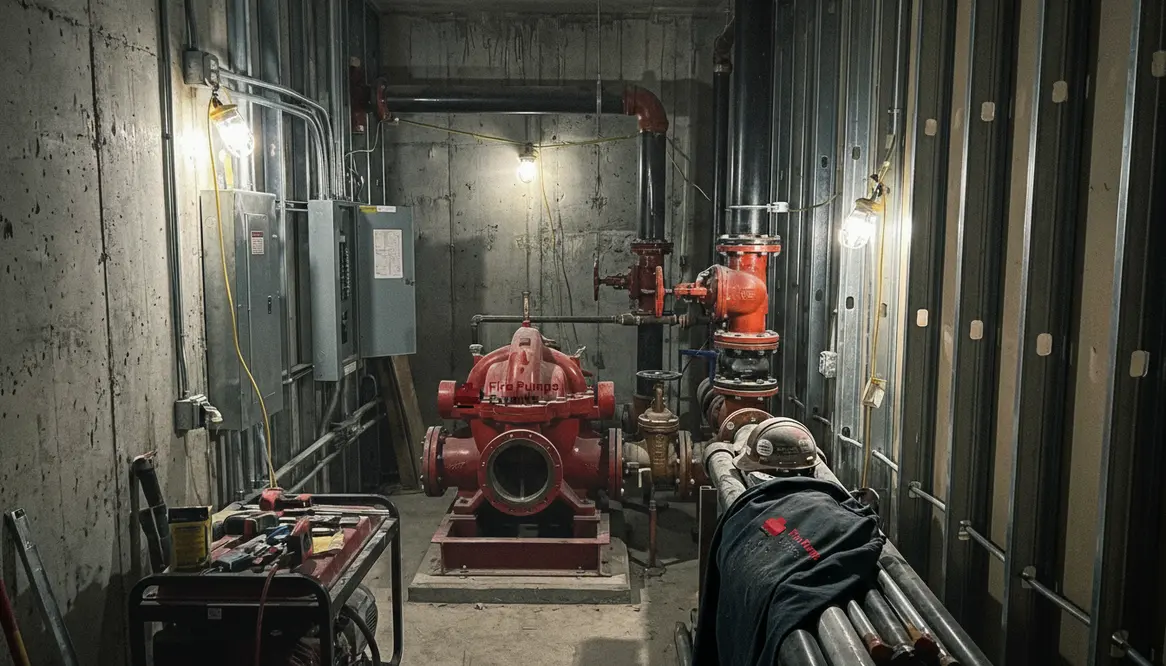
Urban Infill Fire Pump Requirements for Compact Sites
When I step onto a tight commercial jobsite, I already know the dance ahead. Every inch matters, every decision echoes. And right at the center of that choreography sits one critical piece of infrastructure: the fire pump. Planning around urban infill fire pump requirements is not just about code compliance. It is about fitting life safety into spaces that seem to have no room left to give. That tension, between necessity and limitation, is where smart planning earns its keep.
Understanding the Reality of Compact Site Fire Protection
First, I acknowledge the obvious truth. Compact sites do not forgive poor planning. In dense commercial and industrial builds, I rarely get the luxury of extra square footage. Instead, I work with tight mechanical rooms, shared utility corridors, and sometimes spaces that feel like they were designed by someone who thought Tetris was a documentary.
Because of this, fire pump systems must adapt. I focus on selecting configurations that meet urban infill fire pump requirements while minimizing footprint. Horizontal split case pumps, vertical turbine options, or packaged skid systems often become part of the conversation. However, choosing equipment is only the beginning. Placement, access, and serviceability carry just as much weight.
And yes, if you cannot reach a pump to maintain it, you do not really own it. You are just renting a future problem.
How Do I Fit a Fire Pump Into a Tight Mechanical Room?
I start with a simple principle. I design the room around the pump, not the other way around. While that sounds obvious, many projects try to squeeze fire protection into leftover space. That approach rarely ends well.
Instead, I map out clearance requirements early. I consider:
- Equipment footprint and access zones
- Controller placement and visibility
- Pipe routing and valve accessibility
- Future maintenance paths
Then, I coordinate with architects and structural teams before walls get locked in. This early collaboration prevents the classic moment where someone says, “Can we just rotate the pump 90 degrees?” Sure, and while we are at it, let us rotate gravity too.
Additionally, I lean on vertical space. When horizontal room is limited, stacking components or using vertical inline configurations can preserve function without compromising compliance.
Smart Layout Strategies That Actually Work
Now we get into the craft. A compact site does not mean a compromised system. It simply demands sharper thinking.
Prioritizing clean, efficient piping
I prioritize direct, efficient piping layouts. Every unnecessary bend adds friction loss and complexity. So, I keep runs clean and intentional. Furthermore, I position suction lines with proper straight lengths to ensure stable flow into the pump. It is not glamorous, but it is essential.
Keeping systems separated and serviceable
Next, I think about separation. Even in tight conditions, I maintain clear distinctions between fire protection systems and other building services. This reduces risk and keeps inspections straightforward.
And then there is access. I always ask myself, can a technician walk in, diagnose an issue, and fix it without dismantling half the room? If the answer is no, I adjust the layout. Because eventually, someone will be in there at 2 AM wishing I had.
Balancing Code Compliance and Real World Constraints
Meeting code is non negotiable. Yet, compact sites often test the edges of what is practical. This is where experience matters.
I work closely with local authorities to interpret urban infill fire pump requirements in a way that respects both safety and site limitations. Sometimes that means proposing alternative layouts or demonstrating equivalent protection methods.
For example, I may justify a packaged fire pump room with pre engineered fire ratings instead of a traditional buildout. Or I might adjust access points while still meeting intent. The goal is not to cut corners. It is to navigate them intelligently.
Besides, codes are written for safety, not to win an award for most inconvenient room layout.
Key Design Decisions at a Glance
Space Optimization
I select compact equipment and use vertical stacking where possible. This preserves floor area for other critical systems.
Access Planning
I ensure clear service paths. Maintenance should feel like a routine task, not an escape room challenge.
Piping Efficiency
I design clean, direct piping routes to reduce losses and simplify installation.
Code Alignment
I coordinate early with authorities to align design solutions with compliance expectations. For tight projects, that often means walking through specific urban infill fire pump requirements with everyone at the table so there are no surprises once equipment is ordered.
Coordination Is the Secret Weapon
If there is one thing I never skip, it is coordination. Mechanical, electrical, structural, and fire protection systems must move together. Otherwise, conflicts appear late, and late changes on compact sites are rarely gentle.
I use detailed modeling and regular coordination meetings to keep everyone aligned. This approach not only protects the fire pump system but also prevents costly redesigns.
And let me be honest. Nothing builds team unity faster than collectively avoiding a disaster before it happens.
FAQ Quick Answers for Fire Pump Planning
What is the biggest challenge in compact site fire pump design?
Limited space combined with strict clearance and access requirements.
Can fire pumps be installed in smaller rooms?
Yes, if layout, access, and code compliance are carefully planned.
Are packaged fire pump systems a good option?
Yes, they often simplify installation and save space on tight sites.
How early should fire pump planning start?
At the initial design phase to avoid conflicts and redesigns.
Do urban infill projects require special considerations?
Yes, they demand efficient layouts, coordination, and strict adherence to applicable codes. In many jurisdictions, the same urban infill fire pump requirements that protect high rise cores also shape how small mechanical rooms are detailed.
Bringing It All Together
In the end, planning fire pumps for compact commercial and industrial sites is part science, part strategy, and part patience. I treat every square foot like it matters, because it does. When I align design, compliance, and coordination, even the tightest space can support a reliable system.
If you are navigating a dense project and need a solution that fits without compromise, now is the time to act. Let us design a fire pump system that works with your building, not against it, and make every inch count. When urban infill fire pump requirements are treated as design tools instead of obstacles, compact sites stop feeling like a limitation and start looking like an opportunity to build smarter.