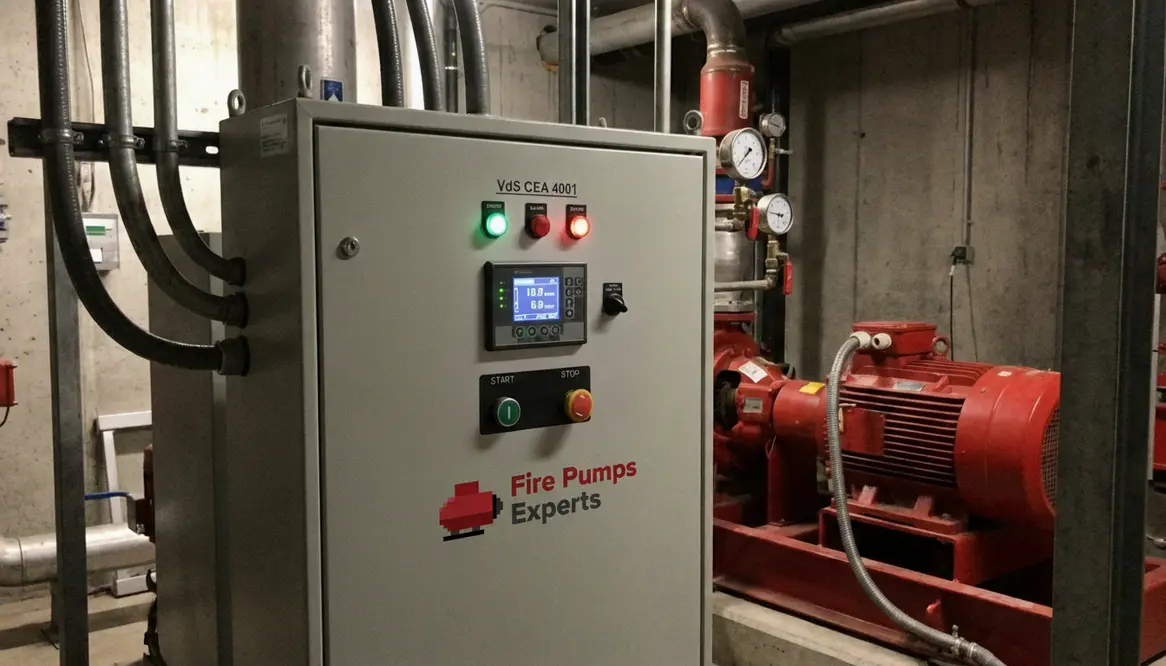
VdS CEA 4001 Fire Pump Controller Requirements
What I look for in commercial and industrial fire protection when choosing and trusting a VdS CEA 4001 controller.
VdS CEA 4001 Fire Pump Controller Requirements: What I Look For in Commercial and Industrial Fire Protection
When I look at a fire pump controller for a commercial tower, a factory floor, or a major property complex, I want one thing first: dependable control when the pressure drops and the stakes rise. That is where the VdS CEA 4001 controller earns its place in the room. It is not there for decoration, like a fancy prop in a sci fi movie. It exists to start the fire pump fast, keep it stable, and support the fire protection system when every second matters. In this article, I walk through the main requirements, how they work in real buildings, and what I would check before I trust one in service.
The VdS CEA 4001 controller is there to turn a drop in pressure into a fast, reliable pump start. When the room is noisy, the alarms are sounding, and nobody is staring at the pump room panel, this controller still has to perform. That is the standard I hold it to in commercial and industrial environments.
What the VdS CEA 4001 standard expects
The standard focuses on safe, automatic, and reliable pump control. In plain terms, the controller must respond when system pressure falls, start the pump without delay, and stay ready for repeated use. That sounds simple, yet the details matter. For commercial and industrial sites, I need a controller that can handle hard duty, not just a clean demo in a quiet room. It should support automatic operation, manual start, and clear fault signals. Also, it should keep working even when conditions get messy, because fire does not wait for a tidy schedule.
Core expectations from a compliant controller
Here is what I treat as core expectations when I look at a controller against the VdS CEA 4001 controller requirements:
Control function
- Automatic pump start when pressure drops
- Safe and clear manual override options
- Reliable switching for the pump motor
- Stable operation under full design load
Safety function
- Clear alarms and fault signals
- Protection against false or unintended starts
- Protection against electrical issues that could stop the pump
- Indications that guide operators during an emergency
How the controller should perform in real buildings
In a high rise, warehouse, or industrial plant, the fire pump controller must do more than pass a test sheet. It has to fit into the building’s fire protection plan. So I look at the power supply, the control logic, and the alarm outputs together. If the controller misses a pressure event, the whole system loses time. And time, as the old detective shows love to remind us, is the one thing you never get back.
I also want strong indication panels. In practice, maintenance teams need to know if the controller is in automatic mode, if the pump has started, or if a fault sits in the system. That helps them act fast. Moreover, the controller should work with the building’s monitoring setup so security or plant staff can respond right away. A quiet fault is a dangerous fault. That is the kind of surprise nobody wants at 2 a.m.
When I evaluate a VdS CEA 4001 controller in a live building, I watch how it behaves with real demand, not just a scripted test. Does it talk cleanly to the monitoring system? Are the indications obvious under stress? Does it make it hard for someone to leave it in the wrong mode by mistake?
In large sites with multiple fire zones, the controller also has to play nicely with other systems and pumps. Coordination between jockey pumps, main fire pumps, and alarms is where a solid controller shows its value.
How I check installation and electrical setup
Installation matters just as much as the unit itself. I always check that the controller sits in a suitable location, with enough protection from heat, moisture, and damage. Then I look at the wiring, the power source, and the motor connection. The controller must match the pump motor and the site’s electrical design. If the sizing is off, performance can slip, and the system will not behave as expected.
I also pay attention to battery or backup support if the design includes it. For major properties and industrial sites, resilience is key. The controller should keep its logic alive long enough to do its job, even during trouble on the supply side. That is not drama. That is basic fire protection discipline.
What I verify on a VdS CEA 4001 controller install
- Location clearances and protection of the controller enclosure
- Correct supply voltage, short circuit protection, and isolation
- Proper motor matching and cable sizing
- Clean, labeled terminations for signals and alarms
- Backup power or battery arrangements, where the design calls for it
What testing and maintenance should cover
Testing tells the truth. A fire pump controller may look perfect on paper, but the proof comes when the system starts under real conditions. I want regular checks on automatic start, manual start, signal lamps, alarms, and fault response. In addition, staff should verify that the controller records the right status and that the pump starts when pressure drops below the set point.
Maintenance should stay simple and steady. I prefer a routine that covers:
- Visual inspection of the enclosure and display
- Functional tests of automatic and manual start
- Review of alarm and fault signals
- Check of wiring, terminals, and control settings
- Confirmation that the pump starts and stops as designed
That may sound like a lot, but compared to a fire event, it is a small investment. And honestly, it beats guessing. Guessing is for game shows, not pump rooms.
Why commercial and industrial facilities need this level of control
Large buildings and industrial sites face higher risk because they often have wide floor areas, complex systems, and heavy water demand. So the fire pump controller must support strong, dependable fire protection across the site. I see this as a business issue as much as a safety issue. A failed pump can lead to major damage, lost operations, and long recovery time. That is bad news for any facility, whether it makes products, stores goods, or manages a major property portfolio.
For that reason, I always recommend working with a supplier that understands commercial and industrial fire protection needs. If you want a deeper look at systems built for these environments, I suggest reviewing this commercial and industrial fire pump solution guide for site focused support and product direction.
Where the VdS CEA 4001 controller fits into the bigger picture
In the full fire protection stack, the VdS CEA 4001 controller is the decision-maker sitting between pressure sensing and pump power. It does not store water, and it does not spray it, but it decides when the heavy machinery wakes up. That role makes it a quiet but critical asset, especially in high-value industrial plants and dense commercial towers.
When I compare options for a new build or an upgrade, I keep coming back to how a VdS CEA 4001 controller handles bad days, not easy ones. Power glitches, sensor noise, false signals, and human error are part of the real world. A controller that copes with that mix without losing sight of its job earns my trust.
FAQs about VdS CEA 4001 fire pump controller requirements
Conclusion
If I am protecting a commercial tower, warehouse, plant, or major property, I do not treat pump control as a side note. I treat it as a core part of the fire protection plan. The VdS CEA 4001 controller gives me a clear path to safe, reliable, and tested operation. If you are planning an upgrade, a new build, or a compliance review, now is the time to act. Choose control gear that supports the system, the building, and the people inside it.