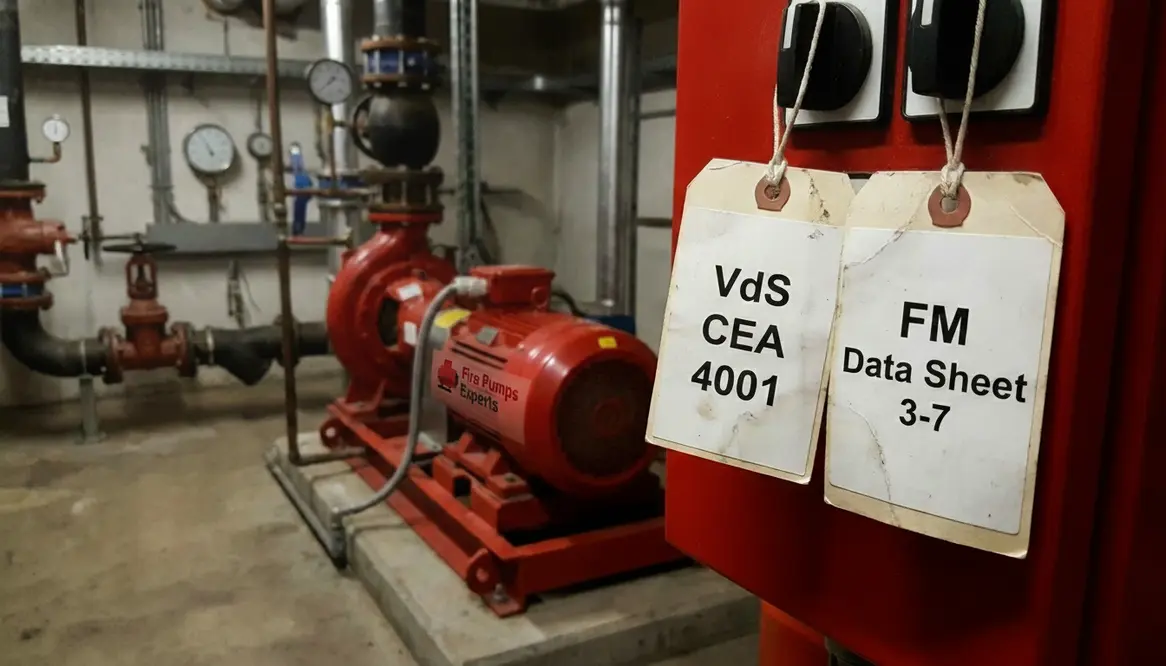
VdS CEA 4001 vs FM Data Sheet 3 7 Fire Pumps
VdS CEA 4001 vs FM Data Sheet 3 7 Fire Pump Requirements
When I compare VdS CEA vs FM DS, I am not just splitting hairs over paperwork. I am looking at how two major standards shape fire pump design for commercial and industrial facilities, especially big properties where failure is not a fun story anyone wants to tell at the quarterly meeting. Both standards aim for dependable fire protection, yet they take different paths on pump setup, testing, supervision, and performance. If you work with a high value building, a plant, or a large complex, these details matter. They can affect compliance, insurance, uptime, and, yes, everyone’s peace of mind.
In this article, I break down the practical differences so you can see what each standard expects and where the real risk lives. The comparison of VdS CEA vs FM DS is not about picking a favorite cousin; it is about understanding which one actually fits your project, your insurer, and your building’s risk profile.
At a glance: why this comparison matters
For large commercial and industrial sites, the fire pump is the quiet backbone of the fire protection system. Choosing between VdS CEA 4001 and FM Data Sheet 3 7 is not a box-ticking exercise; it can change how you select pumps, how you test them, how you supervise them, and how confidently your insurer sleeps at night.
Think of this as a practical map for navigating VdS CEA vs FM DS so your next project does not turn into a compliance maze with a fire pump hiding in the middle.
What I look for in VdS CEA 4001 and FM Data Sheet 3 7
First, I look at purpose. VdS CEA 4001 comes from a European loss prevention view, while FM Data Sheet 3 7 comes from Factory Mutual’s property protection model. Both want a fire pump that starts when the pressure drops and keeps water moving when the building needs it most. However, FM often digs deeper into system reliability and component approval, while VdS focuses strongly on sound fire protection practice and system consistency.
That difference shows up fast. For example, FM tends to be stricter about approved equipment and installation details. VdS also demands discipline, but it may allow more flexibility depending on the design basis and local setup. So, I do not treat them like twins. They are more like cousins who wore the same suit to different weddings.
Purpose in plain language
- VdS CEA 4001: “Design a robust, coherent system that fits European loss prevention practice.”
- FM Data Sheet 3 7: “Control the risk with rigorously approved components and tightly defined installation rules.”
For commercial and industrial sites, I always review the project goal before choosing a path. If the property needs insurer driven approval, FM criteria may carry more weight. If the project sits in a European compliance setting, VdS CEA 4001 may guide the design more closely. Either way, the pump room should not become the forgotten basement of doom.
How VdS CEA vs FM DS handle pump types and power sources
When I compare pump type requirements, I see a clear pattern. FM Data Sheet 3 7 usually leans hard on reliability, so it places strong attention on driver type, fuel supply, and starting method. Electric pumps need stable power, and diesel pumps need dependable fuel storage, ventilation, and cooling. Nothing glamorous, but very important when the alarm sounds.
VdS CEA 4001 also checks driver reliability, yet it often frames the requirement around the full protection concept instead of only the pump itself. That means I have to think about the pump, power source, suction conditions, and the whole water supply chain as one linked system. If one part stumbles, the rest can follow. Fire protection loves a chain, but only if every link shows up to work.
Practical split I keep in mind
| Topic | FM Data Sheet 3 7 | VdS CEA 4001 |
|---|---|---|
| Pump approval | Strong focus on approved equipment | Strong focus on compliant design and system fit |
| Driver choice | Detailed rules for electric and diesel pumps | Rules tied to the overall protection plan |
| Reliability view | Very strict on proven performance | Strict, with more system based evaluation |
So, if I need a quick summary, FM often feels more prescriptive, while VdS can feel more design integrated. That does not make one better than the other. It means I need to match the standard to the project and the insurer’s expectations, especially whenever VdS CEA vs FM DS becomes a debate at design meetings.
Why testing and supervision matter in commercial and industrial sites
Testing separates a working fire pump from a very expensive decoration. FM Data Sheet 3 7 usually expects routine testing, clear records, and close attention to alarms, churn conditions, and pump readiness. VdS CEA 4001 also calls for careful inspection and testing, because a pump that never gets checked can fail at the worst possible time. That is the kind of surprise nobody asked for.
I pay close attention to supervision too. Both standards want alarms, monitoring, and reliable signals so someone knows when a fault appears. In large properties, that matters even more because problems can hide inside complex systems. One silent valve issue or a missed low fuel alarm can grow into a major loss event.
Turning “we test sometimes” into a real plan
- Set a clear test schedule and actually follow it.
- Log results in a way that would make an auditor smile, not squint.
- Train staff so they understand what the alarms mean and what to do next.
- Coordinate with the insurer so your VdS CEA vs FM DS testing regime actually matches their expectations.
For commercial and industrial buildings, I always recommend a clear test log, trained staff, and a maintenance plan that fits the site size. A huge warehouse, hospital, or plant does not get to act casual about fire pump care. The system should prove itself on schedule, not improvise during an emergency like a rookie in a disaster movie.
Where VdS CEA vs FM DS differ on installation details
Installation is where the two standards start showing their personalities. FM Data Sheet 3 7 often pushes harder on details like room layout, pump access, suction piping quality, and approval of supporting parts. It wants the setup to reduce failure risk before the first test even begins. I respect that. It is the engineering version of looking both ways before crossing the street.
VdS CEA 4001 also cares about room conditions, access, suction, and water supply. However, I often see more emphasis on the full fire protection concept and how the pump supports the broader facility strategy. That can give designers room to build a system that fits the property, as long as it still meets the rule set.
Three questions I always ask
What does the insurer require? That may decide the path.
What does the local authority expect? That keeps the project clean.
What does the site risk profile demand? That keeps the building safe.
When I answer those clearly, the standard choice gets much easier. And yes, it saves a lot of back and forth that can feel like office politics with better plumbing.
Which standard fits my project best?
If I work on a major commercial or industrial property, I do not choose a standard by habit alone. I compare the insurer position, the region, the approval path, and the building risk. FM Data Sheet 3 7 often suits projects where insurer approval and strict product control matter most. VdS CEA 4001 often suits European projects or sites already built around VdS based fire protection logic.
In many cases, the right answer is not about one standard defeating the other. It is about matching the fire pump system to the property’s real needs. That is where design quality, testing, and maintenance become more important than theory. A strong system should be practical, reliable, and easy to manage over time. After all, fire protection should work quietly in the background, not demand a heroic rescue scene.
A quick way to frame your choice
- If the insurer or client waves FM approvals like a flag, expect FM Data Sheet 3 7 to set the tone.
- If the project lives in a VdS centric ecosystem, VdS CEA 4001 will likely drive the main decisions.
- If you must reconcile both, treat VdS CEA vs FM DS as a “take the stricter of the two” exercise and design accordingly.
FAQ
Conclusion
VdS CEA vs FM DS is not a beauty contest, it is a question of fit. One project may need the tight product control and detailed installation rules of FM Data Sheet 3 7, while another sits more naturally in the VdS CEA 4001 world with its integrated system logic and European regulatory context. The trick is to anchor your choice in insurer demands, local rules, and the actual risk profile of the building in front of you.
If your commercial or industrial site is large, complex, or high value, the fire pump is not the place for improvisation. Treat the standard as a blueprint, not a suggestion. Align testing, supervision, and maintenance with that blueprint, and the pump room stops being the forgotten basement of doom and becomes what it should have been all along: a quiet, reliable safety net for when everything else goes wrong. And if you want support translating theory into a practical design and inspection plan, you can always reach out to a specialist resource such as https://firepumps.org to keep those standards working in your favor.