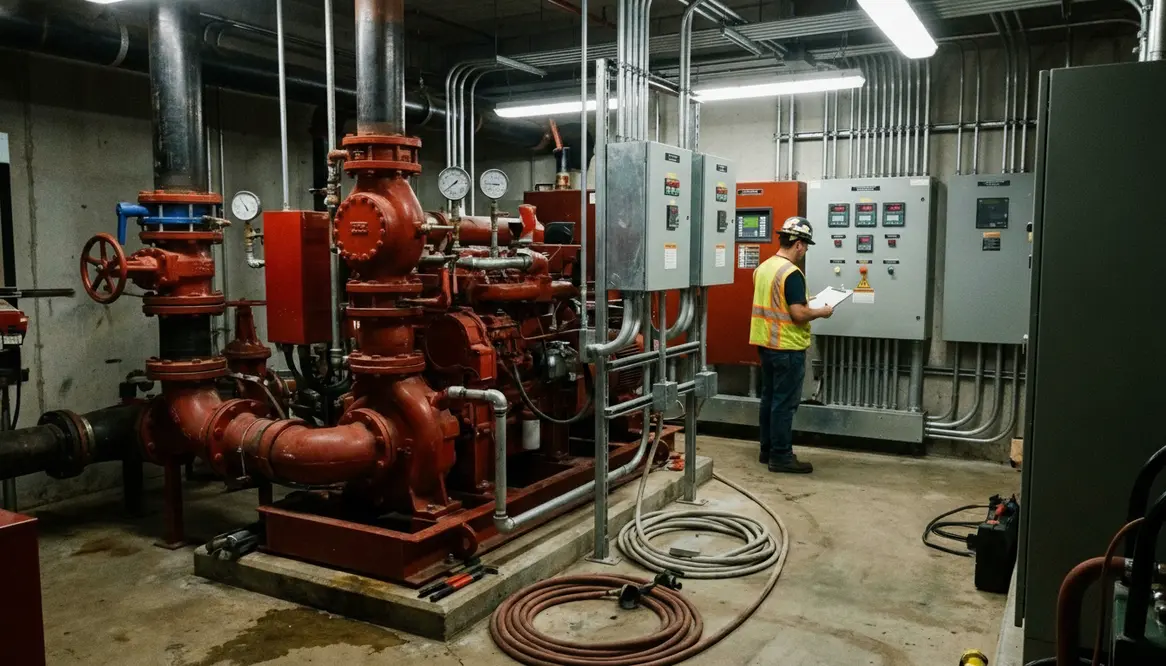
VdS Fire Pump Testing and Commissioning Guide
When I look at fire protection, I see one simple truth: a fire pump is not there to look impressive in a plant room like a shiny prop from a space movie. It exists to perform when pressure drops and the system needs help fast. That is why I rely on VdS testing as a clear path for commercial and industrial facilities, as well as major property buildings, to prove the pump works before anyone trusts it with real risk. In the first 100 words, let me say this plainly: commissioning without proper testing is like sending a heavyweight into the ring with no training. It may look ready, but nobody should bet the building on that.
Why Fire Pump Testing Has To Be Relentless
A fire pump is the heavyweight of a sprinkler or hydrant system. It sits on standby for years, then has to perform at full strength the moment pressure drops. There is no warm‑up lap, no rehearsal, and certainly no second take. VdS testing exists to remove guesswork from that moment. Instead of hoping the pump delivers its rated flow and pressure, the process forces the pump to prove it under controlled, repeatable conditions.
For property managers, risk engineers, and owners of logistics hubs, factories, and large commercial buildings, that proof is not a luxury. It ties into insurance, compliance, and business continuity. When a pump fails during a real fire, the story that follows does not end well for anyone.
What I Check Before Commissioning Starts
Core hardware and design review
I begin with the basics, because the basics usually save the day. First, I confirm the pump type, driver, controller, pipe layout, power supply, and water source. Then I compare the installed system against the approved design and the VdS requirements. If something small is off, it can grow into a larger issue later, and nobody wants a last minute drama worthy of a soap opera.
Safety, access, and readiness
Before I run any test, I also inspect valves, gauges, wiring, alarms, and the suction and discharge lines. In addition, I check that the test area stays clear and safe. For commercial sites and large industrial buildings, this step matters even more because a bad setup can affect daily operations, asset safety, and compliance.
How I Run VdS Testing for Fire Pumps
Structured stages that do not skip the hard parts
Once the system looks ready, I move into structured VdS testing. I do not rush this part, because fire pump work rewards patience and punishes guesswork. The process usually includes three clear stages.
- Start and run observation: I start the pump and confirm smooth operation. I watch for vibration, odd noise, leaks, slow start up, and any sign that the driver struggles.
- Performance under flow: I test performance at different flows. This tells me whether the pump can hold the pressure and flow the building needs, and whether the curve matches what the nameplate promises.
- Alarms, failover, and shutdown: I check alarms, failover functions, and shutdown behavior, because a pump must respond properly under normal and fault conditions.
Snapshot of what I verify during testing
Mechanical checks
Alignment, seals, bearings, suction condition, discharge pressure, and vibration.
Control and safety checks
Controller response, alarm signals, auto start, manual start, and power changeover.
This is where the system proves itself. If the pump behaves well here, I gain confidence that it can serve a warehouse, factory, logistics hub, or other major property without surprises. And yes, surprises are fine in birthday gifts, not in fire systems.
Commissioning Steps I Follow On Site
From tested hardware to trusted protection
Commissioning turns a tested pump into a trusted part of the fire protection system. I usually follow a clear sequence so nothing gets missed. First, I confirm that the installation matches the design documents. Then I document the test setup, take readings, and compare the results to the expected values. After that, I run full functional checks with the fire protection controls and connected systems.
During this stage, I also verify that the water supply can support the pump demand over the required duration. That matters a great deal in larger commercial and industrial facilities, where water loss or pressure drop can change the outcome in a real emergency. In addition, I make sure site staff understand the basic operating steps, because a well trained team can spot trouble early and avoid costly downtime.
Common Problems I Look For
The usual suspects that try to sneak by
Even good systems can hide problems, so I stay alert for the usual suspects. Low suction pressure often points to supply trouble. Excess vibration can suggest alignment issues or worn parts. Likewise, delayed start up may point to control faults or power problems. If the pump cannot reach the required performance curve, I dig into the cause instead of hoping it magically improves overnight. Pumps, unlike old movie villains, do not improve with dramatic timing.
I also watch for poor documentation. Without clean records, a building team can lose track of test results, service dates, and repair actions. That creates risk during audits and can slow down future maintenance. For that reason, I keep every reading, note, and corrective step clear and easy to review.
Solid records are not just paperwork; they are the backbone of recurring inspections and routine VdS testing that keeps a site ready over the long term.
Where VdS Testing Fits Into Your Overall Strategy
Risk, insurance, and ongoing reliability
For many owners, the first contact with VdS testing is through an insurer or consultant who wants proof that a new or upgraded pump will actually perform. That proof does more than tick a box. It can support premium calculations, show due diligence to stakeholders, and give internal teams the confidence to invest in expansion, storage changes, or new production lines without fearing that fire protection has fallen behind.
Regular performance checks also expose slow drifts in condition long before a full failure. Seal wear, driver issues, and controller glitches tend to whisper before they scream. Structured VdS testing turns those whispers into data you can act on.
FAQ
Final Thoughts and Next Step
When I finish a fire pump test and commissioning job, I want one result above all others: certainty. A commercial or industrial site should know the pump will answer when called. If you manage a major property and need dependable support, I recommend planning your VdS testing early, keeping records tight, and working with a team that treats every detail like it matters. Because it does. Reach out now, and let me help you get the system ready the right way, starting with a clear plan, solid execution, and documentation that stands up to any review.