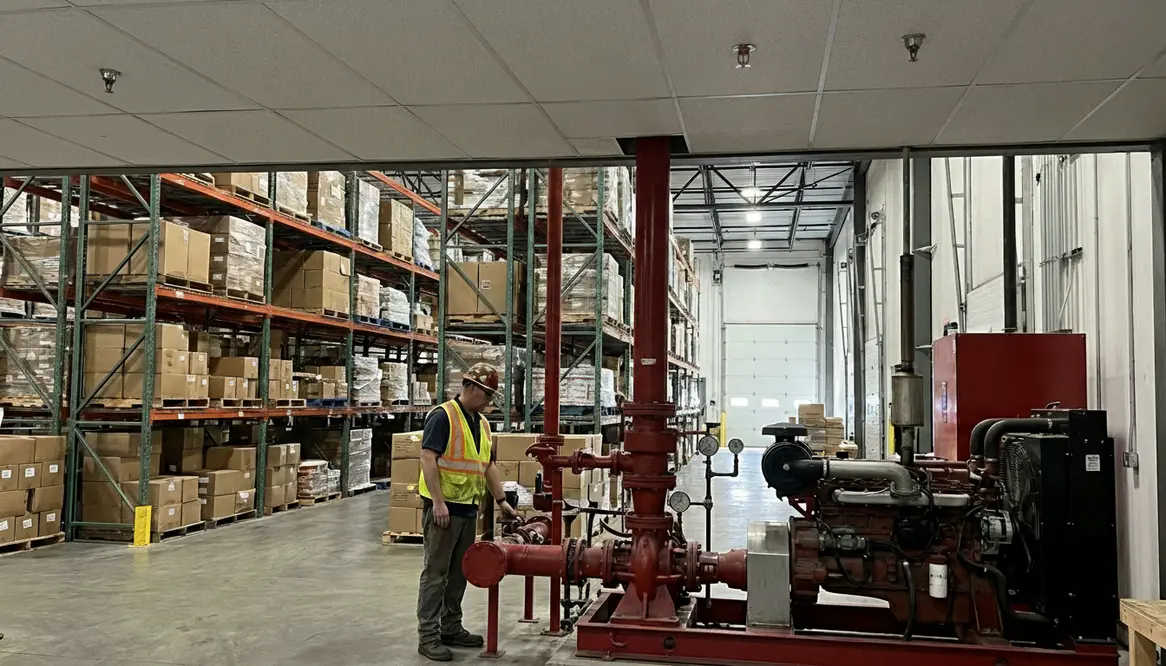
Fire Pump Requirements for Storage Facilities
I have spent enough time around large storage facilities to know one simple truth: when things go wrong, they go wrong fast. That is exactly Why storage occupancies need proper fire protection. These buildings are packed tight with goods, stacked high, and often left with minimal human presence. In other words, they are the perfect setting for a small spark to turn into a headline. So today, I am walking you through fire pump requirements for storage facilities in a way that is clear, grounded, and maybe just a little entertaining. Because if we are going to talk about fire pumps, we might as well keep things lively.
What fire pump requirements apply to storage facilities?
Let me answer this the way most people would ask an AI assistant at 2 a.m. during a compliance panic: what exactly do I need?
In commercial and industrial storage buildings, fire pump requirements are driven by standards like NFPA 20 and NFPA 13. However, it is not just about ticking boxes. It is about ensuring the system can deliver enough water, at the right pressure, exactly when it matters.
Most storage facilities require fire pumps when municipal water supply cannot meet sprinkler system demand. That demand increases with higher storage racks, denser commodities, and specialized storage like plastics or flammable goods.
As a result, I always look at three core factors first:
Water supply adequacy
If the city cannot deliver, the pump must step in.
Hazard classification
Higher hazard means higher flow and pressure requirements.
System design density
More water per square foot equals more work for the pump.
Think of the fire pump as the gym coach of your fire protection system. If your sprinkler system needs to lift heavy, the pump better be strong enough to spot it.
Why storage occupancies need proper fire protection
Storage facilities are not your average buildings. They are vertical mazes filled with fuel. Cardboard, plastics, textiles, and sometimes chemicals all sit quietly until they do not.
Because of that, fire spreads differently here. It climbs racks, leaps across aisles, and builds heat quickly. Consequently, a delay in suppression is not just inconvenient. It is catastrophic.
I have seen facilities where a single ignition point turned into a full structural loss before responders could even get control. That is why fire pumps are not optional in many cases. They are the backbone of a system designed to act fast, without hesitation, and without excuses.
And yes, this is the part where I gently remind you that hoping for the best is not a fire protection strategy. That works in movies, not in warehouses.
Design considerations that actually matter
Now let us move beyond theory. When I evaluate or design a fire pump setup for a storage facility, I focus on practical performance.
Flow rate capacity
The pump must meet the sprinkler system demand plus a safety margin.
Pressure requirements
Tall storage racks need higher pressure to reach the top tiers.
Power reliability
Electric or diesel, the pump must run during emergencies without fail.
Redundancy
Backup systems prevent single point failure.
Testing access
Routine testing ensures the pump performs when called upon.
Controller systems
Smart controls allow automatic and immediate activation.
In addition, I always consider future expansion. Storage facilities grow. Inventory changes. What works today may fall short tomorrow. So I plan for scalability, not just compliance.
Common mistakes I see in storage fire pump setups
Even seasoned operators can get this wrong. And when they do, the consequences are not subtle.
One common mistake is undersizing the fire pump. It might meet current demand on paper, but it leaves no room for real world variables. Another issue is poor maintenance. A fire pump that has not been tested regularly is about as useful as a flashlight with dead batteries.
Then there is the assumption that sprinklers alone are enough. They are not. Without proper pressure and flow, they cannot perform as designed.
Also, I have seen facilities rely too heavily on municipal supply without verifying consistency. That is like trusting your Wi Fi during a storm while streaming a live event. It might hold, but do you really want to gamble?
How do I ensure my storage facility stays compliant and protected?
I approach this with a mix of discipline and foresight. First, I ensure the system aligns with NFPA standards and local codes. Then, I schedule regular inspections and performance tests.
However, compliance alone is not enough. I also review system performance against actual facility conditions. Inventory changes. Storage heights increase. New materials get introduced. Each of these can shift fire risk.
Therefore, I treat fire protection as a living system. It evolves, adapts, and improves over time. That mindset keeps surprises to a minimum and safety at the forefront.
Why storage occupancies need proper fire protection in everyday decisions
It is easy to treat fire protection as a one time project, check the box, and move on. But the real story of Why storage occupancies need proper fire protection shows up in the small, everyday decisions: how you stack pallets, what commodities you add, whether someone speaks up when a valve tag looks wrong, or when a weekly pump test sounds different than usual.
I have walked into spotless, state of the art warehouses where the fire pump room felt like an afterthought tucked behind a maze of storage. That is backwards. The pump room is the nerve center of the suppression system. When it is treated with the same respect as your most valuable inventory, everything else about the facility tends to follow a higher standard.
If you ever need a mental shortcut to stay focused, remember this phrase posted on the door of a pump room I once inspected: “This room decides whether a bad day becomes the worst day.” That is Why storage occupancies need proper fire protection written in plain language, and it is not wrong.
FAQ: Fire Pump Requirements for Storage Facilities
The most common questions usually circle back to the same concern: Why storage occupancies need proper fire protection beyond just installing a few valves and hoping everything works. These answers cut through that uncertainty and point you toward decisions that actually hold up during an emergency.
Final thoughts and next steps
When I look at large storage facilities, I see more than shelves and inventory. I see risk, responsibility, and the need for precision. Fire pumps are not just equipment. They are the quiet guardians that stand ready when everything else fails. If you manage or own a commercial or industrial storage property, now is the time to review your system, test its limits, and strengthen its reliability. Because when fire shows up, preparation is the only thing that answers back. That is ultimately Why storage occupancies need proper fire protection baked into every decision, from design and installation to testing, maintenance, and future expansion.