Fire Pump Requirements for Outsourced Production
I have spent years walking through contract manufacturing facilities where production hums like a well scored symphony. Yet behind that rhythm sits a quiet truth. Without Fire protection for outsourced production sites, everything can stop in seconds. Not in a dramatic Hollywood explosion, but in something far more common and costly. A preventable fire. So today, I am going to walk you through fire pump requirements in these environments with a calm, steady lens. Think less action movie, more chess match. Every move matters.
Why fire pump systems matter in contract manufacturing
Contract manufacturing facilities are unique beasts. They combine high value equipment, varying materials, and changing production lines. Therefore, fire risks are not static. They evolve. And because of that, fire pump systems become the backbone of any reliable suppression strategy.
I have seen facilities rely too heavily on municipal water pressure. That works fine until demand spikes or supply dips. Then suddenly, your sprinklers are more decorative than functional. A properly designed fire pump ensures consistent pressure and flow, even when everything else decides to take the day off.
Additionally, insurers and local codes expect these systems to meet strict standards. Not because they enjoy paperwork, but because downtime in contract manufacturing can ripple across entire supply chains. One fire can delay production for multiple brands. That is not just a facility issue. That is a business continuity crisis.
The hidden cost of downtime
In outsourced production, every lost hour compounds across multiple customers. Missed shipments turn into penalties, strained relationships, and emergency rescheduling. A single preventable fire event can turn a well orchestrated operation into a backlog that takes weeks to unwind.
Why pumps beat hope and luck
Relying on municipal supply alone is essentially a hope based strategy. Fire protection for outsourced production sites demands something better than “it usually works.” Fire pumps convert that uncertainty into controlled, predictable performance when your suppression system is under maximum stress.
How do fire pump requirements differ for outsourced production sites
Here is where things get interesting. Fire protection for outsourced production sites must account for flexibility. These facilities often switch products, processes, and materials. As a result, hazard classifications can shift over time.
I approach this by planning for the highest reasonable hazard level, not the current one. It is a bit like packing an umbrella when the forecast says maybe. You might not need it today, but when you do, you will be glad it is there.
Key requirements I always evaluate
- Water supply reliability which determines whether a fire pump is even optional
- Hazard classification that drives flow and pressure demands
- System redundancy to prevent single points of failure
- Compliance with NFPA 20 which governs fire pump installation
Because of these factors, I rarely recommend a one size fits all solution. Each outsourced production facility deserves a tailored approach that reflects its operational reality.
Why flexibility changes the rules
Traditional single product plants can design fire protection once and forget it for a decade. Outsourced production environments do not have that luxury. New clients bring new materials, new packaging, and sometimes new solvents or combustibles that quietly shift risk categories. Fire protection for outsourced production sites has to be future friendly from day one, so that the next product launch does not outgrow the pump curve.
Core components that define a compliant fire pump system
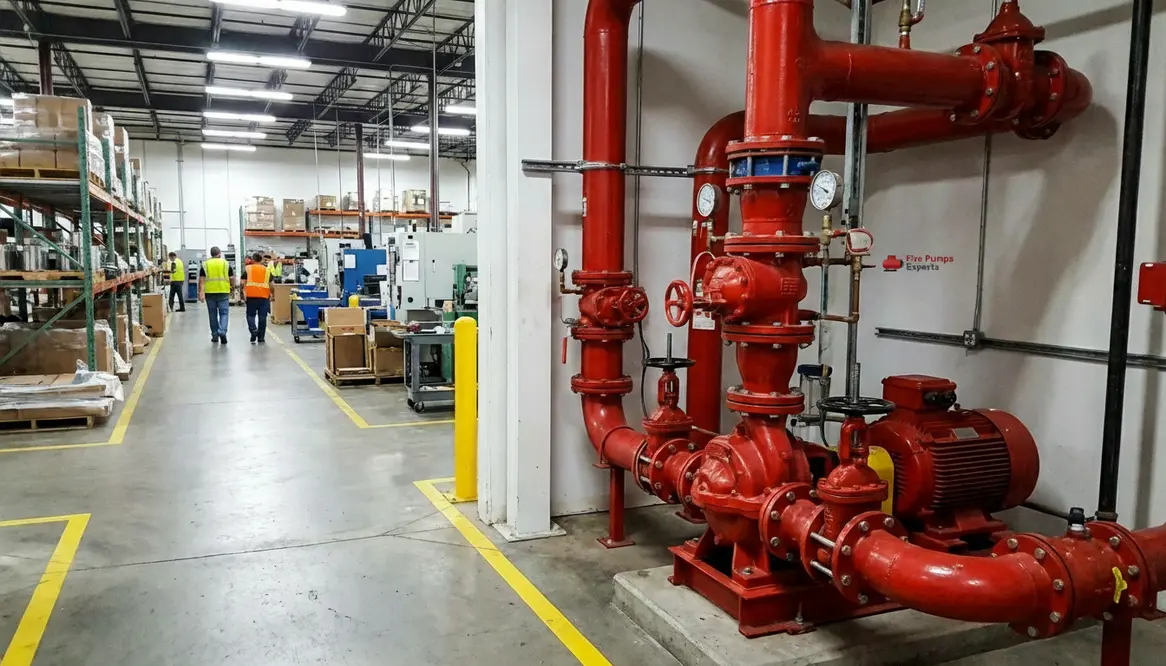
When I walk into a facility, I do not just look for a pump. I look for an ecosystem. Every component must play its role with precision.
Fire pump unit
This is the heart. Electric or diesel driven, it must meet the required flow and pressure without hesitation.
Controller
Think of this as the brain. It ensures automatic activation and monitors performance.
Jockey pump
A small but critical player. It maintains system pressure and prevents unnecessary starts.
Water storage
In many contract manufacturing facilities, on site tanks provide a dependable supply.
Valves and piping
These guide the flow. Poor design here can undermine even the best pump.
Power supply
Reliable power or backup fuel ensures operation during emergencies.
Each element must align with the facility’s risk profile. Otherwise, you end up with a system that looks impressive on paper but underperforms when it matters most. And trust me, fires are not known for giving second chances.
Where many systems quietly fail
Most issues are not heroic, dramatic failures. They are small mismatches: pumps sized for old layouts, tanks that no longer support current storage heights, or controllers that have not been upgraded since the last major process change. Fire protection for outsourced production sites cannot be built once and filed away; it has to evolve with the contracts it supports.
Design considerations that go beyond the basics
Now, this is where experience separates routine installations from resilient systems. Fire protection for outsourced production sites requires thinking ahead.
For instance, I always consider future expansion. Contract manufacturers often scale quickly. If your fire pump system cannot handle increased demand, you will face costly upgrades later. It is like buying a phone with no storage and then acting surprised when you run out of space after two apps.
Additionally, I evaluate environmental conditions. Temperature extremes, flood risks, and even vibration from nearby equipment can impact performance. Therefore, placement and housing of fire pumps matter more than most people realize.
Maintenance access is another critical factor. A system that is difficult to inspect or service will eventually fail. Not because it was poorly designed, but because it was neglected. And neglect, in fire protection, is a silent saboteur.
Design questions worth asking early
- Will upcoming product lines introduce flammable liquids, aerosols, or dust hazards that change the pump demand?
- Is the pump room protected from flooding, freezing, and vehicle impact?
- Can technicians safely access valves, test headers, and controllers without gymnastics or lockout nightmares?
- Is there a clear plan for periodic review as new customers and SKUs arrive?
Thinking this way keeps Fire protection for outsourced production sites aligned with the realities on the plant floor rather than the assumptions in an old design binder.
Compliance, testing, and long term reliability
Installing a fire pump is only the beginning. Keeping it operational is where the real work begins. Regular testing ensures that the system performs as expected under pressure.
I recommend weekly churn tests and annual flow testing, aligned with NFPA standards. These are not just checkboxes. They are opportunities to catch issues early. A minor pressure drop today can signal a major failure tomorrow.
Moreover, documentation plays a vital role. Inspectors, insurers, and facility managers all rely on accurate records. Without them, even a well maintained system can become a liability.
And let us be honest. No one wants to explain to leadership that a preventable issue caused downtime. That is a conversation best avoided.
Building a culture around the pump room
The most reliable facilities treat the pump room as critical infrastructure, not a forgotten corner. Operators know the basic indicators, maintenance staff own the test schedule, and leadership understands how Fire protection for outsourced production sites supports contracts, audits, and long term reputation.
For deeper technical guidance, resources such as https://firepumps.org can help frame specifications, upgrades, and testing approaches around recognized best practices.
FAQ: Fire pump requirements for contract manufacturing facilities
Closing thoughts on protecting production and profit
If there is one thing I have learned, it is this. Fire pump systems are not just about compliance. They are about continuity. They protect not only buildings, but relationships, contracts, and reputations.
So if you are managing or designing a contract manufacturing facility, take a closer look at your system. Make sure it is ready, not just present. Because when the unexpected happens, preparation is the difference between a brief interruption and a lasting setback. And if you need guidance, now is the time to act before the alarm ever sounds.