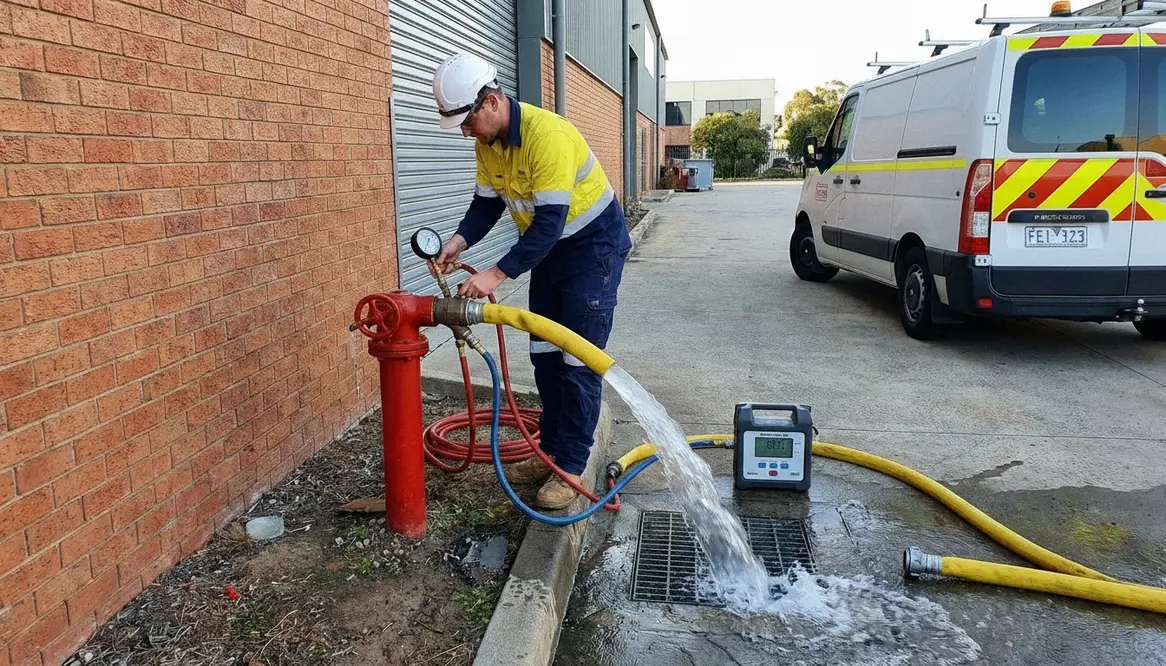
Fire Hydrant Testing Australia Requirements Guide
A practical, Australian-focused walkthrough of how fire hydrant testing keeps commercial and industrial buildings ready for the day everyone hopes never arrives.
Fire Hydrant Testing Explained: Australian Requirements
When I talk about fire hydrant testing, I am talking about one of the quiet heroes of building safety. It is not flashy. It does not wear a cape. Yet when a fire breaks out in a commercial tower, warehouse, or industrial site, this system can mean the difference between control and chaos. In Australia, the rules are clear, and they matter. If you own or manage a major property, you need to know what gets tested, why it gets tested, and how often it happens. The good news is that the process is simple once you break it down.
And yes, this is one of those topics that sounds dry at first. But stay with me. Once you see how the system works, it becomes less “boring compliance paperwork” and more “let us avoid a very bad day.”
What Australian fire hydrant rules actually require
In Australia, fire hydrant systems must meet the intent of the National Construction Code and the relevant Australian Standards, especially AS 1851 for routine service and AS 2419 for design and installation. In plain English, that means the system must stay ready, usable, and able to deliver enough water when needed. That is the whole point. A hydrant that looks fine on the wall but fails under pressure is about as helpful as a superhero who forgets their shoes.
For commercial and industrial buildings, I always focus on three things: flow, pressure, and access. First, the system must deliver the right water flow. Second, it must maintain proper pressure. Third, people must be able to reach and use it without delay. Moreover, the site must keep records that show the system has been checked and maintained on time.
Why these rules are worth your attention
Fire codes, Australian Standards, and the National Construction Code can feel like an alphabet soup of obligations. The real story is simpler: a compliant hydrant system buys time, control, and options when heat and smoke turn your building into a problem no one wants.
Treating fire hydrant testing as a checklist exercise misses the point. It is about proving, in measurable terms, that your system can still do its job under stress, not just that it looked fine during last year’s walkthrough.
How I test a fire hydrant system step by step
Here is the practical side. During fire hydrant testing, I usually work through the system in a clear order so nothing gets missed.
1. I inspect the visible parts
I check valves, landing valves, hose reels if linked, signage, cabinets, couplings, and general access. If a forklift has turned the hydrant area into a storage zone, that is a problem. A very common one, sadly.
2. I test the water supply
Next, I confirm that the supply can perform under demand. This may involve measuring pressure and flow at the hydrant outlet and comparing the result with the system design. If the pump set supports the system, I also verify pump operation and response.
3. I check for leaks, damage, and wear
Small leaks can grow fast. So can corrosion. I look for damage in pipes, fittings, and valves. I also confirm that the system has not been altered in a way that weakens performance.
4. I record the results
Finally, I document everything. This part may not sound exciting, but records matter when an auditor, insurer, or regulator asks for proof. Paperwork may not save a building on its own, but it certainly helps avoid a headache later.
Dual view: what I check and why it matters
Fire hydrant testing is more than staring at gauges. Every reading and inspection line ties back to a simple question: will this system help crews control a real fire?
| What I check | Why it matters |
| Hydrant pressure | Shows the system can fight fire at the point of use |
| Water flow | Confirms enough water reaches the fire attack point |
| Valves and fittings | Prevents failure during emergency use |
| Access and signage | Helps crews find and use the system quickly |
| Maintenance records | Proves the building stays compliant |
How often commercial sites should test hydrants
For most major properties, routine inspection and testing follow a scheduled maintenance plan under AS 1851. The exact timing depends on the building, system type, and risk level. However, the general idea stays the same: do not wait until something fails before you check it. That approach belongs in a disaster movie, not in a warehouse or office tower.
In many cases, I see monthly visual checks, periodic flow testing, and more detailed annual service work. Also, after any major repair, alteration, or incident, I recommend testing again. If the system has changed, the performance may have changed too. Fire safety does not like surprises, and frankly, neither do insurers.
What usually causes hydrant failures
Most hydrant problems do not appear out of nowhere. They build slowly. Corrosion inside pipework can reduce flow. Blocked valves can stop water movement. Pump faults can limit pressure. In addition, poor site housekeeping can block access and make the hydrant hard to use during an emergency.
AS 2419 guidance and good industry practice both push us toward the same goal: make the system reliable, keep it clear, and prove it works. For a useful technical overview, I also recommend this guide to AS 2419 hydrant compliance and maintenance. It gives a strong reference point for building owners who need to understand the standard in more detail.
If your site leans on pumps, tanks, or complex ring mains, structured fire hydrant testing becomes even more important. Every extra component is another potential point of failure, and the only honest way to know where you stand is to test, measure, and keep your records straight.
Why fire hydrant testing belongs in your risk plan
People and property protection
On the worst day your building will ever see, crews rely on hydrants to push a lot of water to exactly the right spot. Regular, structured fire hydrant testing is how you make sure that happens. It protects occupants, firefighters, adjacent properties, and your business continuity all at once.
Compliance and credibility
For owners and facility managers, a clean log of fire hydrant testing, inspections, and maintenance is a powerful asset. It keeps auditors calmer, insurers friendlier, and regulators far less interested in your building for the wrong reasons.
FAQ
Conclusion
If you manage a commercial or industrial site, I recommend treating fire hydrant testing as part of your core risk plan, not an optional extra. A compliant system protects people, property, and business continuity. It also saves you from nasty surprises when the pressure is on, which is a nice bonus. If you want your site checked properly, keep your schedule tight, your records clean, and your system ready. That is how I help buildings stay safe, compliant, and prepared.