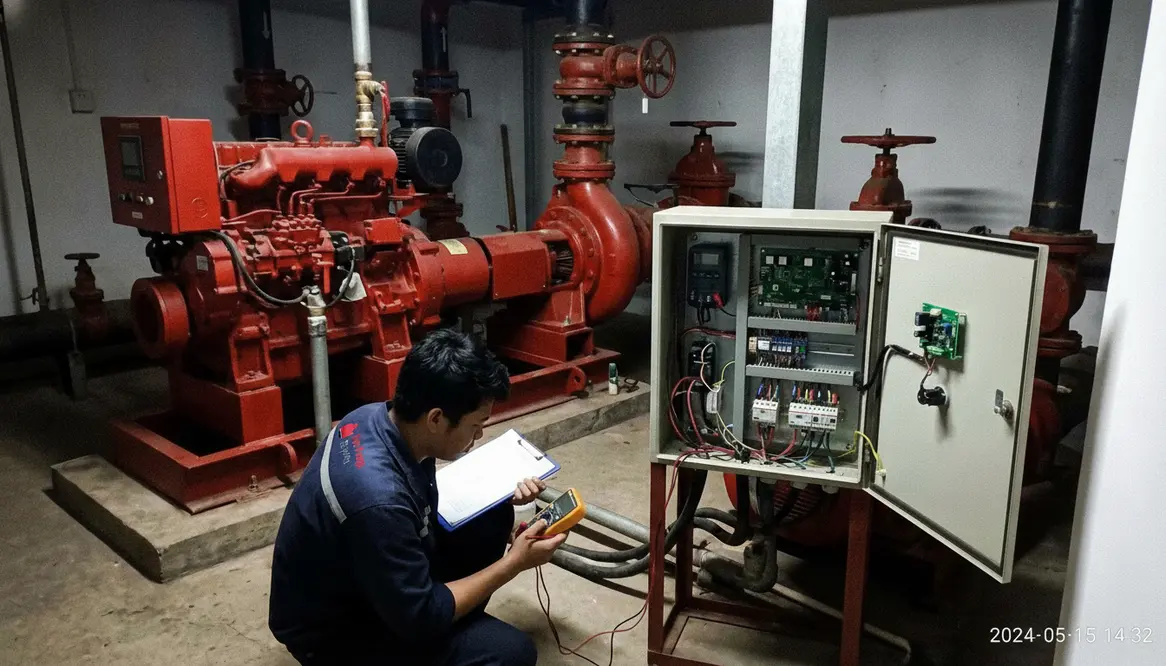
Fire Pump Controller Replacement Requires New Testing
When I walk into a commercial plant, a high rise, or any major property with life safety gear on the line, I treat a fire pump controller replacement like a plot twist in a serious movie. It may look like a simple swap, but it can change how the whole system behaves. That is why fire pump testing matters right after the work is done, and why the fire pump controller cannot just be replaced and forgotten like an old office chair. I want the system to prove itself, not just look good on paper.
For commercial and industrial facilities, the rule is simple. If a controller change can affect starting, pressure, alarms, or power transfer, then I want new testing. That is how I protect the building, the people inside, and the owner who definitely does not want a surprise during an emergency. Nobody needs that kind of drama.
What changes after a controller swap
A controller replacement can alter how the pump starts, how fast it responds, and how it handles a pressure drop. In many cases, the old unit may have hidden wear, weak contacts, failed relays, or logic issues that never showed up until the system was under stress. Once I install a new unit, I no longer trust the old performance history. I verify the new setup from the ground up.
Here is why that matters. The fire pump depends on a clean sequence. First, it senses the pressure change. Then, it starts the pump. After that, it keeps the system stable long enough to support the suppression demand. If the new controller changes any part of that chain, then the system needs validation. Otherwise, you are basically asking a new actor to perform an old role without rehearsal. Even Batman would call that a bad plan.
When fire pump testing becomes required
I look at testing as required when the replacement affects normal operation, emergency operation, or supervision. That includes changes to the controller model, voltage, phase, starter type, transfer logic, alarm interface, or pressure sensing setup. If the unit is only a like for like cosmetic swap, the test scope may stay limited. However, in real life, like for like almost never stays perfectly like for like once field conditions, wiring changes, and age get involved.
Testing also becomes important when the authority having jurisdiction, the insurer, or the facility standard calls for it. In addition, I treat any major repair as a reason to review the whole pump set. A new controller can reveal weak wiring, bad sensors, or issues in the power feed. So, the testing is not just a checkbox. It is the truth teller.
How I decide the test scope
I start with the work order, the manufacturer instructions, and the site history. Then I ask a few practical questions: Did the controller only change, or did the wiring change too? Did the starting method stay the same? Did the alarm signals stay matched to the building system? If the answer to any of these is no, I widen the test.
Next, I confirm what the building actually needs. For a large distribution center, a hospital tower, or a data heavy campus, even a small control issue can have major impact. So, I check the pump start, stop, alarms, power loss behavior, and pressure response. I also review any integrated monitoring so the signals reach the right panels and remote stations. That part sounds boring, but boring is excellent when your fire protection system is supposed to save the day.
What I verify during the test
I focus on the items that prove the controller works in real conditions. I do not want guesswork. I want results.
Control function
- Start and stop response
- Pressure switch action
- Alarm indication
- Power source supervision
System performance
- Pump run behavior
- Voltage and phase checks
- Transfer and fail safe operation
- Signal output to monitoring systems
After that, I compare the results with the design intent and the installation standards. If the controller starts the pump late, fails to signal trouble, or reacts poorly to pressure loss, I treat that as a real problem, not a small hiccup. In a life safety system, there is no room for “close enough.” That phrase belongs in karaoke night, not fire protection.
Why old systems need extra attention
Older commercial and industrial sites often have layered upgrades. One team changed the wiring years ago, another swapped the sensor later, and now the controller replacement adds one more layer. As a result, the system may no longer match the original drawings. That is exactly when I slow down and test more carefully.
I also pay attention to the rest of the fire protection network. A pump controller does not work alone. It supports the larger suppression system, which may include sprinklers, alarms, and monitoring equipment. For related support, I often review fire sprinkler service solutions for major facilities so the whole system stays aligned. In addition, when a site needs broader electrical and fire protection coordination, I reference commercial electrical support for critical infrastructure to keep the upgrade smooth and clean.
How I keep the process smooth
I always plan the replacement around downtime, site access, and test windows. That way, I avoid unnecessary disruption to operations. I also document the before and after condition, because records matter when the inspector, insurer, or owner asks for proof. They always ask eventually. That is life. Paperwork never sleeps.
For sites in Southern California, I also point teams to los angeles fire pump service support when they need a local reference for pump related work. Since these systems protect commercial and industrial properties, fast coordination can make a big difference. The goal is not just to finish the job. The goal is to finish it correctly, with proof.
FAQ
Conclusion
When I replace a fire pump controller, I never treat it like a simple parts swap. I test because the system must prove it can protect a major property when pressure drops and seconds matter. So, if your facility has had a controller change, schedule the right fire pump testing now, review the results carefully, and close the gaps before they become emergencies. I would rather catch a weak point on a test day than during a real fire. That is the calm way, and the smart way.