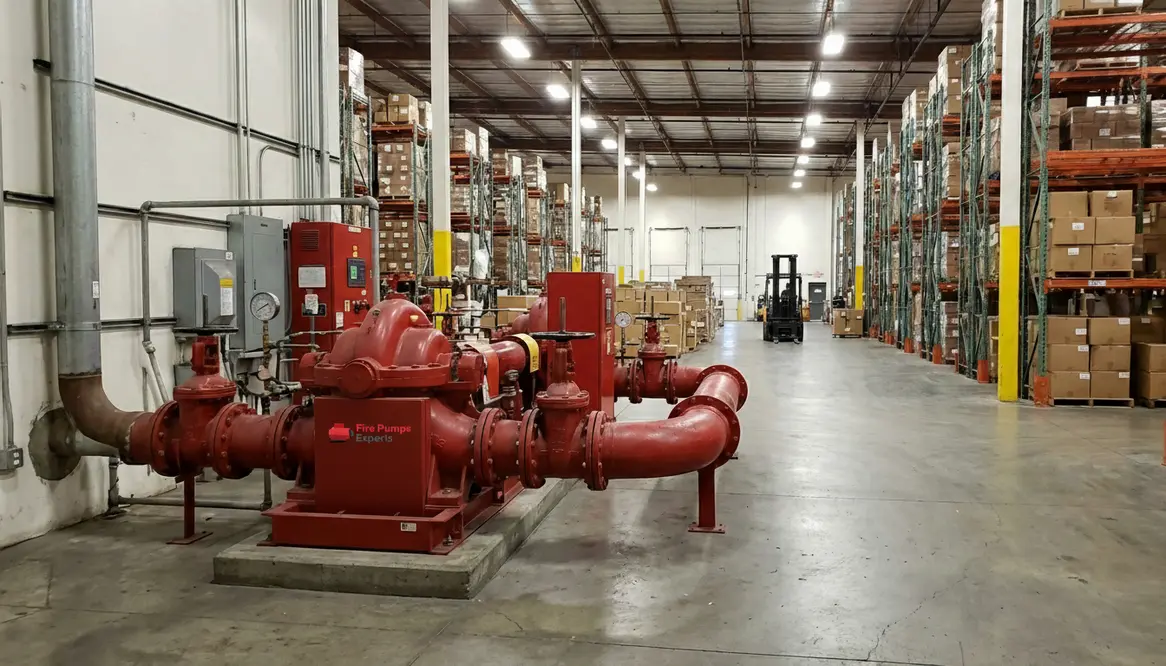
Fire Pump Distribution Center Fontana CA Guide
I have spent enough time around large scale logistics buildings to know one thing for certain. When it comes to fire protection, there is no room for guesswork. In a fire pump distribution center Fontana CA environment, every second counts and every system must perform without hesitation. These facilities move fast, store high value inventory, and operate around the clock. So naturally, the fire pump you choose cannot just be good. It has to be dependable, precise, and built for serious demand. Think less “nice to have” and more “this better work every single time.”
Understanding the Demands of Large Distribution Facilities
First, I like to set the stage. Distribution centers in Fontana are not your average buildings. They stretch across vast square footage, often with high rack storage and complex sprinkler systems. Because of that, they demand strong water pressure and consistent flow.
Additionally, these facilities often operate at peak capacity, which means downtime is not an option. If a fire pump system fails, the consequences are not just inconvenient. They are catastrophic. Therefore, selecting the right fire pump is less about preference and more about matching performance to risk.
And let’s be honest, no one wants to explain to upper management why the “budget friendly” option suddenly became the most expensive mistake.
Which Fire Pump Types Perform Best in Distribution Centers
I get this question all the time, and the answer depends on layout, water supply, and hazard classification. However, a few fire pump types consistently stand out in high demand industrial environments.
Horizontal Split Case Pumps
These are the workhorses. I rely on them for their durability and ease of maintenance. Because of their design, they handle high flow rates efficiently, making them ideal for large sprinkler systems.
Vertical Turbine Pumps
Now, when the water source comes from underground wells or tanks, I turn to vertical turbine pumps. They excel in pulling water from deep sources, which is often the case in large scale Fontana developments.
End Suction Pumps
These are more compact, but still effective. I recommend them when space is tight, though they typically serve smaller sections of a facility rather than the entire operation.
Each option plays a role, and choosing incorrectly is like casting the wrong actor in a blockbuster film. Sure, it might still work, but something will feel off.
fire pump distribution center Fontana CA Design Factors That Matter Most
When I evaluate a system for a fire pump distribution center Fontana CA project, I focus on a few critical elements.
Water supply reliability
First, I look at water supply reliability. If the municipal source cannot meet demand, I plan for backup storage and pumps that can compensate.
System pressure requirements
Next, I assess system pressure requirements. High rack storage needs stronger pressure to ensure water reaches the top levels effectively.
Redundancy and reliability
Then, I consider redundancy. Because if one pump fails, another must immediately take over. No drama, no delay.
Compliance and standards
Finally, I account for compliance. NFPA standards are not suggestions. They are the rulebook, and skipping steps is not an option.
In other words, I design systems like I expect the worst day to happen. Because eventually, it might.
Comparing Pump Types Side by Side for Practical Decisions
Horizontal Split Case
Best for: Large scale systems
Strength: High efficiency and easy maintenance
Consideration: Requires more floor space
Vertical Turbine
Best for: Deep water sources
Strength: Strong suction capability
Consideration: Installation complexity
Seeing them side by side makes decisions easier. It is a bit like choosing between a pickup truck and a sports car. Both are impressive, but only one fits the job at hand.
How I Future Proof Fire Protection Systems in Industrial Spaces
Now here is where things get interesting. I never design just for today. I design for what the facility might become five or ten years down the line.
For example, distribution centers often expand storage height or increase inventory density. When that happens, fire protection demand increases. So, I plan for scalability from the start.
Additionally, I integrate smart monitoring systems. These allow operators to track pump performance in real time. Because if something starts to drift, I want alerts before it becomes a problem.
And yes, while it may sound like overkill, I prefer overprepared to under pressure. Literally.
fire pump distribution center Fontana CA Installation and Maintenance Insights
Installation is where plans meet reality. And in a fire pump distribution center Fontana CA setting, precision matters.
I ensure alignment, proper foundation, and correct piping configurations from day one. Even the best pump will fail if installed poorly.
Then comes maintenance. Regular testing, inspections, and performance checks keep systems ready. I treat maintenance like brushing your teeth. Skip it long enough, and things get ugly fast.
Moreover, trained personnel make a difference. A well maintained system is not just reliable. It is predictable, and that is exactly what you want in an emergency.
FAQ: Fire Pumps for Distribution Centers
Below are some of the questions that come up most often when planning a fire pump distribution center Fontana CA project, from reliability to testing frequency and redundancy.
Final Thoughts and Next Steps
If you are responsible for a distribution center, this is not the place to cut corners. The right fire pump system protects your people, your inventory, and your operation. I always recommend working with specialists who understand large scale industrial needs and local requirements.
If you are planning or upgrading a system, now is the time to act. Because when it comes to fire protection, preparation is everything. That is especially true in a fire pump distribution center Fontana CA facility, where every second of system performance carries real financial and safety consequences.
For deeper technical guidance and standards, you can review NFPA resources and industry references, or explore specialist content at https://firepumps.org before finalizing your design strategy.