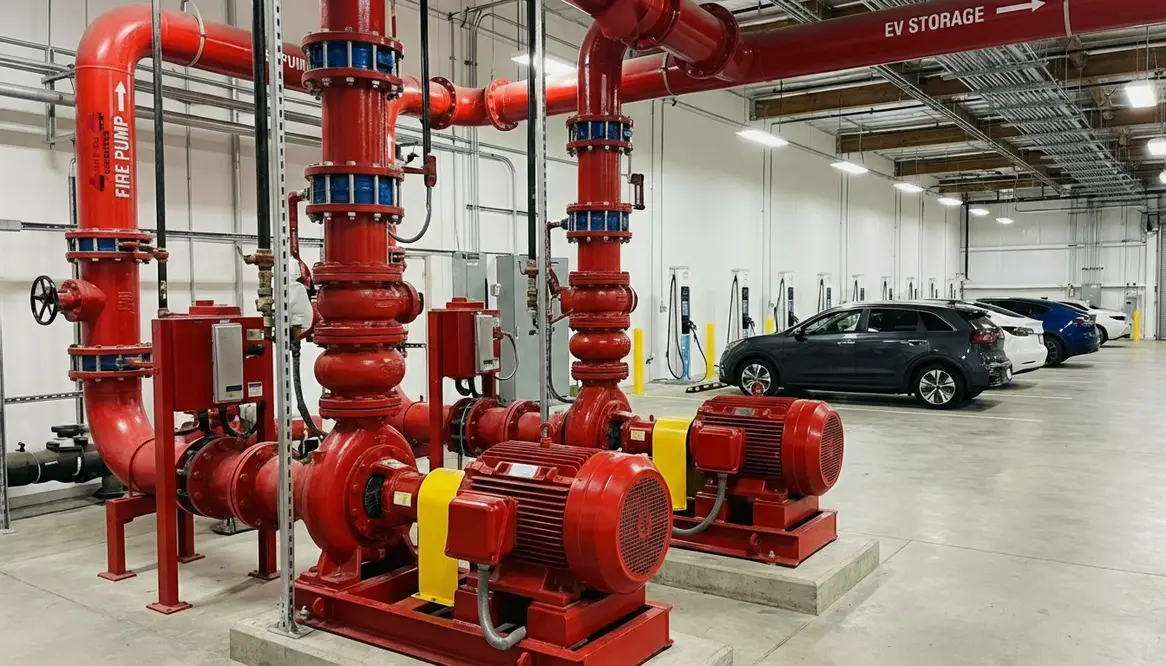
Fire Pump EV Facility Torrance Design Guide
I have spent enough time around industrial sites to know one thing for certain: when lithium batteries decide to misbehave, they do not send a polite warning first. That is exactly why fire pump EV facility Torrance projects demand careful thinking from day one. In a city like Torrance, where innovation meets dense commercial infrastructure, the margin for error is slim. So I take a slow, deliberate approach to fire protection design, because when the stakes are high, guesswork belongs in game shows, not engineering plans.
Understanding Fire Risks in EV Storage Environments
First, I look at the nature of the hazard. EV storage facilities are not your typical warehouse filled with cardboard boxes and good intentions. Instead, they house high energy lithium ion batteries that can enter thermal runaway. Once that chain reaction starts, it behaves less like a fire and more like a stubborn argument that refuses to end.
Because of this, I factor in rapid heat release, toxic gases, and re ignition risks. Additionally, I consider how tightly vehicles are stored and whether charging systems are active. These elements shape the type of suppression system required. A standard setup might handle ordinary combustibles just fine. However, EV storage demands something more resilient and responsive.
How Do I Choose the Right Fire Pump for EV Storage in Torrance?
I start with water demand. It sounds simple, yet it is where most designs either shine or quietly fall apart. EV fires require sustained flow over extended periods. Therefore, I evaluate the expected fire duration and match it with a pump that can maintain pressure without breaking a sweat.
Next, I consider reliability. In Torrance, seismic factors and power stability play a role. So I often lean toward diesel driven pumps for critical facilities. Electric pumps are efficient, but when power fails during an emergency, efficiency becomes a very philosophical concept.
Then comes system integration. The pump must work seamlessly with sprinklers, standpipes, and detection systems. If these components do not communicate well, the result is like assembling the Avengers without a plan. Plenty of power, very little coordination.
Key Fire Pump Types I Evaluate for EV Facilities
Not all fire pumps are created equal. Each type brings its own strengths, and I match them carefully to the facility’s needs.
Split case pumps offer high efficiency and are ideal for large commercial buildings. I often use them when consistent, high flow is required.
Vertical turbine pumps become essential when the water source sits below ground. In some Torrance properties, this is not optional, it is reality.
End suction pumps work well for smaller industrial setups, though I approach them cautiously for EV storage due to demand intensity.
Meanwhile, I always weigh maintenance access. A pump that is hard to service tends to become a pump that is not serviced. And that is a story that never ends well.
Fire Pump EV Facility Torrance Design Factors I Never Ignore
Design is where theory meets consequence. So I pay attention to details that others might rush past.
Water Supply Considerations
- Reliable municipal connection
- Backup storage tanks
- Pressure consistency during peak demand
System Performance Goals
- Required gallons per minute output
- Pressure at the most remote point
- Duration of sustained operation
Additionally, I account for local codes and insurance requirements. Torrance does not leave much room for improvisation, and neither should you. Codes exist because someone, somewhere, learned a hard lesson.
Balancing Efficiency, Cost, and Long Term Reliability
Now, let us talk about the balancing act. Every client wants efficiency. Every budget has limits. And every facility expects reliability. Getting all three is possible, but it requires discipline.
I avoid oversizing pumps just to feel safe. Bigger is not always better. In fact, an oversized pump can cause pressure issues and unnecessary wear. On the other hand, undersizing is like bringing a garden hose to a wildfire. Bold, but not effective.
Instead, I rely on precise calculations and real world scenarios. I ask how the facility will operate five years from now, not just on opening day. Because systems that age gracefully save money and headaches down the road.
Common Mistakes I See in EV Fire Pump Selection
Some mistakes show up more often than I would like. So I call them out early.
- First, ignoring battery fire behavior. EV fires are not traditional, and treating them as such leads to underperforming systems.
- Second, poor integration. A strong pump paired with weak distribution is like having a sports car stuck in traffic. Impressive, but ineffective.
- Third, neglecting maintenance planning. If a system cannot be tested easily, it will not be tested often. That is just human nature.
- And finally, chasing the lowest upfront cost. That decision often comes back later, usually at the worst possible time.
Strategic Planning for a Fire Pump EV Facility Torrance Project
A well executed fire pump EV facility Torrance layout always starts with a realistic look at how vehicles move, charge, and sit in storage. I map circulation paths, dead zones, and high density parking to understand where heat and smoke are most likely to accumulate.
From there, I match pump capacity and distribution so that the most remote, most inconvenient corner of the facility still receives the water it needs. If a design only looks good on paper at the riser room, it is not ready for the reality of a fire pump EV facility Torrance installation.
FAQ: Fire Pump Selection for EV Storage Facilities
Below are some of the questions I hear most often when planning protection for any fire pump EV facility Torrance project.
Final Thoughts and Next Steps
Choosing the right fire pump is not just a technical decision, it is a responsibility. If you are planning or upgrading a facility, I encourage you to approach it with clarity and intention. Work with experts who understand EV risks and commercial scale systems. The right design protects assets, people, and your peace of mind. When you are ready, take that next step and build a system that performs when it matters most.
If you want a deeper technical reference point on system components and performance expectations, you can review resources such as https://firepumps.org alongside local jurisdictional requirements to keep your planning aligned with industry standards.