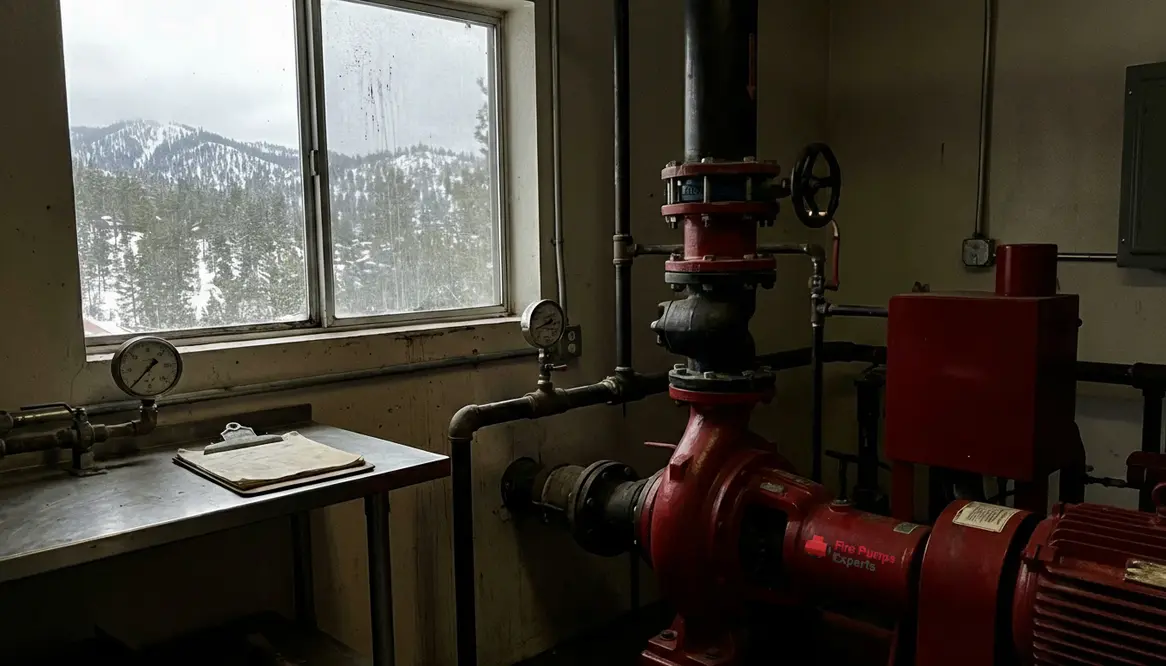
Fire Pump High Elevation Performance Big Bear
What actually happens to your fire pump when you take it 6,700 feet up a mountain, and what that really means for your Big Bear Lake property.
I have spent enough time around pump rooms to know one thing for certain. Water behaves differently when you take it up a mountain. And in places like Big Bear Lake, that difference is not subtle. When we talk about fire pump high elevation performance Big Bear, we are really talking about how physics quietly shifts the rules while most people are not looking. Up here, the air thins, pressure drops, and suddenly that dependable system at sea level starts acting like it skipped its morning coffee.
So let me walk you through what actually changes, why it matters for commercial and industrial properties, and how to stay ahead of it without losing sleep or budget.
What Changes in Fire Pump Performance at High Elevation in Big Bear
The first thing I always point out is this. Elevation reduces atmospheric pressure. That means your pump does not get the same help pushing water as it would down below. As a result, suction pressure drops, and performance curves shift whether you like it or not.
Now, in Big Bear Lake, we sit above 6,700 feet. That is not Everest, but it is high enough to matter. Consequently, fire pumps must work harder to achieve the same output. You may still meet flow requirements on paper, but in practice, efficiency dips and margins shrink.
And here is the quiet troublemaker. Net Positive Suction Head, or NPSH. At higher elevations, available NPSH decreases. If that number falls too low, your pump can cavitate. And cavitation is not just a fancy word. It is the sound of your system slowly tearing itself apart from the inside. Not exactly the soundtrack you want in a commercial facility.
Why This Matters More Up Here
At sea level, a mildly stressed pump can often skate by without anyone noticing. At 6,700 feet, the same pump might struggle to deliver what your design promised. That is why fire pump high elevation performance Big Bear needs its own attention instead of borrowing assumptions from lower altitudes.
If you are counting on a margin of safety built into the original design, elevation may already be eating into it quietly. By the time testing shows a problem, that margin may be gone.
Why Pressure Loss Hits Commercial Systems Harder
In large buildings, everything scales up. Longer pipe runs, higher vertical lifts, and more complex layouts. Therefore, even a small loss in pressure becomes a big deal fast.
For example, a distribution center or resort property in Big Bear may rely on multiple zones. Each zone demands consistent pressure. However, when elevation reduces baseline performance, those zones start competing for flow like kids fighting over the last slice of pizza.
Additionally, fire codes do not relax just because you are closer to the clouds. Systems still need to deliver required flow and pressure at the most remote points. So if your pump underperforms, compliance becomes a moving target.
I have seen facilities assume their standard pump setup would translate directly from lower elevations. It rarely does. The mountain always has the final say.
How I Evaluate Fire Pump High Elevation Performance Big Bear Systems
When I step into a pump room up here, I look at three things right away. Not because I enjoy routine, but because these factors tell the whole story quickly.
System Inputs
- Available water supply pressure
- Suction pipe configuration
- Elevation adjusted NPSH values
System Outputs
- Actual flow versus rated flow
- Discharge pressure under load
- Motor performance under strain
Once I compare these, patterns emerge. If output struggles while inputs look tight, elevation is usually the invisible hand tipping the scale.
And yes, sometimes the fix is not dramatic. It might be as simple as adjusting pump selection or revisiting suction design. Other times, it requires a more serious upgrade. Either way, guessing is not a strategy.
Smart Design Adjustments That Actually Work
So what do I recommend when designing or upgrading systems in Big Bear Lake? I focus on practical moves that respect the environment instead of fighting it.
Select Pumps With Realistic Margins
First, I lean toward pumps with higher performance margins. Not oversized for the sake of it, but selected with elevation derating in mind. That way, the system still performs when conditions are less than ideal.
Protect Suction Conditions
Next, I prioritize clean suction conditions. Shorter runs, fewer bends, and proper pipe sizing all help preserve what little pressure we have. Think of it as giving your pump a smoother runway instead of a gravel road.
Choose Motors That Can Breathe Thin Air
Then there is motor selection. At higher elevations, motors can lose efficiency due to reduced cooling. So choosing the right motor rating is not optional. It is essential.
Test for Reality, Not Just Theory
Finally, I always recommend performance testing under real conditions. Not just factory curves. Not just assumptions. Real water, real load, real results. Because up here, theory only gets you halfway.
Can Your Existing System Keep Up?
Short answer. Maybe. Longer answer. It depends on how it was designed and how long it has been operating under elevation stress.
If your system was installed without accounting for altitude, there is a good chance it is underperforming right now. You might not notice it during routine operation. However, during a fire event, that gap becomes very real.
On the other hand, if your system was designed with high elevation in mind, you are in a much better position. Still, regular testing matters. Conditions change. Equipment ages. And Big Bear weather does not exactly believe in being predictable.
I like to say this. A fire pump is like a superhero. It can stay quiet for years, but when it is called, it better show up ready. No excuses.
FAQ About High Elevation Fire Pump Performance
People managing properties in Big Bear Lake ask many of the same questions when they start looking closely at fire pump high elevation performance Big Bear realities. Here are some of the most common ones.
Bringing It All Together
If you manage a commercial or industrial property in Big Bear Lake, ignoring elevation is not an option. I have seen small adjustments make a big difference, and I have seen small oversights turn into costly problems. So take a close look at your system, test it under real conditions, and make informed decisions.
When your fire pump performs exactly as it should, even at altitude, you gain something rare. Confidence when it matters most. And that is worth every ounce of effort. Paying attention to fire pump high elevation performance Big Bear details today is a lot easier than explaining avoidable failures tomorrow.