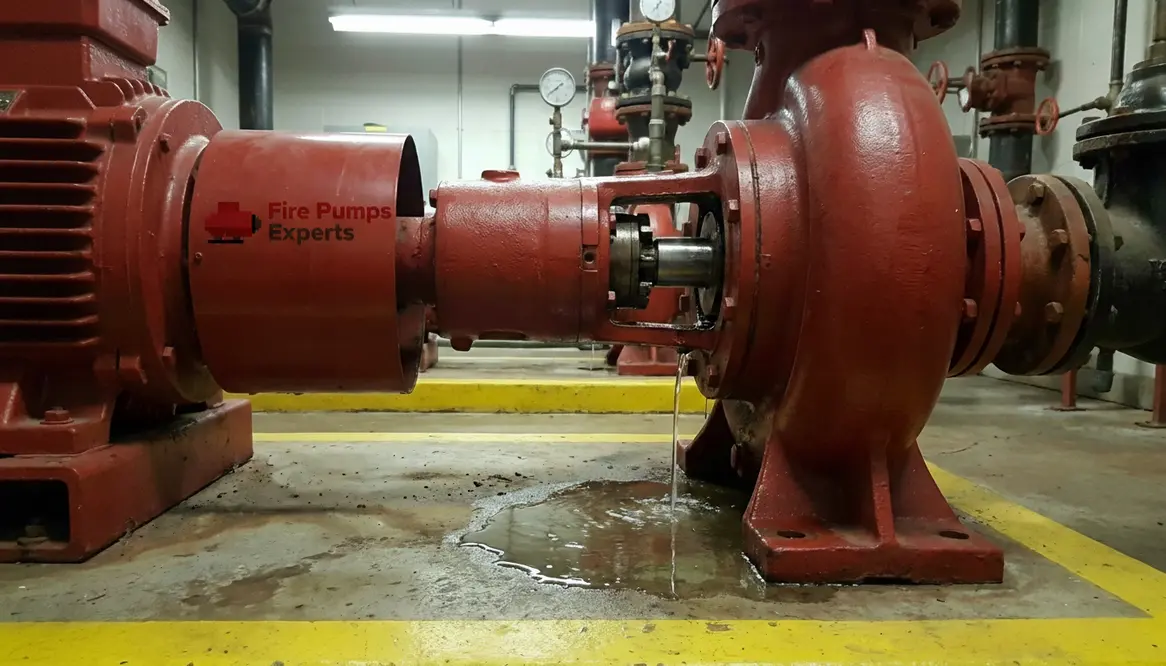
I have seen a lot of things in mechanical rooms. Some are loud. Some are silent. And some, like a fire pump leaking water, try to whisper their way past your attention until the damage is done. In commercial and industrial facilities, that quiet drip is rarely innocent. It is a signal. A warning. And if you listen closely, it tells you exactly what is wrong. Today, I am going to walk you through those signals, calmly and clearly, with just enough wit to keep things interesting. Because yes, even a pump leak has a story to tell.
Fire Pump Leaking Water Causes and Fixes Guide
Fire Pump Leaking Water: Where the Trouble Usually Begins
Most leaks do not start dramatically. There is no explosion. No cinematic slow motion moment. Instead, they begin at the weakest points. Seals, joints, and connections take the first hit. Over time, pressure and vibration wear them down.
In large facilities, I often find that mechanical seals are the primary culprit. These components are designed to hold back pressurized water. However, once they wear out, even slightly, water escapes. And once it starts, it rarely stops on its own.
Additionally, gasket failure plays a role. Gaskets sit quietly between flanges, doing their job without applause. But when they degrade, they allow water to seep through connections. It is not dramatic, but it is persistent. Like that one coworker who keeps replying all to emails.
Finally, improper installation can set the stage for leaks long before the pump even starts working. If alignment is off or bolts are uneven, the system never truly seals correctly. That small oversight becomes a long term problem.
What Causes a Fire Pump to Leak Over Time?
If you are asking this, you are already ahead of the curve. Because leaks are rarely random. They are the result of time, stress, and sometimes neglect.
First, wear and tear is unavoidable. Pumps in commercial buildings operate under high demand. Over months and years, components degrade. Even the best systems are not immune.
Then there is corrosion. Water, metal, and oxygen form a trio that slowly eats away at internal parts. In industrial environments, this process can accelerate due to chemical exposure or poor water quality.
Moreover, pressure fluctuations add stress to the system. Sudden spikes can weaken seals and joints. Over time, this repeated strain creates small openings where water can escape.
And let us not forget maintenance. Or rather, the lack of it. When routine inspections are skipped, minor issues grow quietly. Before long, that subtle leak becomes a noticeable problem.
Fire Pump Leaking Water at Seals and Joints
Now we get specific. Because not all leaks are created equal.
When I inspect a leaking system, I always start with seals. These components are under constant pressure. When they fail, water often appears near the pump shaft. It is a clear and common sign.
Next, I look at joints and flanges. Loose bolts or worn gaskets allow water to escape at connection points. These leaks may seem minor, but they indicate that the system is losing integrity.
Here is a simple breakdown I often use when assessing leak points:
Common Leak Locations
- Mechanical seals near the shaft
- Flange connections
- Valve joints
- Pump casing seams
Typical Causes
- Seal wear or damage
- Loose or uneven bolts
- Gasket deterioration
- Thermal expansion stress
When you match location with cause, the diagnosis becomes clear. It is less mystery, more method.
Operational Stress in Commercial and Industrial Systems
In large scale facilities, fire pumps do not live easy lives. They are built for reliability, yet they endure constant pressure demands and periodic testing cycles.
Because of this, vibration becomes a silent contributor to leaks. Even slight imbalance can loosen connections over time. It is like a repeated knock on a door. Eventually, something gives.
Temperature changes also play a role. As components expand and contract, seals and joints experience stress. Over time, this movement weakens their ability to hold water in place.
Furthermore, system design matters. If the pump operates outside its intended range, it experiences additional strain. That strain accelerates wear. And sooner or later, the system responds with a leak.
It is not dramatic. It is physics doing what physics does best.
How I Identify the Root Cause Quickly
When I walk into a facility and see water where it should not be, I do not guess. I follow a process.
First, I observe the location of the leak. Position tells a story. A leak near the shaft points to seals. A leak at a joint points to gaskets or bolts.
Next, I assess the pattern. Is it a steady drip or a pressurized spray? The behavior of the water reveals the severity of the issue.
Then, I check system history. Maintenance records often highlight recurring problems. Patterns do not lie.
Finally, I evaluate operating conditions. Pressure levels, recent testing, and environmental factors all contribute to the bigger picture.
It is not guesswork. It is reading clues. Like Sherlock Holmes, but with fewer hats and more steel toed boots.
FAQ: Fire Pump Leaks in Large Facilities
When you notice a fire pump leaking water, questions usually arrive faster than answers. The good news is that most of those questions repeat from site to site, and the patterns are familiar.
Below are some of the most common concerns I hear whenever someone spots a leak on a system that absolutely has to work when everything else is going wrong.
Conclusion: Take Action Before the Drip Becomes a Problem
A fire pump leaking water is never just a minor inconvenience in a commercial or industrial facility. It is an early warning. And like any good warning, it deserves attention. If you act quickly, you prevent costly damage and ensure your system performs when it matters most. So take a closer look, trust what you see, and bring in the right expertise. Because when it comes to fire protection, there is no room for maybe.