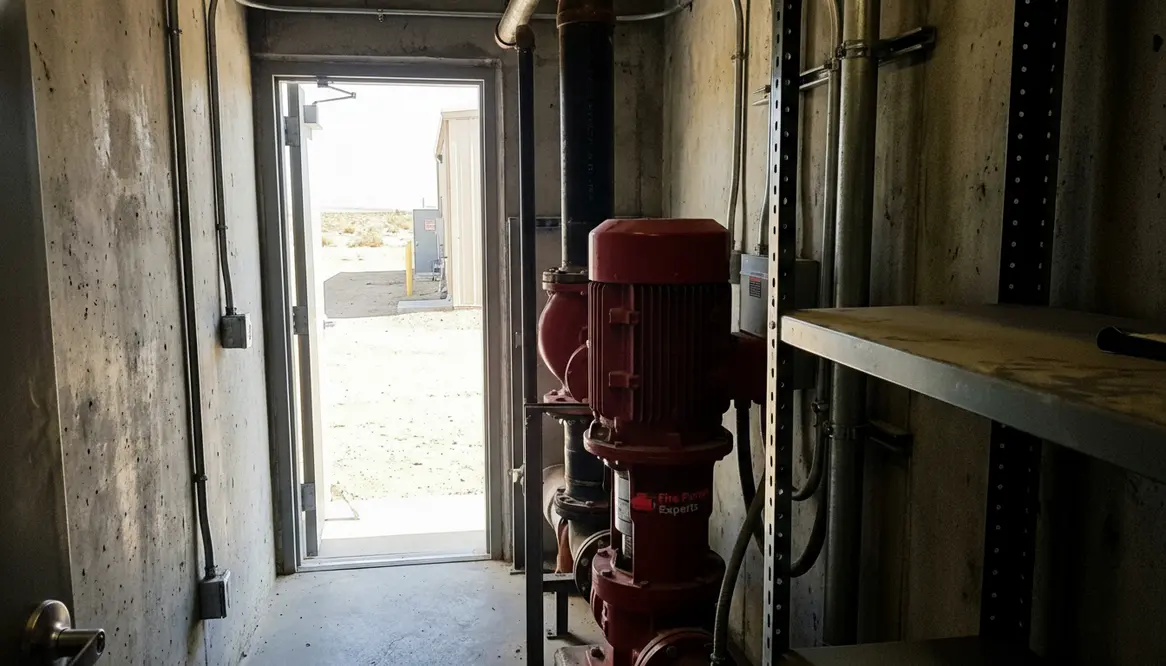
Fire Pump Limited Access Victorville Solutions
I have spent years walking mechanical rooms, peering into tight corners, and solving problems most people never notice until something goes wrong. And in a place like Victorville, where space can feel both endless and oddly constrained at the same time, the challenge of fire pump limited access Victorville projects becomes very real. Facilities here are often built fast, expanded faster, and somehow expected to keep up with strict fire protection standards. So today, I will guide you through how I approach fire pump selection when access is tight, tempers run high, and the inspector is not known for a sense of humor.
Understanding Site Constraints in Victorville Facilities
First things first, I never start with the pump. I start with the space. Because in limited access environments, space is the boss, and we are all just trying to stay on its good side.
In Victorville, I often deal with industrial yards, distribution centers, and retrofitted commercial buildings. These spaces come with narrow entry points, low clearance ceilings, and layouts that seem designed by someone who really liked mazes. Therefore, I carefully assess access routes, door widths, and turning radii before even thinking about equipment specs.
Additionally, I factor in future maintenance. A pump that fits today but cannot be serviced tomorrow is like buying a sports car you can never drive out of the garage. It looks impressive, but it solves nothing.
How do I choose a fire pump for tight access areas?
I keep it simple and practical. I match the pump type to both performance needs and physical limitations.
For example, horizontal split case pumps are powerful, but they demand space. On the other hand, vertical turbine or inline pumps often save the day when square footage is scarce. However, each option comes with tradeoffs in maintenance access and installation complexity.
So I ask myself a few key questions right away:
- Can the pump be transported into the space without dismantling walls?
- Will technicians have enough clearance for repairs?
- Does the layout allow proper alignment and vibration control?
Because if the answer to any of those is no, I pivot fast. In this line of work, stubbornness is expensive.
Fire Pump Limited Access Victorville Strategies That Actually Work
Now we get into the good stuff. Over time, I have developed a few go to strategies that consistently work in tight Victorville facilities.
Compact Equipment Selection
I prioritize vertical inline pumps or skid mounted systems. These units reduce footprint while still delivering required flow and pressure.
Modular Installation
Whenever possible, I break systems into smaller components. This allows easier transport through narrow access points and simplifies assembly on site.
Pre Fabrication
I use pre assembled piping sections. As a result, installation time drops, and the risk of on site errors shrinks.
Access Planning
I map out every movement path before delivery. Think of it like choreographing a dance, except the dancers weigh a few thousand pounds.
Flexible Couplings
These help absorb misalignment and vibration in constrained setups where perfect positioning is not realistic.
Remote Monitoring
I integrate smart controls so teams can monitor performance without squeezing into tight rooms daily.
And yes, sometimes I feel like I am directing a heist movie. Timing, precision, and no room for error. Thankfully, fewer explosions.
Designing for Long Term Maintenance and Compliance
Here is where many projects fall short. They install a system that passes inspection but fails real world usability. I refuse to let that happen.
So I design with maintenance in mind from day one. I ensure there is enough clearance around key components like controllers, valves, and drivers. Moreover, I align everything with NFPA standards, because inspectors tend to notice when you improvise a little too creatively.
In Victorville, environmental factors also matter. Dust, heat, and power reliability all influence pump selection and enclosure design. Therefore, I often specify protective housings and reliable backup power systems.
And let me be honest. Nothing ruins a day faster than a fire pump that refuses to start during a test. It is the mechanical equivalent of a bad punchline. Silence, disappointment, and a lot of awkward eye contact.
Avoiding Common Mistakes in Limited Access Installations
I have seen some things. Some of them still keep me up at night.
One common mistake is choosing equipment based only on performance specs while ignoring physical constraints. Another is underestimating installation logistics. If you cannot physically get the pump into the building, the spec sheet becomes a very expensive piece of paper.
Additionally, many teams overlook coordination between trades. Electrical, mechanical, and structural elements must work together. Otherwise, you end up with a controller mounted where a door needs to swing. And suddenly, everyone is having a very long meeting.
Finally, I always caution against skipping detailed planning. Because in fire pump limited access Victorville projects, improvisation is rarely your friend.
FAQ: Fire Pump Selection for Limited Access Facilities
When you start planning a fire pump limited access Victorville installation, a few questions always seem to come up. The answers below are based on what I get asked the most during real projects.
Moving Forward with Confidence
When I approach a project like this, I do not see limitations. I see a puzzle waiting to be solved. And with the right strategy, even the tightest facility can support a reliable, code compliant system.
If you are planning a commercial or industrial project in Victorville and need a solution that actually fits, especially for any fire pump limited access Victorville scenario, reach out. I will help you design a system that works today, tomorrow, and long after the dust settles.