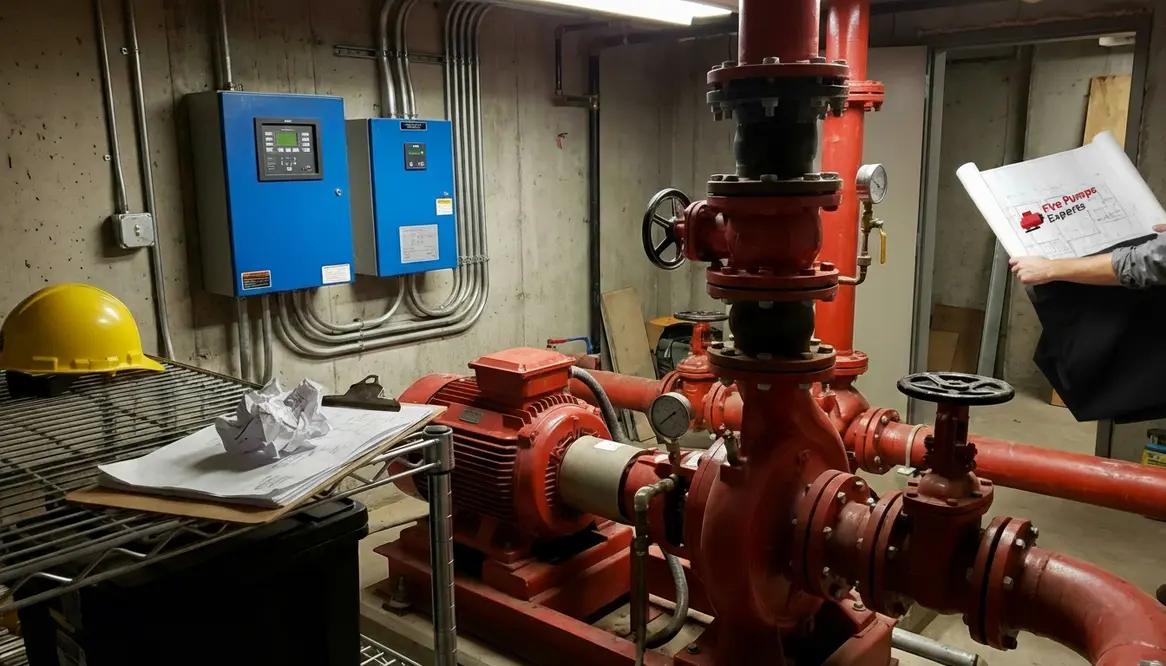
Fire Pump Permit Plan Review Indianapolis Corrections
I have spent enough time reviewing fire pump drawings to know one simple truth. The plans always look perfect on the designer’s screen. However, the moment they land on a city reviewer’s desk in Indianapolis, reality walks in like a building inspector with a clipboard and a raised eyebrow.
That is where fire pump permit plan review indianapolis triggers corrections becomes a real conversation. Not a theory. Not a checklist buried in a manual. A real process that decides whether your project moves forward or sits in review while everyone waits.
For commercial towers, industrial facilities, distribution centers, and large mixed use properties, a fire pump is the heart of the suppression system. When the plan review finds problems, the city sends corrections. Those corrections delay permits, inspections, and sometimes entire construction schedules.
What This Article Covers
- Why large Indianapolis projects face intense fire pump reviews
- The design gaps that most often trigger corrections
- What reviewers actually look for in pump submittals
- Common pump room layout mistakes
- How coordination between trades can save weeks of review time
- Practical steps to reduce fire pump permit plan review indianapolis triggers corrections before submission
If your goal is fewer surprises and faster approvals, you are in the right place.
So today I will walk through what actually causes those corrections in Indianapolis. And yes, some of them are obvious. Others are the kind of detail that makes engineers sigh and contractors reach for another cup of coffee.
Let’s take a calm, steady walk through it.
Why Large Facilities in Indianapolis Face Detailed Fire Pump Plan Reviews
First, we need to understand the mindset of a plan reviewer. Their job is not to ruin your Tuesday. Their job is to make sure a 20 story office building or a massive warehouse does not run out of water when the worst day arrives.
Indianapolis follows national fire protection standards along with local amendments. Therefore, every fire pump design must show clear compliance with hydraulic calculations, pump sizing, power supply reliability, and system integration.
High‑Demand Buildings, High‑Scrutiny Reviews
For large commercial and industrial properties, the review becomes even more detailed. These buildings often require:
- High demand fire suppression systems
- Redundant water supply strategies
- Complex pump room layouts
- Integration with large sprinkler zones
Because of that complexity, even small drawing mistakes can raise questions. And once questions appear, the plan review process slows down.
In other words, the city reviewer is not being picky. They are making sure that when a sprinkler opens at 2 AM, the system responds like a superhero and not like a dial up modem from 1998.
Top Design Gaps That Cause Fire Pump Permit Plan Review Indianapolis Triggers Corrections
Now we get into the real story. I see the same design gaps appear again and again during reviews.
These issues are not dramatic. They are simply overlooked details that reviewers catch quickly.
Documentation Issues
- Incomplete hydraulic calculations
- Missing pump curves
- Unclear equipment specifications
- Lack of controller information
Design Coordination Issues
- Pump room layout conflicts
- Incorrect pipe sizing
- Improper suction supply design
- Electrical power details missing
However, the biggest correction trigger is usually coordination. The fire pump design often arrives separate from the overall sprinkler design or electrical plan.
As a result, reviewers see mismatches between systems. Pipe sizes do not match calculations. Electrical feeds are not shown clearly. Pump rooms lack required clearances.
When that happens, the city sends the project back with corrections. And the clock resets.
What Do Indianapolis Reviewers Look For In Fire Pump Submittals?
If you could sit beside a plan reviewer for an afternoon, you would notice a pattern. They are looking for clarity first. Math second. Coordination third.
Let me break that down.
Clear hydraulic calculations
The reviewer checks whether the pump truly meets system demand. For large commercial facilities, the margin between adequate pressure and system failure can be narrow. Therefore the calculations must align with the sprinkler layout.
Pump performance verification
The submitted pump curve must support the design demand. If the pump appears oversized or undersized, the reviewer asks questions immediately.
Reliable water supply
Indianapolis reviewers carefully check the suction supply. They want confirmation that the municipal water source or tank supply supports the pump at peak demand.
Electrical reliability
For major properties and industrial sites, power reliability matters. Reviewers expect clear diagrams showing controllers, transfer switches, and power feeds.
When any of those elements appear incomplete, the result becomes familiar. Yes, another round of fire pump permit plan review indianapolis triggers corrections.
Pump Room Layout Mistakes That Slow Down Permit Approval
Next comes the physical space where the pump lives. And this is where even experienced teams sometimes trip.
Fire pump rooms must allow safe maintenance, proper ventilation, and clear equipment access. Sounds simple. Yet during plan reviews, these details often raise red flags.
- Insufficient clearance around the pump or controller
- Improper door swing or room access
- Drainage missing from the pump room floor
- Lack of space for testing equipment
Now imagine a large industrial facility where the pump room sits deep inside the building. If the layout prevents safe maintenance, reviewers request corrections immediately.
And frankly, they should.
A fire pump is not decorative equipment. It is not there to look impressive on a blueprint. It must be accessible, testable, and dependable.
Even Batman needs room for the Batmobile. The same principle applies here.
Coordination Between Sprinkler Design and Pump Engineering
Here is the quiet truth behind many permit delays. Fire pump drawings often arrive from one engineer while sprinkler drawings arrive from another.
When those two designs fail to align, reviewers notice quickly.
- Sprinkler calculations demand more pressure than the pump provides
- Pipe sizes differ between drawings
- Flow test data does not match hydraulic calculations
Because of this, coordination meetings before submission can save weeks of review time.
Many of the fire pump permit plan review indianapolis triggers corrections originate from these coordination gaps rather than technical errors.
So the lesson is simple. Designers must treat the fire pump as part of a larger system, not as an isolated component. Think orchestra, not solo guitar.
How I Reduce Fire Pump Permit Plan Review Indianapolis Triggers Corrections Before Submission
Over time, I have learned that prevention beats correction every single time.
Before submitting a fire pump permit package for a major commercial or industrial project, I focus on several checks.
- I verify hydraulic calculations against the sprinkler design
- I confirm pump curves match system demand
- I review pump room clearance and access requirements
- I check water supply data and flow test reports
- I coordinate electrical details with power distribution plans
In addition, I review the entire submittal from the perspective of a city reviewer. If something feels unclear, it probably will feel unclear to them as well.
By resolving those questions early, I reduce the chances of another round of fire pump permit plan review indianapolis triggers corrections. And trust me, contractors appreciate that. Nothing delays a project schedule faster than waiting for revised drawings.
Connecting Design Quality With Long‑Term Fire Pump Reliability
A clean permit review is only part of the story. The other part is how that pump behaves 5 or 10 years after the certificate of occupancy is issued.
A well‑coordinated design makes maintenance and testing easier. Clear access, logical piping, and accurate documentation mean that when service technicians arrive, they spend more time improving reliability and less time playing detective in a cramped pump room.
Routine inspections and service are where design decisions either shine or fall apart. Companies that specialize in fire pump maintenance and testing, like those offering dedicated fire pump service programs, know immediately when a design was built with real‑world operation in mind.
So while the immediate concern might be avoiding yet another round of fire pump permit plan review indianapolis triggers corrections, the long game is this: a system that performs as expected when tested, maintained, and ultimately called into action.
FAQ: Fire Pump Permit Reviews in Indianapolis
Final Thoughts
If you manage a commercial tower, industrial facility, or major property development in Indianapolis, fire pump permitting deserves careful attention. A smooth review does not happen by luck. It happens through coordination, clear documentation, and thoughtful design.
If you want fewer delays and faster approvals, treat the pump system like the critical infrastructure it is. When the details align, permits move faster and your project keeps moving forward. And that is exactly how it should be.